
 stars
stars exoplanets

News

 Latest astronomy news
Stay updated with the latest astronomy news, discoveries about stars and exoplanets, and current research. Explore fresh articles from the world of astronomy.
 17. 3. 2026
 Stars | Exoplane
TOI-3884 b is a rare super-Neptune planet that transits a fully convective M-dwarf star with a persistent giant polar starspot. Because the planet passes over this spot during every transit, astronomers can directly study the spot’s properties using the James Webb Space Telescope (JWST). Seven transits were observed with JWST, covering a wide range of wavelengths from 0.5 to 5.3 micrometers.
Each transit showed a recurring signature as the planet crossed the starspot, but the details varied, ...
Read article 
Advertisement
16. 3. 2026Stars | ExoplaneSilicate clouds are a key feature in the atmospheres of many giant exoplanets, but their formation and composition are still being studied. This research compares the silicate clouds seen in four hot Jupiters observed by JWST with theories developed for brown dwarfs, objects that are between planets and stars in mass and temperature. The study also uses evidence from meteorites to show that giant planets forming in the outer regions of protoplane...
Read article 16. 3. 2026Stars | Exoplanets | TESS | Red dwarf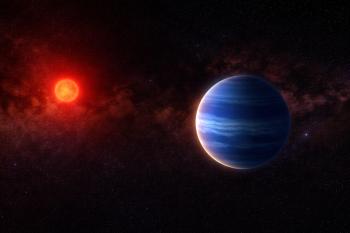
The Neptunian desert is a region where Neptune-sized planets are rare at short orbital periods, likely due to intense starlight stripping away their atmospheres or changes in their orbits. Understanding this desert helps scientists learn how planets evolve, especially around different types of stars. In this study, astronomers confirmed the existence of TOI-672 b, a massive super-Neptune orbiting a red dwarf star, using data from TESS, ground-bas...
Read article 16. 3. 2026Stars | ExoplaneThe exoALMA Large Program has uncovered many detailed structures in the dust and gas of protoplanetary disks, where planets are forming around young stars. By using a technique called tomography—studying how molecular lines change at different locations and velocities—astronomers can now detect the presence of planets hidden within these disks.
The study shows that even with a few hours of ALMA telescope time, it is possible to spot the signat...
Read article 16. 3. 2026Stars | Exoplanets | James Webb Space Telescope | Planetary atmosphereThe James Webb Space Telescope (JWST) has detected silicate clouds in the atmospheres of several exoplanets, providing new insights into how clouds form in extreme environments. While simple models can fit these observations, they do not always match the results from more detailed microphysical models. To address this, researchers developed Nimbus, a fast model that simulates cloud formation based on physical processes, and used it alongside Virg...
Read article 16. 3. 2026Stars | ExoplaneThe protoplanetary disk around TW Hya is a key site for studying how planets form and what materials they inherit. Understanding the distribution of chemical elements and molecules in such disks helps scientists learn about the building blocks of planets, especially those that could be habitable. One important molecule is formaldehyde (H2CO), which exists in two forms: ortho and para, depending on the spins of its hydrogen atoms.
Recent ALMA o...
Read article 13. 3. 2026Stars | ExoplaneLong-period giant planets, or cold Jupiters, play a key role in shaping planetary systems, but they are difficult to detect because they orbit far from their stars. Traditional methods like radial velocity and transit surveys have limited sensitivity at these distances. By combining long-term radial velocity data with precise astrometry from the Hipparcos and Gaia missions, astronomers can now better detect and measure these distant worlds.
In...
Read article 13. 3. 2026Stars | Exoplanets | Planetary atmospheres | James Webb Space TelescopeWASP-107 b is a warm gas giant planet that has been studied in detail using the James Webb Space Telescope (JWST). Its atmosphere shows a unique feature at 8–10 micrometers, thought to be caused by silicate clouds. Scientists aimed to explain the planet’s full spectrum, from near-infrared to mid-infrared, using a physically realistic model of cloud formation and temperature.
The research team used a model that links how clouds form with how he...
Read article 12. 3. 2026Stars | ExoplaneHD 332231 b is a warm sub-Saturn exoplanet that orbits close to its host star. Astronomers studied the timing of its transits—when the planet passes in front of the star—and found that these events do not occur at perfectly regular intervals. Instead, the transit times show a repeating pattern, known as transit timing variations (TTVs), which can reveal the presence of other planets in the system.
Using precise data from the TESS mission and g...
Read article 12. 3. 2026Stars | Exoplanets | TESS | Red dwarfTOI-4616 b is an Earth-sized exoplanet that orbits a nearby red dwarf star, just 28 parsecs from Earth. Red dwarfs are small, cool stars, and their low brightness makes it easier to spot planets passing in front of them. This planet was discovered and confirmed using data from NASA’s TESS mission, along with ground-based telescopes and detailed follow-up observations.
The host star, classified as an M4 dwarf, is about 19% the size and mass of ...
Read article Top article categories
Filtered articles by category.
Recently discovered exoplanets
| EK Chamaeleontis b | 10 / 2026 | 2702.2 M⊕ | 321.3 ly | |
| HD 715 b | 10 / 2026 | 201.9 M⊕ | 542.8 ly | |
| DENIS J1253-5709 b | 10 / 2026 | 244.8 M⊕ | 54.4 ly | |
| TOI-6417 b | 09 / 2026 | 349.7 M⊕ | 1903.9 ly | |
| TOI-6443 b | 09 / 2026 | 1605.4 M⊕ | 2051.6 ly | |
| TOI-7219 b | 09 / 2026 | 661 M⊕ | 1074.2 ly | |
| TOI-4079 B b | 09 / 2026 | 1646.8 M⊕ | 1185.6 ly | |
| HD 45652 b | 09 / 2026 | 1557.7 M⊕ | 113.9 ly | |
| LSPM J0804+1116 b | 09 / 2026 | 6.4 M⊕ | 82.6 ly | |
| HR 8799 f | 09 / 2026 | 524.5 M⊕ | 133.3 ly | |
| 61 Cygni A b | 09 / 2026 | 2543.3 M⊕ | 11.4 ly | |
| TOI-5646 b | 08 / 2026 | 45.9 M⊕ | 1352.3 ly | |
| TOI-4468 c | 08 / 2026 | 11.1 M⊕ | 1233.1 ly | |
| TOI-4468 b | 08 / 2026 | 170.1 M⊕ | 1233.1 ly | |
| TOI-4468 d | 08 / 2026 | 311 M⊕ | 1233.1 ly |
Newly discovered exoplanets
Latest scientific studies
Browse the latest scientific studies on stars and exoplanets in our galaxy. Stellar Catalog provides access to scientific data from astrophysics and stellar or planetary astronomy. It's a resource for anyone interested in the newest discoveries about what lies beyond our solar system.

More research