
 stars
stars exoplanets

News

 Latest astronomy news
Stay updated with the latest astronomy news, discoveries about stars and exoplanets, and current research. Explore fresh articles from the world of astronomy.
 21. 3. 2026
 James Webb Space Telescope | Planet formation | Star
The star HD 163296 is surrounded by a large disk of dust and gas, making it an important target for studying how disks affect the light from background stars. Using the James Webb Space Telescope’s NIRCam coronagraph, astronomers observed HD 163296 and identified several background sources seen through or near the disk. These background stars provide valuable benchmarks for measuring how much the disk dims and reddens starlight—a process known as extinction.
The study presents precise measure...
Read article 
Advertisement
20. 3. 2026Stars | Exoplanets | James Webb Space Telescope | Planetary atmospheres | Hot Jupiter
NGTS-2 b is a hot Jupiter with a temperature of about 1,470 Kelvin, orbiting an F-type star in an orbit aligned with the star’s spin. Using the James Webb Space Telescope (JWST), astronomers observed a transit of NGTS-2b and measured its atmosphere’s spectrum from 2.84 to 5.18 micrometers. The spectrum shows weak absorption features from water and carbon dioxide, but the data are not sufficient to precisely determine the planet’s atmospheric comp...
Read article 20. 3. 2026Stars | Exoplanets | TESS | Sun-like star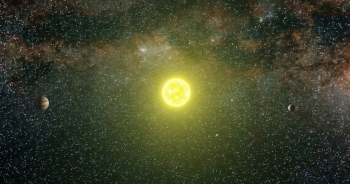
TOI-1232 is a Sun-like star with slightly higher metallicity than the Sun. It hosts two massive planets, both warmer than Jupiter, discovered using data from the TESS space telescope and ground-based follow-up. The inner planet, TOI-1232 b, is a Jovian-mass planet with a 14.26-day orbit, while the outer planet, TOI-1232 c, is Saturn-mass with a 30.36-day orbit.
The TESS light curve of TOI-1232 is complex due to contamination from a background ...
Read article 20. 3. 2026Stars | Exoplanets | Giant StarAs stars like the Sun age and evolve, they lose mass through strong stellar winds, which can affect the planets orbiting them. This study used computer simulations to explore how much material planets can accrete from the wind of a star as it goes through its red giant and asymptotic giant branch phases. The simulations covered planets with masses from half to thirteen times that of Jupiter, at distances of 5, 10, and 20 astronomical units from t...
Read article 20. 3. 2026Stars | Exoplanets | Hot JupiterThe alignment between a planet’s orbit and its star’s rotation axis can reveal how giant planets migrate and evolve, especially in binary star systems. TOI-1333 A b is a hot Jupiter—a giant planet in a close orbit—around an F-type star that also has a distant stellar companion. By analyzing spectroscopic data taken during a planetary transit, astronomers measured the angle between the planet’s orbit and the star’s spin axis, known as the projecte...
Read article 18. 3. 2026Stars | Exoplanets | James Webb Space Telescope | Planetary atmospheres | Red dwarfTOI-5293 A b is a giant planet about half the mass of Jupiter, orbiting an early red dwarf star every three days. The planet’s atmosphere was studied using two transits observed by the James Webb Space Telescope (JWST). The host star’s surface changes rapidly, making it challenging to interpret the data. In the first transit, the planet crossed regions of the star with different brightness, which contaminated the spectrum. The second transit allo...
Read article 17. 3. 2026Stars | ExoplaneStudying exoplanet atmospheres with transmission spectroscopy can be complicated by features on the star’s surface, which can affect the observed spectra. To better understand these effects, astronomers analyzed the surface of the star HD 189733 by observing two transits of its planet using the ESPRESSO spectrograph. They used a technique called Doppler shadow analysis to probe how the star’s spectral lines change from the center to the edge (lim...
Read article 17. 3. 2026Stars | Exoplanets | ALMA | Planet formatio
High-resolution images from the ALMA telescope have revealed a variety of shapes in the dust of planet-forming disks, including rings, spirals, and crescents. While most disks show symmetrical rings, some display asymmetric features like blobs or crescents, which may be linked to vortices or the influence of forming planets. This study focuses on the disk around the star HD 163296, where a crescent-shaped arc was observed in the dust using ALMA d...
Read article 17. 3. 2026Stars | ExoplaneA new study has analysed six planetary systems, each with at least one small planet passing in front of its star. By combining new and existing observations from space and ground-based telescopes, researchers have measured the mass and size of these planets with high precision. This allows for a better understanding of what these distant worlds are made of and how they might have formed.
The team used data from CHEOPS, K2, TESS, and several gr...
Read article 17. 3. 2026The TOLIMAN mission is building and preparing to launch a low-cost space telescope with a unique optical design. Its main goal is to search for rocky, Earth-like planets in temperate orbits around the stars Alpha Centauri A and B, the closest Sun-like stars to Earth. Finding such planets is difficult with current instruments, even though these stars are nearby and bright.
TOLIMAN will use a technique called narrow-angle astrometry, which measu...
Read article Top article categories
Filtered articles by category.
Recently discovered exoplanets
| EK Chamaeleontis b | 10 / 2026 | 2702.2 M⊕ | 321.3 ly | |
| HD 715 b | 10 / 2026 | 201.9 M⊕ | 542.8 ly | |
| DENIS J1253-5709 b | 10 / 2026 | 244.8 M⊕ | 54.4 ly | |
| TOI-6417 b | 09 / 2026 | 349.7 M⊕ | 1903.9 ly | |
| TOI-6443 b | 09 / 2026 | 1605.4 M⊕ | 2051.6 ly | |
| TOI-7219 b | 09 / 2026 | 661 M⊕ | 1074.2 ly | |
| TOI-4079 B b | 09 / 2026 | 1646.8 M⊕ | 1185.6 ly | |
| HD 45652 b | 09 / 2026 | 1557.7 M⊕ | 113.9 ly | |
| LSPM J0804+1116 b | 09 / 2026 | 6.4 M⊕ | 82.6 ly | |
| HR 8799 f | 09 / 2026 | 524.5 M⊕ | 133.3 ly | |
| 61 Cygni A b | 09 / 2026 | 2543.3 M⊕ | 11.4 ly | |
| TOI-5646 b | 08 / 2026 | 45.9 M⊕ | 1352.3 ly | |
| TOI-4468 c | 08 / 2026 | 11.1 M⊕ | 1233.1 ly | |
| TOI-4468 b | 08 / 2026 | 170.1 M⊕ | 1233.1 ly | |
| TOI-4468 d | 08 / 2026 | 311 M⊕ | 1233.1 ly |
Newly discovered exoplanets
Latest scientific studies
Browse the latest scientific studies on stars and exoplanets in our galaxy. Stellar Catalog provides access to scientific data from astrophysics and stellar or planetary astronomy. It's a resource for anyone interested in the newest discoveries about what lies beyond our solar system.

More research