
 stars
stars exoplanets

News

 Latest astronomy news
Stay updated with the latest astronomy news, discoveries about stars and exoplanets, and current research. Explore fresh articles from the world of astronomy.
 11. 3. 2026
 Stars | Exoplanets | James Webb Space Telescope | Planetary atmosphere
The nearby star Epsilon Indi hosts a cold gas giant planet, Epsilon Indi A b, located just under 12 light years from Earth. Using the James Webb Space Telescope (JWST), astronomers captured the longest-wavelength image ever taken of an exoplanet, extending up to 25 micrometers. By combining these new images with decades of radial velocity and astrometric data, the team precisely determined the planet’s orbit and mass.
The planet’s light was measured across a wide range of wavelengths, creatin...
Read article 
Advertisement
10. 3. 2026Stars | Exoplanets | ALMA | Young Stellar ObjeHD 34282 is a young star surrounded by a disk of gas and dust, where planets may be forming. Using the ALMA telescope, astronomers captured detailed images of this disk at several wavelengths, revealing a bright arc and a complex pattern of rings and gaps. These features help scientists understand how dust and gas behave in planet-forming environments.
The observations show that the bright arc has a lower spectral index than the surrounding ri...
Read article 9. 3. 2026Stars | Exoplane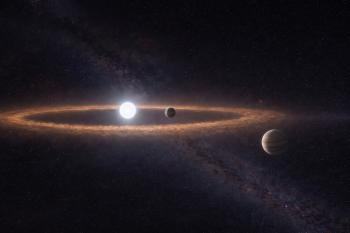
The Beta Pictoris system is famous for its young star, two giant planets, and a large disk of dust and gas. Recent studies have found many comet-like bodies orbiting the star (exocomets). To understand how these exocomets form and evolve, researchers simulated the system with over 100,000 test particles, tracking their paths for 25 million years.
The simulations show that most material is quickly cleared out by the planets, except for two main...
Read article 9. 3. 2026Stars | Exoplanets | TESS | Orange dwarfTOI-4504 is an orange dwarf star that hosts two giant planets, both orbiting in a special pattern called a 2:1 mean-motion resonance. This means that for every orbit the outer planet completes, the inner planet completes exactly two. The planets, named TOI-4504 c and d, have orbital periods of 82.8 and 41.3 days, respectively, and show some of the largest known variations in the timing of their transits across the star.
Recent data from the TE...
Read article 9. 3. 2026Stars | Exoplanets | TESSAstronomers have used data from NASA’s TESS mission to study 347 single exoplanets with orbital periods between 8 and 200 days. These planets, called 'warm' because they are neither too close nor too far from their stars, show a surprising link between their size and the shape of their orbits.
The team analyzed the planets by grouping them into size categories: sub-Neptunes, sub-Saturns, and Jovians. They found that most small and medium-sized...
Read article 8. 3. 2026Stars | ExoplaneThe Dispersed Matter Planet Project (DMPP) is a survey using the radial velocity method to search for planets around stars that show unusual activity, which may be caused by close-in planets losing their atmospheres. This project aims to understand how common such planets are and to find new examples.
In this study, researchers discovered seven new planetary signals in five different star systems, including DMPP-2c and d, HD67200/DMPP-6b and c...
Read article 8. 3. 2026Stars | TESSAn eclipsing binary star system consists of two stars orbiting each other so close that they periodically block each other's light as seen from Earth. Over millions to billions of years, gravity between these stars reshapes their orbits and spinning rates in a process called tidal evolution, which helps us understand how both close star pairs and exoplanet systems change over time.
Researchers examined 68 binary pairs (among them EBLM J0040+01...
Read article 8. 3. 2026Stars | White dwarfs | Giant Star
RS Ophiuchi is a recurrent nova system, where a white dwarf and a red giant star orbit each other closely. The dwarf sucks material from the giant which leads to repeating eruptions known as nova. In 2021, RS Ophiuchi experienced another eruption, providing astronomers with a rare chance to observe changes before, during, and after the event using near-infrared light.
Researchers collected spectra before the eruption, showing the signature of ...
Read article 7. 3. 2026Stars | Neutron starScientists have used X-ray observations to create a detailed map of the Fe K emission in the low-mass X-ray binary system 4U 1822-371. This system consists of a compact object, likely a neutron star, and a companion star orbiting each other every 5.57 hours. The study used data from the XRISM satellite, covering eleven orbits of the system, to track how the X-ray emission changes with the orbital period.
By analyzing the Doppler shifts in the ...
Read article 6. 3. 2026Stars | Exoplanets | Planetary atmosphereNASA's Pandora mission is a small satellite project designed to study exoplanets and their host stars by separating the effects of star activity from the signals of exoplanet atmospheres. Pandora will observe both visible and near-infrared light from systems where planets pass in front of their stars, allowing scientists to monitor changes in the star and better understand the atmospheres of the planets.
The mission, set to run from 2026 to 20...
Read article Top article categories
Filtered articles by category.
Recently discovered exoplanets
| EK Chamaeleontis b | 10 / 2026 | 2702.2 M⊕ | 321.3 ly | |
| HD 715 b | 10 / 2026 | 201.9 M⊕ | 542.8 ly | |
| DENIS J1253-5709 b | 10 / 2026 | 244.8 M⊕ | 54.4 ly | |
| TOI-6417 b | 09 / 2026 | 349.7 M⊕ | 1903.9 ly | |
| TOI-6443 b | 09 / 2026 | 1605.4 M⊕ | 2051.6 ly | |
| TOI-7219 b | 09 / 2026 | 661 M⊕ | 1074.2 ly | |
| TOI-4079 B b | 09 / 2026 | 1646.8 M⊕ | 1185.6 ly | |
| HD 45652 b | 09 / 2026 | 1557.7 M⊕ | 113.9 ly | |
| LSPM J0804+1116 b | 09 / 2026 | 6.4 M⊕ | 82.6 ly | |
| HR 8799 f | 09 / 2026 | 524.5 M⊕ | 133.3 ly | |
| 61 Cygni A b | 09 / 2026 | 2543.3 M⊕ | 11.4 ly | |
| TOI-5646 b | 08 / 2026 | 45.9 M⊕ | 1352.3 ly | |
| TOI-4468 c | 08 / 2026 | 11.1 M⊕ | 1233.1 ly | |
| TOI-4468 b | 08 / 2026 | 170.1 M⊕ | 1233.1 ly | |
| TOI-4468 d | 08 / 2026 | 311 M⊕ | 1233.1 ly |
Newly discovered exoplanets
Latest scientific studies
Browse the latest scientific studies on stars and exoplanets in our galaxy. Stellar Catalog provides access to scientific data from astrophysics and stellar or planetary astronomy. It's a resource for anyone interested in the newest discoveries about what lies beyond our solar system.

More research