do not follow here
Stellar Catalog more icon
Noticias
more icon

news icon
Latest astronomy news

stellar brief logoStellar Brief

line
25. 11. 2026
stellar brief logo
JWST observations reveal that atmospheric haze differs sharply across eight sub-Neptunes, while a giant planet around HIP 17378 may complicate future searches for Earth-like worlds. New measurements also point to a possibly water-rich composition for TOI-2120 b, reveal gas gaps aligned with giant protoplanets around WISPIT 2, and precisely measure a white dwarf in the rare Welopō‘ai triple-star system.
Transit timing variations suggest a third planet orbiting red dwarf LP 890-9
icon20. 11. 2026
iconEstrellas | Exoplanetas | Enanas roj
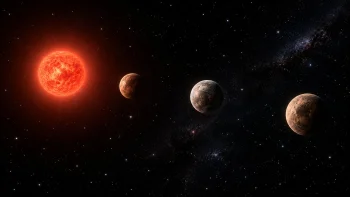
Image: Transit timing variations suggest a third planet orbiting red dwarf LP 890-9
Data from the JWST telescope indicates the presence of a third planet in the LP 890-9 system. By tracking the exact arrival times of transits for the two known planets, researchers detected slight irregularities in their orbits. These patterns cannot be explained by the two-planet model, leading to the conclusion that a third, as-yet-unseen planet, LP 890-9 d, is likely exerting a gravitational influence....
Read article tag icon
Advertisement
Ultraviolet absorption lines provide a test for magnetic fields on KELT-20 b and HAT-P-32 b
icon19. 11. 2026
iconEstrellas | Exoplanetas | Júpiter caliente
Image: Ultraviolet absorption lines provide a test for magnetic fields on KELT-20 b and HAT-P-32 b
Ultraviolet light may offer a way to test whether the hot Jupiters KELT-20 b and HAT-P-32 b have their own magnetic fields. The proposed method looks for changes in particular absorption lines caused by atomic alignment, a response to the host star’s unevenly distributed light. Models and telescope exposure estimates outline how observations could search for this signal....
Read article tag icon
A faster method estimates WASP-39 b atmospheric composition
icon19. 11. 2026
iconEstrellas | Exoplanetas | Estrellas de tipo solar
Image: A faster method estimates WASP-39 b atmospheric composition
A new computational method estimates the atmospheric composition of WASP-39 b from James Webb Space Telescope observations. Its results broadly agree with those from a widely used, slower approach, while tests show that the methods differ for some parameters. Once trained, the new method can produce estimates in seconds, making it useful for studying many planets....
Read article tag icon
Two planets around 14 Herculis fit a mathematical framework for long-term stability
icon18. 11. 2026
iconEstrellas | Exoplanetas | Enana naranj
Image: Two planets around 14 Herculis fit a mathematical framework for long-term stability
Two massive giant planets orbit 14 Herculis on eccentric, mutually tilted paths. A mathematical analysis finds families of possible long-term motions that can keep such an arrangement confined, provided certain conditions hold. The results offer a theoretical explanation for how this complex planetary system could remain stable over time....
Read article tag icon
Surface spots on the young orange dwarf V1298 Tau resemble solar sunspots
icon17. 11. 2026
iconEstrellas | Exoplanetas | Objetos estelares jóvene
Image: Surface spots on the young orange dwarf V1298 Tau resemble solar sunspots
Observations of the young star V1298 Tau reveal that its starspots share distinct structural and thermal similarities with sunspots. By tracking planets passing in front of the star, researchers mapped the dark umbra and lighter penumbra regions of these active surface zones, finding that the fundamental nature of these magnetic spots remains consistent with those observed on our own Sun....
Read article tag icon
Giant planet TOI-2665 b survives in the intense heat of the hot Neptune desert
icon17. 11. 2026
iconEstrellas | Exoplanetas | TESS
Image: Giant planet TOI-2665 b survives in the intense heat of the hot Neptune desert
The sub-Saturn planet TOI-2665 b orbits its parent star every three days, placing it within the hot Neptune desert, a region where such planets are rarely found due to extreme heat from their host stars. Despite intense irradiation, measurements reveal that this giant planet has successfully retained a thick gaseous atmosphere, providing new insights into how these worlds form and evolve....
Read article tag icon
Atmospheric composition of ultra-hot Jupiter HAT-P 70 b reveals intense heat and dissociation
icon17. 11. 2026
iconEstrellas | Exoplanetas | Júpiter caliente | Atmósferas planetari
Image: Atmospheric composition of ultra-hot Jupiter HAT-P 70 b reveals intense heat and dissociation
The dayside atmosphere of the ultra-hot Jupiter HAT-P 70 b has been characterized using thermal emission spectroscopy. Observations reveal an environment dominated by intense heat that breaks down water molecules and vaporizes rock-forming elements. The findings suggest the planet shares a similar chemical makeup to its host star, while specific elements like titanium are being sequestered on the planet's cooler nightside....
Read article tag icon
New tool predicts required observation time for measuring exoplanet masses
icon16. 11. 2026
iconEstrellas | Exoplanetas | Enana naranj
Image: New tool predicts required observation time for measuring exoplanet masses
A new computational tool called MINERVA helps prioritize telescope time by calculating the exact number of radial velocity measurements needed to accurately weigh exoplanets. By simulating realistic observational constraints and stellar activity, the tool assists in planning the most efficient schedules for future space missions, such as the upcoming atmospheric characterization studies....
Read article tag icon
Gaia-3 b is the closest known giant planet on an extreme orbit
icon16. 11. 2026
iconEstrellas | Exoplanetas | Enana naranja | Gai
Image: Gaia-3 b is the closest known giant planet on an extreme orbit
Gaia-3 b is a giant planet with one of the most elongated orbits known, and it is the closest known planet of this kind. New measurements pin down its orbit at 331.52 days and confirm its exceptionally high eccentricity. They also support its classification as a planet rather than a nearly equal-mass stellar companion, while a distant star may have helped shape its orbit....
Read article tag icon
Beta Pictoris b shows tentative signs of methane and ammonia
icon16. 11. 2026
iconEstrellas | Exoplanetas | Atmósferas planetari
Image: Beta Pictoris b shows tentative signs of methane and ammonia
Beta Pictoris b is a directly imaged planet in a young system about 64 light-years away. New analysis of near-infrared light finds tentative signals of methane and ammonia in its atmosphere, alongside strong signals from water and carbon monoxide. The possible methane and ammonia detections need further confirmation because leftover data effects could mimic weak signals....
Read article tag icon

Top article categories

Filtered articles by category.

Exoplanetas recién descubiertos

TOI-1277 b 11 / 2026 9.6 M⊕ 328.7 ly
TOI-7721 b 11 / 2026 42.7 M⊕ 1093.8 ly
HD 112987 b 11 / 2026 2695.8 M⊕ 733.4 ly
TOI-2535 b 11 / 2026 150.1 M⊕ 1113.8 ly
HD 156295 b 11 / 2026 2002.8 M⊕ 143.3 ly
WASP-4 c 11 / 2026 2956.5 M⊕ 890.6 ly
BD-12 4935 b 11 / 2026 1535.5 M⊕ 88.9 ly
LP 33-191 b 11 / 2026 0.8 M⊕ 69 ly
LP 890-9 d 11 / 2026 - 105.4 ly
EK Chamaeleontis b 10 / 2026 2702.2 M⊕ 321.3 ly
HD 715 b 10 / 2026 201.9 M⊕ 542.8 ly
DENIS J1253-5709 b 10 / 2026 244.8 M⊕ 54.4 ly
L 115-21 b 10 / 2026 0.4 M⊕ 41.9 ly
TOI-6647 b 09 / 2026 - 568.8 ly
TIC 219893931 b 09 / 2026 8.9 M⊕ 1319.5 ly
Newly discovered exoplanets
tag icon

Latest scientific studies

Explore los últimos estudios científicos sobre estrellas y exoplanetas en nuestra galaxia. Descubra las últimas investigaciones sobre astrofísica y astronomía estelar.

Kepler-404
2747 ly
study icon Kepler-404: A near-resonant pair of sub-Neptunes. Reinterpreting a false-positive signal with the novel detection method RIVERS.radon
26. 11. 2026

HD 212393
500 ly
study icon The W Transform: an additional powerful tool for astrophysical time-series analysis
26. 11. 2026

WASP-69
164 ly
study icon NASA's Pandora SmallSat Mission: Gaussian Processes for Simulated Stellar Heterogeneity Corrections under Imperfect Stellar Models
26. 11. 2026

HL Tauri
185 ly
study icon Discovery of Trailing Spiral Dust Alignment in the Dust Polarization of HL Tau at $\lambda = 2.1$ mm
26. 11. 2026

LTT 3780
71.8 ly
study icon A comparative analysis of the presence of haze in sub-Neptunes observed with JWST
25. 11. 2026

Rana
29.6 ly
study icon A New Population of Jovian Exoplanets Suitable For Direct Imaging with the Habitable Worlds Observatory, the Roman Coronagraph, and ELTs Identified from HARPS Radial-Velocity Data and Hipparcos-Gaia Astrometry
25. 11. 2026

G 244-27
105 ly
study icon Revisiting TOI-2120 b: Updated mass and radius constraints on a sub-Neptune orbiting an M4 dwarf
25. 11. 2026

TYC 3980-1081-1 Aa
27.6 ly
study icon Welopō‘ai: A peculiar triple system 8 pc from the Sun
24. 11. 2026

TYC 5709-354-1
437 ly
study icon Planetary gas gaps and kinematic signatures in the planet forming disk around WISPIT 2
24. 11. 2026

WASP-33
378 ly
study icon No Evidence of Cold Trapping in the Dayside Atmosphere of WASP-33 b
24. 11. 2026
tag icon
Publicaciones más antiguas

Advertisement