do not follow here
News
Article

Giant planet TOI-2665 b survives in the intense heat of the hot Neptune desert

publication date17. 11. 2026
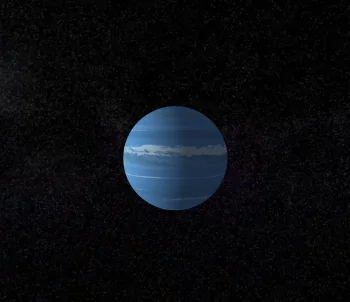
The sub-Saturn planet TOI-2665 b orbits its parent star every three days, placing it within the hot Neptune desert, a region where such planets are rarely found due to extreme heat from their host stars. Despite intense irradiation, measurements reveal that this giant planet has successfully retained a thick gaseous atmosphere, providing new insights into how these worlds form and evolve.
Star system: TOI-2665 | Distance from the Sun: 727 light years
Giant planet TOI-2665 b survives in the intense heat of the hot Neptune desert
Star system: TOI-2665 | Distance from the Sun: 727 light years
The sub-Saturn planet TOI-2665 b orbits a metal-rich G-type star, completing one full revolution in approximately 2.85 days. This proximity to its host star places it squarely within the hot Neptune desert. This term refers to a specific orbital region close to stars where researchers typically find very few giant planets, as the intense radiation from the star usually strips away their gaseous atmospheres, leaving behind only the rocky cores. TOI-2665 b, however, retains a significant gaseous envelope, challenging existing models of how planets survive in such harsh environments.

To understand the composition and nature of this planet, researchers utilized the Transiting Exoplanet Survey Satellite to observe the dimming of the star as the planet crossed its face. They followed these observations with precise radial velocity measurements, which track the subtle gravitational tug of the planet on the host star. By measuring how much the star wobbles in response to the planet's gravity, the mass of the planet was determined with high precision. These data confirm that the planet has a low density, indicating it remains a gas-rich world despite the extreme conditions.

The host star is relatively bright, which, combined with the extensive atmosphere of TOI-2665 b, makes this system an ideal laboratory for future studies. Examining the light filtering through the planet's atmosphere could reveal its chemical makeup and provide clues about how it formed. As a rare example of a giant planet enduring the hot Neptune desert, TOI-2665 b serves as a key case study for understanding planetary stability under heavy irradiation.

Key findings

  • TOI-2665 b is a sub-Saturn planet with a mass of approximately 57.0 Earth masses.
  • The planet orbits its star every 2.85 days, positioning it within the hot Neptune desert.
  • Despite being exposed to 1,068 times the radiation Earth receives, the planet maintains a significant gaseous envelope.
  • The planet has a low density of approximately 0.9 grams per cubic centimeter.
  • The brightness of the host star makes this system a prime candidate for detailed atmospheric characterization.
Generated by LLM, corrected by human

Share this discovery

Related themes

Stars mentioned

Yellow-White star
TOI-2665 is a metal-rich G dwarf star located 727 light years away. It has a mass of 1.15 solar masses and a radius of 1.302 solar radii, with a surface temperature of 5873 Kelvin and an estimated age of 4.79 billion years.
mass: 1.15 M☉
radius: 1.5 R☉
distance: 727 ly
stars in the system: 1
exoplanets: 1
Advertisement
Advertisement

study iconResearch with similar tags

line
Advertisement
Get your next news from nearby stars
Stellar Catalog brings the stars from our galaxy to you. Discover their position, physical properties and whether there are any exoplanets or disks orbiting them. The data in Stellar Catalog come from respectable sources like Gaia space telescope, or SIMBAD database.

Advertisement