
 sterne
 exoplaneten


Nachricht

Stellar Brief: 23. 10. 2026
Today’s astronomy highlights reveal a striking contrast on exoplanet WASP-43 b: models indicate that its nightside is largely cloudy, while its dayside appears clear at the level where light emerges. The findings offer a new way to compare the planet’s extreme weather with telescope observations.
Read today's Stellar Brief
 Latest astronomy nachricht
 23. 3. 2026
 Sterne | Exoplaneten | Planetenentstehung | Junge Sternobjekte

DX Chamaeleontis (HD 104237) is a binary star system surrounded by a compact, asymmetric ring of dust and gas at a radius of 0.43 astronomical units. This ring lies just outside the binary’s orbit, much closer than expected for a typical circumbinary disk.
Normally, the strong gravity of the binary would clear out the inner region, creating a large gap between the stars and the disk. Previous simulations, assuming the disk orbits in the same direction as the binary, found almost no material ...
Read article 
Advertisement
23. 3. 2026Sterne | ExoplaneteThe 70 Ophiuchi AB binary system, just 5.1 parsecs from Earth, is a prime target for future searches for Earth-like planets. Astronomers combined new radial velocity data from the Planet Finder Spectrograph with decades of previous measurements and astrometry to refine the orbits and masses of both stars. The study found no evidence for giant planets around either star, but set strong limits on what kinds of planets could still be hiding there.
...
Read article 22. 3. 2026Sterne | ExoplaneteHigh-resolution spectroscopy is a powerful tool for studying the atmospheres of exoplanets. This research analyzed 50 transits of 14 different exoplanets, ranging from super-Earths to ultra-hot Jupiters, using data from the SPIRou instrument. The team used automated data reduction and advanced atmospheric retrieval techniques to search for molecular signatures in these planets’ atmospheres.
The study confirmed previous detections of water (H2O...
Read article 22. 3. 2026SterneHD 166620 is a star thought to be in a Maunder Minimum-like state, a period of very low magnetic activity similar to what the Sun experienced in the 17th century. Using spectropolarimetric observations from the CFHT/SPIRou and ESPaDOnS instruments, astronomers analyzed the star’s magnetic field over 12 nights. While individual measurements showed no strong polarization, combining the data revealed a weak, axisymmetric dipole field with a strength...
Read article 21. 3. 2026Sterne | Exoplaneten | TESS | Rote Zwerge
Ultra-short period (USP) rocky planets, which orbit their stars in less than a day, are rare, especially around red dwarfs. TOI-4552 b (also UPM J1738-4738 b) is a newly validated Earth-sized planet with a 0.3-day orbit around a quiet M4.5V red dwarf just 90 light years away. It was first found in TESS transit data and later confirmed using TESS photometry, ground-based transit observations, and high-resolution imaging, which ruled out false posi...
Read article 21. 3. 2026James-Webb-Weltraumteleskop | Planetenentstehung | SterneThe star HD 163296 is surrounded by a large disk of dust and gas, making it an important target for studying how disks affect the light from background stars. Using the James Webb Space Telescope’s NIRCam coronagraph, astronomers observed HD 163296 and identified several background sources seen through or near the disk. These background stars provide valuable benchmarks for measuring how much the disk dims and reddens starlight—a process known as...
Read article 20. 3. 2026Sterne | Exoplaneten | James-Webb-Weltraumteleskop | Planetenatmosphären | Heißer Jupiter
NGTS-2 b is a hot Jupiter with a temperature of about 1,470 Kelvin, orbiting an F-type star in an orbit aligned with the star’s spin. Using the James Webb Space Telescope (JWST), astronomers observed a transit of NGTS-2b and measured its atmosphere’s spectrum from 2.84 to 5.18 micrometers. The spectrum shows weak absorption features from water and carbon dioxide, but the data are not sufficient to precisely determine the planet’s atmospheric comp...
Read article 20. 3. 2026Sterne | Exoplaneten | TESS | Sonnähnliche Sterne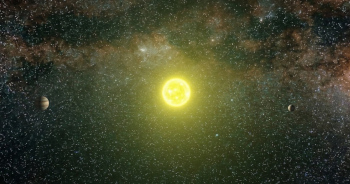
TOI-1232 is a Sun-like star with slightly higher metallicity than the Sun. It hosts two massive planets, both warmer than Jupiter, discovered using data from the TESS space telescope and ground-based follow-up. The inner planet, TOI-1232 b, is a Jovian-mass planet with a 14.26-day orbit, while the outer planet, TOI-1232 c, is Saturn-mass with a 30.36-day orbit.
The TESS light curve of TOI-1232 is complex due to contamination from a background ...
Read article 20. 3. 2026Sterne | Exoplaneten | RieseAs stars like the Sun age and evolve, they lose mass through strong stellar winds, which can affect the planets orbiting them. This study used computer simulations to explore how much material planets can accrete from the wind of a star as it goes through its red giant and asymptotic giant branch phases. The simulations covered planets with masses from half to thirteen times that of Jupiter, at distances of 5, 10, and 20 astronomical units from t...
Read article 20. 3. 2026Sterne | Exoplaneten | Heißer JupiterThe alignment between a planet’s orbit and its star’s rotation axis can reveal how giant planets migrate and evolve, especially in binary star systems. TOI-1333 A b is a hot Jupiter—a giant planet in a close orbit—around an F-type star that also has a distant stellar companion. By analyzing spectroscopic data taken during a planetary transit, astronomers measured the angle between the planet’s orbit and the star’s spin axis, known as the projecte...
Read article Top article categories
Filtered articles by category.
Neu entdeckte Exoplaneten
| EK Chamaeleontis b | 10 / 2026 | 2702.2 M⊕ | 321.3 ly | |
| HD 715 b | 10 / 2026 | 201.9 M⊕ | 542.8 ly | |
| DENIS J1253-5709 b | 10 / 2026 | 244.8 M⊕ | 54.4 ly | |
| L 115-21 b | 10 / 2026 | 0.4 M⊕ | 41.9 ly | |
| TIC 219893931 b | 09 / 2026 | 8.9 M⊕ | 1319.5 ly | |
| TOI-6417 b | 09 / 2026 | 349.7 M⊕ | 1903.9 ly | |
| TOI-6443 b | 09 / 2026 | 1605.4 M⊕ | 2051.6 ly | |
| TOI-7219 b | 09 / 2026 | 661 M⊕ | 1074.2 ly | |
| TOI-4079 B b | 09 / 2026 | 1646.8 M⊕ | 1185.6 ly | |
| HD 45652 b | 09 / 2026 | 1557.7 M⊕ | 113.9 ly | |
| LSPM J0804+1116 b | 09 / 2026 | 6.4 M⊕ | 82.6 ly | |
| HR 8799 f | 09 / 2026 | 524.5 M⊕ | 133.3 ly | |
| 61 Cygni A b | 09 / 2026 | 2543.3 M⊕ | 11.4 ly | |
| TOI-5646 b | 08 / 2026 | 45.9 M⊕ | 1352.3 ly | |
| TOI-4468 c | 08 / 2026 | 11.1 M⊕ | 1233.1 ly |
Newly discovered exoplanets
Latest scientific studies
Durchsuchen Sie die neuesten wissenschaftlichen Studien zu Sternen und Exoplaneten in unserer Galaxie. Entdecken Sie die neuesten Forschungsergebnisse zur Astrophysik und Sternastronomie.

Ältere Veröffentlichungen