Unsere Milchstraße enthält Milliarden von Sternen, von massereichen, hellen Sternen bis hin zu kleinen, lichtschwachen Sternenresten. Manche Sterne existieren allein, viele sind Teil von Doppel- oder Mehrfachsternsystemen. Diese Seite präsentiert eine Liste der sonnennächsten Sterne und hilft so, unsere stellare Umgebung zu kartieren und die Vielfalt der Sterne in unserer Nähe zu verstehen.

Die Liste lässt sich nach Sternkategorien filtern, sodass Sie gezielt nach bestimmten Sterntypen wie Roten Zwergen, sonnenähnlichen Sternen, Weißen Zwergen oder Braunen Zwergen suchen können. Diese flexible Ansicht erleichtert den Vergleich verschiedener Sternpopulationen und die Fokussierung auf interessante Objekte. Obwohl der Schwerpunkt auf nahen Sternen liegt, reicht der Katalog auch über die unmittelbare Nachbarschaft hinaus und bietet so einen umfassenderen Überblick über die Sterntypen in unserer Galaxie.
Nearest star is Proxima Centauri, located approximately 4.24 light-years (1.30 parsecs) from the Sun. It is part of the Alpha Centauri star system, which also includes Alpha Centauri A and Alpha Centauri B.
What are the nearest stars to Earth?
Nearest stars to Earth include the Alpha Centauri system (Alpha Centauri A, Alpha Centauri B, and Proxima Centauri), Barnard's Star, and Wolf 359. There are also brown dwarfs Luhman 16 and WISE 0855−0714.
What is the solar neighborhood?
Solar neighborhood (also Local Interstellar Cloud) is the region of interstellar space that surrounds the Sun with diameter about 15 light years. Stellar Catalog database includes all stars contained within this region.
How do astronomers measure distances to stars?
Astronomers use methods like parallax, standard candles, and redshift to measure distances to stars. Parallax is especially useful for nearby stars in our solar neighborhood, while other techniques help map the universe beyond.
Are there any exoplanets orbiting the nearest stars?
Yes, several exoplanets have been discovered orbiting the nearest stars. For example, Proxima Centauri has an exoplanet called Proxima Centauri b, which is located in the star's habitable zone and is the closest known exoplanet to Earth.
Why are the nearest stars important for astronomy and physics?
The nearest stars provide valuable laboratories for studying stellar evolution, space environments, and the fundamental physics of stars. Observing these stars helps astronomers understand the structure of our galaxy and the broader universe.
Advertisement
StellarGuide: Sterne
Sterne
Sterne sind riesige Kugeln aus heißem Gas, die durch Kernfusion in ihrem Inneren Energie erzeugen und dadurch leuchten. Die meisten Sterne bestehen hauptsächlich aus Wasserstoff und Helium. Im Zentrum eines Sterns verschmelzen Wasserstoffatome aufgrund des hohen Drucks und der Temperatur zu Helium, wobei eine enorme Menge Energie in Form von Licht und Wärme freigesetzt wird.
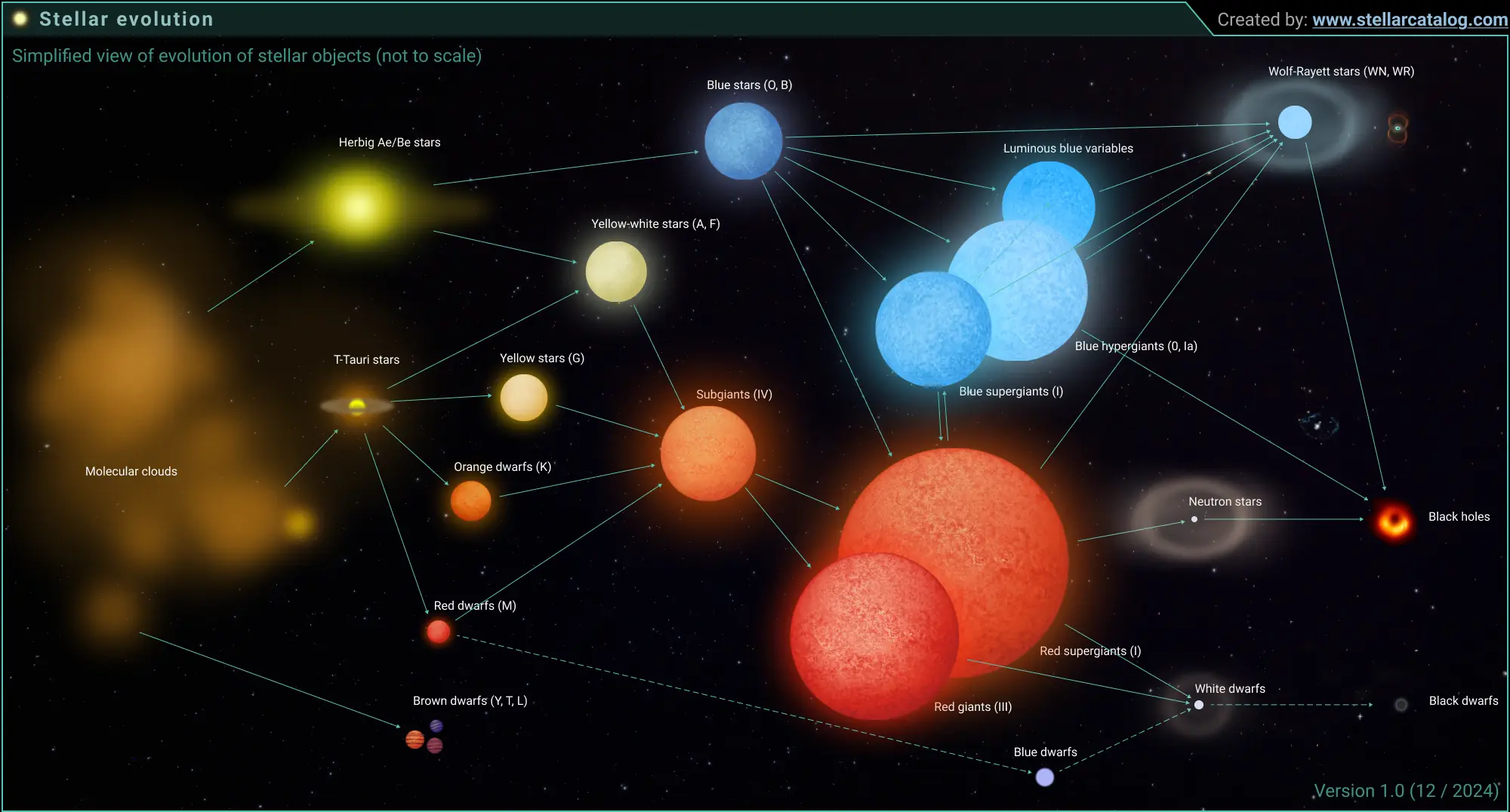
Stars are born and die in various ways depending on their mass, composition, and other factors. The most common life cycle for stars like our Sun involves several key stages.

 sterne
 exoplaneten
 nachricht


 StellarGuide: Sterne