
 Звезды
 Экзопланеты


Новости

Stellar Brief: 20. 10. 2026
Today’s standout finding changes the story of PDS 70: the young star is estimated to be 12 to 16 million years old, about three times older than previously thought. Alpha Centauri was the leading Stellarcatalog search query, with 1,537 impressions on October 19.
Read today's Stellar Brief
 Latest astronomy Новости
 16. 3. 2026
 Звезды | Экзопланеты
The protoplanetary disk around TW Hya is a key site for studying how planets form and what materials they inherit. Understanding the distribution of chemical elements and molecules in such disks helps scientists learn about the building blocks of planets, especially those that could be habitable. One important molecule is formaldehyde (H2CO), which exists in two forms: ortho and para, depending on the spins of its hydrogen atoms.
Recent ALMA observations measured the amounts of ortho- and par...
Read article 
Advertisement
13. 3. 2026Звезды | ЭкзопланетыLong-period giant planets, or cold Jupiters, play a key role in shaping planetary systems, but they are difficult to detect because they orbit far from their stars. Traditional methods like radial velocity and transit surveys have limited sensitivity at these distances. By combining long-term radial velocity data with precise astrometry from the Hipparcos and Gaia missions, astronomers can now better detect and measure these distant worlds.
In...
Read article 13. 3. 2026Звезды | Экзопланеты | Атмосферы планет | Космический телескоп имени Джеймса УэббаWASP-107 b is a warm gas giant planet that has been studied in detail using the James Webb Space Telescope (JWST). Its atmosphere shows a unique feature at 8–10 micrometers, thought to be caused by silicate clouds. Scientists aimed to explain the planet’s full spectrum, from near-infrared to mid-infrared, using a physically realistic model of cloud formation and temperature.
The research team used a model that links how clouds form with how he...
Read article 12. 3. 2026Звезды | ЭкзопланетыHD 332231 b is a warm sub-Saturn exoplanet that orbits close to its host star. Astronomers studied the timing of its transits—when the planet passes in front of the star—and found that these events do not occur at perfectly regular intervals. Instead, the transit times show a repeating pattern, known as transit timing variations (TTVs), which can reveal the presence of other planets in the system.
Using precise data from the TESS mission and g...
Read article 12. 3. 2026Звезды | Экзопланеты | TESS | Красные карликиTOI-4616 b is an Earth-sized exoplanet that orbits a nearby red dwarf star, just 28 parsecs from Earth. Red dwarfs are small, cool stars, and their low brightness makes it easier to spot planets passing in front of them. This planet was discovered and confirmed using data from NASA’s TESS mission, along with ground-based telescopes and detailed follow-up observations.
The host star, classified as an M4 dwarf, is about 19% the size and mass of ...
Read article 11. 3. 2026Звезды | Экзопланеты | Космический телескоп имени Джеймса Уэбба | Атмосферы планет
The nearby star Epsilon Indi hosts a cold gas giant planet, Epsilon Indi A b, located just under 12 light years from Earth. Using the James Webb Space Telescope (JWST), astronomers captured the longest-wavelength image ever taken of an exoplanet, extending up to 25 micrometers. By combining these new images with decades of radial velocity and astrometric data, the team precisely determined the planet’s orbit and mass.
The planet’s light was me...
Read article 10. 3. 2026Звезды | Экзопланеты | ALMA | Молодые звездные объектыHD 34282 is a young star surrounded by a disk of gas and dust, where planets may be forming. Using the ALMA telescope, astronomers captured detailed images of this disk at several wavelengths, revealing a bright arc and a complex pattern of rings and gaps. These features help scientists understand how dust and gas behave in planet-forming environments.
The observations show that the bright arc has a lower spectral index than the surrounding ri...
Read article 9. 3. 2026Звезды | Экзопланеты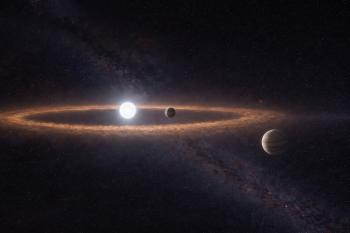
The Beta Pictoris system is famous for its young star, two giant planets, and a large disk of dust and gas. Recent studies have found many comet-like bodies orbiting the star (exocomets). To understand how these exocomets form and evolve, researchers simulated the system with over 100,000 test particles, tracking their paths for 25 million years.
The simulations show that most material is quickly cleared out by the planets, except for two main...
Read article 9. 3. 2026Звезды | Экзопланеты | TESS | Оранжевый карликTOI-4504 is an orange dwarf star that hosts two giant planets, both orbiting in a special pattern called a 2:1 mean-motion resonance. This means that for every orbit the outer planet completes, the inner planet completes exactly two. The planets, named TOI-4504 c and d, have orbital periods of 82.8 and 41.3 days, respectively, and show some of the largest known variations in the timing of their transits across the star.
Recent data from the TE...
Read article 9. 3. 2026Звезды | Экзопланеты | TESSAstronomers have used data from NASA’s TESS mission to study 347 single exoplanets with orbital periods between 8 and 200 days. These planets, called 'warm' because they are neither too close nor too far from their stars, show a surprising link between their size and the shape of their orbits.
The team analyzed the planets by grouping them into size categories: sub-Neptunes, sub-Saturns, and Jovians. They found that most small and medium-sized...
Read article Top article categories
Filtered articles by category.
Недавно обнаруженные экзопланеты
| EK Chamaeleontis b | 10 / 2026 | 2702.2 M⊕ | 321.3 ly | |
| HD 715 b | 10 / 2026 | 201.9 M⊕ | 542.8 ly | |
| DENIS J1253-5709 b | 10 / 2026 | 244.8 M⊕ | 54.4 ly | |
| TOI-6417 b | 09 / 2026 | 349.7 M⊕ | 1903.9 ly | |
| TOI-6443 b | 09 / 2026 | 1605.4 M⊕ | 2051.6 ly | |
| TOI-7219 b | 09 / 2026 | 661 M⊕ | 1074.2 ly | |
| TOI-4079 B b | 09 / 2026 | 1646.8 M⊕ | 1185.6 ly | |
| HD 45652 b | 09 / 2026 | 1557.7 M⊕ | 113.9 ly | |
| LSPM J0804+1116 b | 09 / 2026 | 6.4 M⊕ | 82.6 ly | |
| HR 8799 f | 09 / 2026 | 524.5 M⊕ | 133.3 ly | |
| 61 Cygni A b | 09 / 2026 | 2543.3 M⊕ | 11.4 ly | |
| TOI-5646 b | 08 / 2026 | 45.9 M⊕ | 1352.3 ly | |
| TOI-4468 c | 08 / 2026 | 11.1 M⊕ | 1233.1 ly | |
| TOI-4468 b | 08 / 2026 | 170.1 M⊕ | 1233.1 ly | |
| TOI-4468 d | 08 / 2026 | 311 M⊕ | 1233.1 ly |
Newly discovered exoplanets
Latest scientific studies
Просмотрите последние научные исследования звезд и экзопланет в нашей галактике. Откройте для себя новейшие исследования в области астрофизики и звездной астрономии.

Старые публикации