
 etoile
 exoplanètes


Nouvelles

Stellar Brief: 20. 10. 2026
The planet-forming disk around HD 100546 contains an unexpectedly high amount of methyl formate: ALMA measured a methyl-formate-to-methanol ratio of about 2, hinting that active chemistry is reshaping the ingredients from which planets form.
Read today's Stellar Brief
 Latest astronomy nouvelles
 17. 3. 2026
 Étoiles | Exoplanète
Studying exoplanet atmospheres with transmission spectroscopy can be complicated by features on the star’s surface, which can affect the observed spectra. To better understand these effects, astronomers analyzed the surface of the star HD 189733 by observing two transits of its planet using the ESPRESSO spectrograph. They used a technique called Doppler shadow analysis to probe how the star’s spectral lines change from the center to the edge (limb) of its disk.
The team cross-correlated the o...
Read article 
Advertisement
17. 3. 2026Étoiles | Exoplanètes | ALMA | Formation des planète
High-resolution images from the ALMA telescope have revealed a variety of shapes in the dust of planet-forming disks, including rings, spirals, and crescents. While most disks show symmetrical rings, some display asymmetric features like blobs or crescents, which may be linked to vortices or the influence of forming planets. This study focuses on the disk around the star HD 163296, where a crescent-shaped arc was observed in the dust using ALMA d...
Read article 17. 3. 2026Étoiles | ExoplanèteA new study has analysed six planetary systems, each with at least one small planet passing in front of its star. By combining new and existing observations from space and ground-based telescopes, researchers have measured the mass and size of these planets with high precision. This allows for a better understanding of what these distant worlds are made of and how they might have formed.
The team used data from CHEOPS, K2, TESS, and several gr...
Read article 17. 3. 2026The TOLIMAN mission is building and preparing to launch a low-cost space telescope with a unique optical design. Its main goal is to search for rocky, Earth-like planets in temperate orbits around the stars Alpha Centauri A and B, the closest Sun-like stars to Earth. Finding such planets is difficult with current instruments, even though these stars are nearby and bright.
TOLIMAN will use a technique called narrow-angle astrometry, which measu...
Read article 17. 3. 2026Étoiles | ExoplanèteTOI-3884 b is a rare super-Neptune planet that transits a fully convective M-dwarf star with a persistent giant polar starspot. Because the planet passes over this spot during every transit, astronomers can directly study the spot’s properties using the James Webb Space Telescope (JWST). Seven transits were observed with JWST, covering a wide range of wavelengths from 0.5 to 5.3 micrometers.
Each transit showed a recurring signature as the pla...
Read article 16. 3. 2026Étoiles | ExoplanèteSilicate clouds are a key feature in the atmospheres of many giant exoplanets, but their formation and composition are still being studied. This research compares the silicate clouds seen in four hot Jupiters observed by JWST with theories developed for brown dwarfs, objects that are between planets and stars in mass and temperature. The study also uses evidence from meteorites to show that giant planets forming in the outer regions of protoplane...
Read article 16. 3. 2026Étoiles | Exoplanètes | TESS | Naines rouge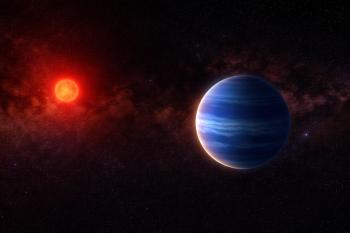
The Neptunian desert is a region where Neptune-sized planets are rare at short orbital periods, likely due to intense starlight stripping away their atmospheres or changes in their orbits. Understanding this desert helps scientists learn how planets evolve, especially around different types of stars. In this study, astronomers confirmed the existence of TOI-672 b, a massive super-Neptune orbiting a red dwarf star, using data from TESS, ground-bas...
Read article 16. 3. 2026Étoiles | ExoplanèteThe exoALMA Large Program has uncovered many detailed structures in the dust and gas of protoplanetary disks, where planets are forming around young stars. By using a technique called tomography—studying how molecular lines change at different locations and velocities—astronomers can now detect the presence of planets hidden within these disks.
The study shows that even with a few hours of ALMA telescope time, it is possible to spot the signat...
Read article 16. 3. 2026Étoiles | Exoplanètes | Télescope spatial James Webb | Atmosphères planétaireThe James Webb Space Telescope (JWST) has detected silicate clouds in the atmospheres of several exoplanets, providing new insights into how clouds form in extreme environments. While simple models can fit these observations, they do not always match the results from more detailed microphysical models. To address this, researchers developed Nimbus, a fast model that simulates cloud formation based on physical processes, and used it alongside Virg...
Read article 16. 3. 2026Étoiles | ExoplanèteThe protoplanetary disk around TW Hya is a key site for studying how planets form and what materials they inherit. Understanding the distribution of chemical elements and molecules in such disks helps scientists learn about the building blocks of planets, especially those that could be habitable. One important molecule is formaldehyde (H2CO), which exists in two forms: ortho and para, depending on the spins of its hydrogen atoms.
Recent ALMA o...
Read article Top article categories
Filtered articles by category.
Exoplanètes nouvellement découvertes
| EK Chamaeleontis b | 10 / 2026 | 2702.2 M⊕ | 321.3 ly | |
| HD 715 b | 10 / 2026 | 201.9 M⊕ | 542.8 ly | |
| DENIS J1253-5709 b | 10 / 2026 | 244.8 M⊕ | 54.4 ly | |
| TOI-6417 b | 09 / 2026 | 349.7 M⊕ | 1903.9 ly | |
| TOI-6443 b | 09 / 2026 | 1605.4 M⊕ | 2051.6 ly | |
| TOI-7219 b | 09 / 2026 | 661 M⊕ | 1074.2 ly | |
| TOI-4079 B b | 09 / 2026 | 1646.8 M⊕ | 1185.6 ly | |
| HD 45652 b | 09 / 2026 | 1557.7 M⊕ | 113.9 ly | |
| LSPM J0804+1116 b | 09 / 2026 | 6.4 M⊕ | 82.6 ly | |
| HR 8799 f | 09 / 2026 | 524.5 M⊕ | 133.3 ly | |
| 61 Cygni A b | 09 / 2026 | 2543.3 M⊕ | 11.4 ly | |
| TOI-5646 b | 08 / 2026 | 45.9 M⊕ | 1352.3 ly | |
| TOI-4468 c | 08 / 2026 | 11.1 M⊕ | 1233.1 ly | |
| TOI-4468 b | 08 / 2026 | 170.1 M⊕ | 1233.1 ly | |
| TOI-4468 d | 08 / 2026 | 311 M⊕ | 1233.1 ly |
Newly discovered exoplanets
Latest scientific studies
Parcourez les dernières études scientifiques sur les étoiles et les exoplanètes de notre galaxie. Découvrez les dernières recherches en astrophysique et en astronomie stellaire.

Publications plus anciennes