| Star name |
|
Mass |
Distance |
|
L 762-51 LHS 2794, EPIC 212285603, GJ 3804, Gliese 3804, HIC 67164, HIP 67164, LFT 1035, L 762-51, LP 798-34, LTT 5346, 2MASS J13455074-1758047, NLTT 35132, TIC 286942673, TYC 6127-534-1 |
dM3.5 |
- |
36.5 ly |
|
L 136-37 LTT 2816, NLTT 17788, 2MASS J07205204-6210118, DENIS J072051.9-621011, TIC 349374765, WISEA J072051.59-621009.5 |
M3 |
- |
36.6 ly |
|
Gliese 173 GJ 173, BD-11 916, LP 715-52, GCRV 2717, HIC 21556, HIP 21556, LTT 2050, 2MASS J04374188-1102198, MCC 106, NLTT 13657, TIC 55997717, TYC 5324-581-1, WEB 4138 |
M1V |
0.48 M☉ |
36.6 ly |
|
Ross 508 LHS 396, G 137-2, G 136-103, GJ 585, Gliese 585, JP11 5158, LFT 1203, LTT 14584, 2MASS J15235112+1727569, NLTT 40124, TIC 400019820, WISEA J152350.85+172744.4 |
M4.92 |
0.18 M☉ |
36.6 ly |
|
EGGR 248 GJ 1086, Gliese 1086, G 106-4, G 99-37, LTT 17876, NLTT 15714, 2MASS J05511947-0010213, SDSS J055119.47-001021.4, TIC 176670072, WD 0548-001 |
DQ8P |
- |
36.6 ly |
|
UCAC4 608-044702 2MASS J08401597+3127068, TIC 341526939, LSPM J0840+3127 |
M3.5Ve |
- |
36.6 ly |
|
HD 28343 GJ 169, Gliese 169, HIC 20917, HIP 20917, LTT 11433, NLTT 13343, 2MASS J04290013+2155214, TIC 17558287, TYC 1277-601-1, WISEA J042900.05+215523.6 |
M0.5V |
- |
36.6 ly |
|
2MASS J0700+3157 2MASSI J0700366+315726, TIC 165098841, WISEA J070036.77+315719.7, WDS J07006+3157AB |
L3+L6.5 |
- |
36.6 ly |
|
11 Leonis Minoris 11 LMi, BD+36°1979, GJ 356, Gliese 356, HD 82885, HIC 47080, HIP 47080, HR 3815, SAO 61586, WDS 09357+3549, GC 13242, TIC 8915802, TYC 2500-1533-1, WISEA J093538.92+354834.4, LTT 12535, NLTT 22117, 2MASS J09353959+3548366 |
G8Va |
0.96 M☉ |
36.6 ly |
|
2MASS J19251275+0700362 TIC 133125017, WISE J192512.78+070038.8 |
L7 |
- |
36.6 ly |
|
Arcturus * alf Boo, Alpha Boötis, Alramech, Abramech, α Boötis, 16 Boötis, BD+19°2777, GJ 541, Gliese 541, HD 124897, HIC 69673, HIP 69673, HR 5340, SAO 100944, LHS 48, GCTP 3242.00 |
K1.5IIIFe-0.5 |
1.1 M☉ |
36.7 ly |
|
Gliese 3959 2E 3717, G 180-60, HAT 193-01110, NLTT 43010, 2MASS J16311879+4051516, SDSS J163118.77+405152.1, NN 3959, GJ 3959 |
M6 V |
0 M☉ |
36.7 ly |
|
G 107-69 LHS 229, G 111-7, G 193-50, GJ 275.2 A, Gliese 275.2 A, 2MASS J07304280+4811599, NLTT 17949, TIC 328328639, WISEA J073042.55+481145.2 |
M4V |
- |
36.8 ly |
|
2MASS J16452211-1319516 TIC 203506666, WISEA J164521.83-132000.6 |
L1.5 |
- |
36.8 ly |
|
LP 625-34 GJ 3967, Gliese 3967, 2MASS J16400599+0042188, NLTT 43307, TIC 281935723, |
M5V |
- |
36.8 ly |
|
HD 85512 CD−42°5678, Gaia DR2 5412947081287925504, GJ 370, Gliese 370, HIC 48331, HIP 48331, LHS 2201, 2MASS J09510700-4330097 |
K6Vk: |
0.69 M☉ |
36.8 ly |
|
PM J17189-4131 DENIS J171854.5-413140, 2MASS J17185456-4131395, TIC 192642951, WISEA J171854.33-413149.6 |
M6 |
- |
36.8 ly |
|
G 3-14 LHS 1290, G 71-28, GJ 70, Gliese 70, HIC 8051, HIP 8051, LFT 1851, LTT 10604, NLTT 5733, 2MASS J01432015+0419172, TIC 369534824, TYC 32-1005-1, WISEA J014319.89+041910.0 |
M2V |
- |
36.9 ly |
|
LP 938-71 DENIS J010250.6-373744, LHS 132, 2MASS J01025100-3737438, NLTT 3459, TIC 180724005, WISEA J010252.38-373741.0 |
M8.0V |
- |
36.9 ly |
|
PM J19515-3510 NSN 488A, WDS J19516-3511A |
M4 D |
- |
37 ly |
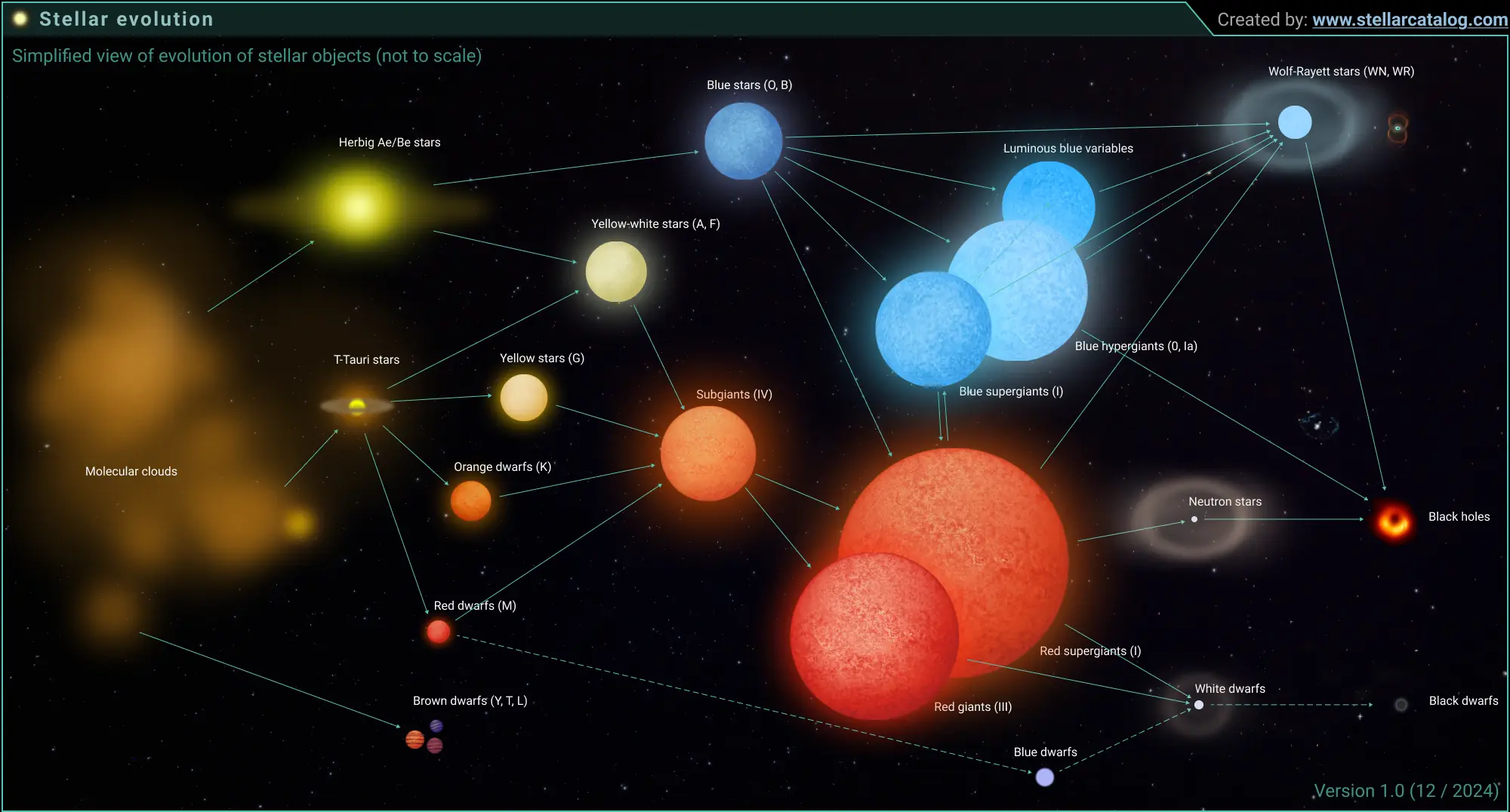
Stellar Evolution
Stars are born and die in various ways depending on their mass, composition, and other factors. The most common life cycle for stars like our Sun involves several key stages.

 stars
 exoplanets
 news


 StellarGuide: Stars