| Star name |
|
Mass |
Distance |
|
Gliese 4048 LHS 462, GJ 4048, G 204-58, 2MASS J18180427+3846342, NLTT 46274, TIC 76349247, WISEA J181803.91+384621.7 |
M3V |
0.32 M☉ |
37.1 ly |
|
2MASSI J1546271-332511 2MASS J15462718-3325111, TIC 99213845, WISEA J154627.29-332509.2, EQ J1546-3325 |
T5.7 |
- |
37.1 ly |
|
LSR J0539+4038 2MASS J05392474+4038437, TIC 239097694, WISEA J053925.39+403834.1 |
M8.0Ve |
- |
37.1 ly |
|
2MASS J18283572-4849046 TIC 324498463, WISE J182835.96-484903.9 |
T6 |
- |
37.1 ly |
|
Eta Boötis Muphrid, Saak, 8 Boötis, Gl 534, GJ 534, Gliese 534, HR 5235, BD +19°2725, HD 121370, LTT 14060, GCTP 3175.00, SAO 100766, FK5 513, HIP 67927, WDS J13547+1824, * eta Boo, 8 Boo, FK5 513, 2MASS J13544106+1823514, TIC 367758676, TYC 1470-1157-1, WDS J13547+1824A |
G0IV |
1.7 M☉ |
37.2 ly |
|
LP 838-16 |
M3 |
- |
37.2 ly |
|
WOH G 618 2MASS J05532643-7133502, TIC 31381302, WISEA J055326.47-713345.6 |
M6.0 D |
- |
37.2 ly |
|
G 34-23 LP 351-34, LTT 10491, 2MASS J01221027+2209032, NLTT 4534, TIC 411628298, WISEA J012210.48+220901.5 |
M4.0V C |
- |
37.2 ly |
|
2MASS J17545447+1649196 TIC 286431253, WISE J175454.55+164918.2 |
T5.5 C |
- |
37.2 ly |
|
V2689 Orionis HD 245409, GJ 208, Gliese 208, HIC 26335, HIP 26335, 2MASS J05363099+1119401, TIC 436248822, TYC 709-63-1, WDS J05365+1120A, YZ 11 1712, V* V2689 Ori |
K6V C |
- |
37.3 ly |
|
Ross 52 GJ 568, GJ 568 A, Gliese 568, G 166-53, G 167-3, HIC 72896, HIP 72896, LFT 1155, LHS 2997, LTT 14417, NLTT 38729, 2MASS J14535144+2333208, TIC 311182575, TYC 2017-588-3, WISEA J145350.90+233321.9 |
M3V |
- |
37.3 ly |
|
HD 222237 Gliese 902, GJ 902, LHS 3994, CD-73 1672, GC 32863, HIC 116745, HIP 116745, LFT 1813, LTT 9640, 2MASS J23393736-7243197, NLTT 57525, TIC 277913391, WISEA J233937.61-724327.5 |
K3+V |
0 M☉ |
37.3 ly |
|
OT Serpentis BD+21 2763, GJ 9520, Gliese 9520, HIC 75187, HIP 75187, 2MASS J15215291+2058394, RBS 1489, TIC 355793860, TYC 1493-378-1, USNO-B1.0 1109-00243006, V* OT Ser |
M1.0V |
0.55 M☉ |
37.3 ly |
|
Gliese 1187 GJ 1187, G 201-27, LHS 3006, LP 98-348, 2MASS J14575374+5639242, NLTT 38963, TIC 405503787, WISEA J145754.09+563917.6 |
M5.5V |
- |
37.4 ly |
|
WISE J222055.31-362817.4 |
Y0 |
- |
37.4 ly |
|
UCAC2 16493854 |
|
- |
37.5 ly |
|
Gliese 3417 G 250-31, HEN 2, LHS 1885, NLTT 17183, PLX 1611.01, 2MASS J06575703+6219197, GJ 3417 |
M6 V |
0.16 M☉ |
37.5 ly |
|
RX J0713.1-0511 TYC 4823-2265-1, TIC 23369524, 2MASS J07131123-0511482, SCR J0713-0511 |
M3Ve |
- |
37.5 ly |
|
PM J00156+4735 TYC 3251-1875-1, 2MASS J00153905+4735220, TIC 440065990 |
|
- |
37.5 ly |
|
Gliese 494 BEU 16, G 60-57, G 61-27, BD+13 2618, GJ 494, HIC 63510, HIP 63510, LFT 964, LHS 2665, LTT 13752, NLTT 32600, 2MASS J13004666+1222325, Ross 458, TIC 88138162, TYC 886-839-1, V* DT Vir, WISEA J130046.11+122232.4, Wolf 462, DT Virginis, DT Vir |
M0V |
0.51 M☉ |
37.5 ly |
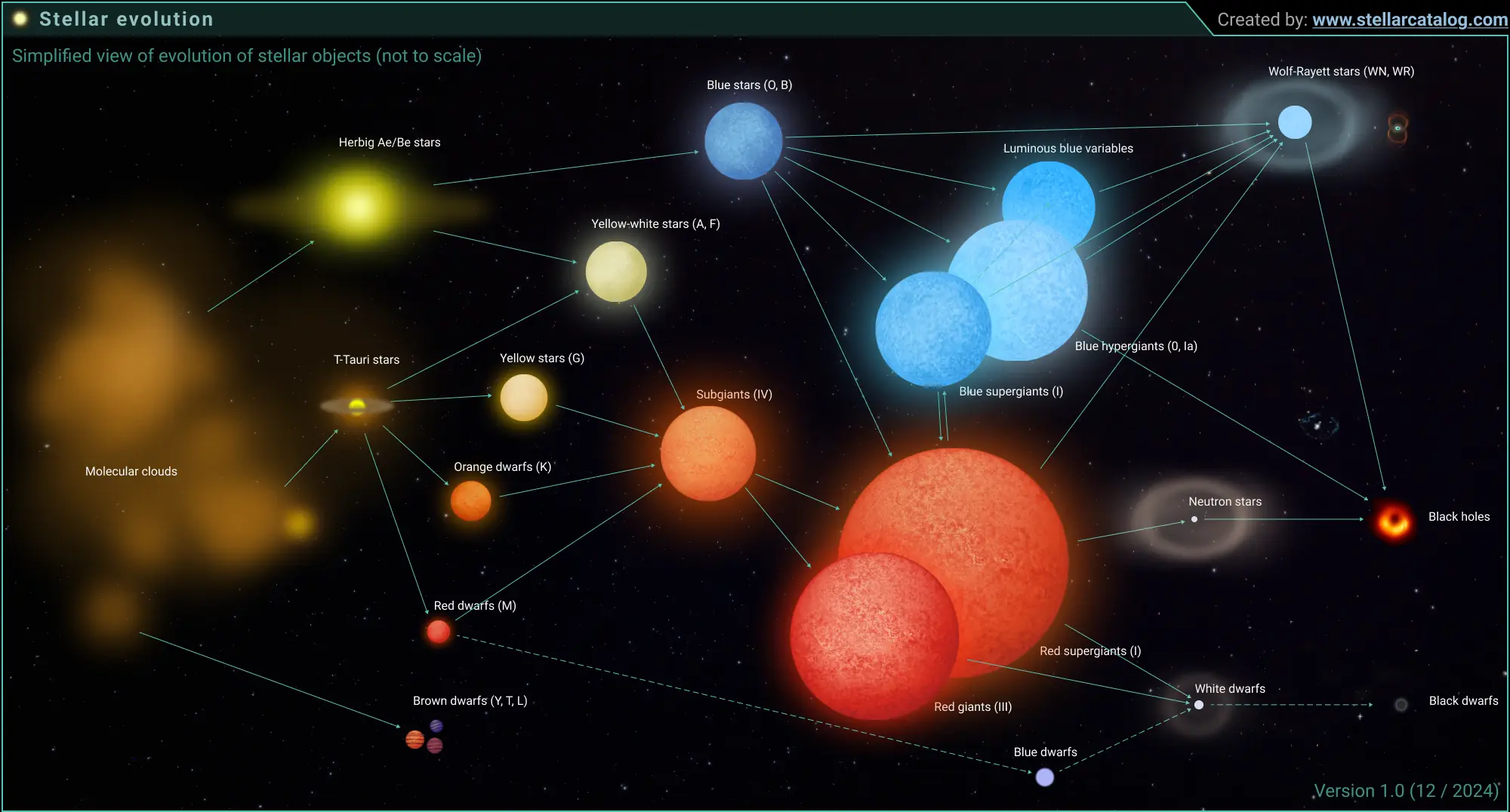
Stellar Evolution
Stars are born and die in various ways depending on their mass, composition, and other factors. The most common life cycle for stars like our Sun involves several key stages.

 stars
 exoplanets
 news


 StellarGuide: Stars


