do not follow here

List of nearest Red dwarfs

        This page highlights red dwarfs near the Solar System, which are key targets in the study of nearby stars and planetary systems. Their abundance and long-lived stability make them especially interesting for exoplanet searches, including exoplanets in the habitable zone. Understanding nearby red dwarfs helps place our Sun in context and provides important clues about where habitable planets and potential life might be found.
    
More about Red dwarfs
Advertisement
Stars 1-20
>
Star name Mass Distance

Proxima Centauri
Alpha Centauri C, CCDM J14396-6050C, GCTP 3278.00, Gliese 551, HIP 70890, LFT 1110, LHS 49, LPM 526, LTT 5721, NLTT 37460, V645 Centauri
M5.5 Ve 0.12 M☉ 4.2 ly

Barnard star
GCTP 4098.00, Gl 140-024, Gliese 699, GJ 699, HIC 87937, HIP 87937, LFT 1385, LHS 57, LTT 15309, Munich 15040, Proxima Ophiuchi, V2500 Ophiuchi, Velox Barnardi, Vyssotsky 799
M4 V 0.14 M☉ 6 ly

Wolf 359
CN Leonis, Gliese 406, GJ 406, G 045-020, LTT 12923, LFT 750, LHS 36, GCTP 2553
M6.5 Ve 0.11 M☉ 7.9 ly

Lalande 21185
BD+36 2147, G 119-052, Gliese 411, GJ 411, HD 95735, HIP 54035, LFT 756, LHS 37, LTT 12960, MCC 594, PLX 2576, SAO 62377, NLTT 26105, NSV 18593
M2+V 0.46 M☉ 8.3 ly

Luyten 726-8 B
LHS 10, G 272-61B
M6 V 0.12 M☉ 8.7 ly

Luyten 726-8
Gliese 65, GJ 65, BL Ceti, UV Ceti, LHS 9, LHS 10, G 272-61, LUY 726, IDS 01340-1828, L 726-8, 2MASS J01390120-1757026, WISE J013903.93-175655.7
M5.5 V 0.12 M☉ 8.9 ly

Ross 154
Gliese 729, GJ 729, V1216 Sgr, CD−23° 14742, GCTP 4338, HIP 92403, LHS 3414, V1216 Sagittarii, Ross 154
M3.5 V 0.17 M☉ 9.7 ly

Ross 248
Gliese 905, GJ 905, HH Andromedae, HH And, 2MASS J23415498+4410407, G 171-010, GCTP 5736.00, LHS 549
M5.0V 0.14 M☉ 10.3 ly

Lacaille 9352
Gliese 887, GJ 887, HD 217987, CD -36°15693, GCTP 5584, LHS 70, SAO 214301, LTT 9348, LFT 1758, Cordoba 31353, NSV 14420, HIP 114046, UGPMF 591, CPC 18 11792, Ci 20 1400, HIC 114046
M1V 0.5 M☉ 10.7 ly

Ross 128
FI Virginis, FI Vir, G 010-050, GCTP 2730, GJ 447, Gliese 447, HIC 57548, HIP 57548, LHS 315, Vyssotsky 286, LTT 13240, LFT 852, LSPM PM I11477+0048, 2MASS J11474440+0048164
M3V 0.17 M☉ 11 ly

EZ Aquarii
Luyten 789-6, Gliese 866, GJ 866, GCTP 5475.00, LHS 68, G 156-031, EZ Aqr, V* EZ Aqr
M5 V 0.11 M☉ 11.1 ly

EZ Aquarii B
M5 V 0.11 M☉ 11.1 ly

EZ Aquarii C
M5 V 0.1 M☉ 11.1 ly

Struve 2398
Gliese 725, G 227-046, HD 173739, HIP 91768, LHS 58, Vyssotsky 184, ADS 11632, BD +59°1915, GCTP 4330.00 A/B
M3 V 0.33 M☉ 11.5 ly

Struve 2398 B
G 227-047, HD 173740, HIP 91772, LHS 91772.
M3.5 V 0.25 M☉ 11.5 ly

Groombridge 34
GX Andromedae, V* GX And, BD+43° 44, GCTP 49, Gliese 15 A, GJ 15 A, Gl 15 A, G 171-047, HD 1326, HIP 1475, LHS 3, LTT 10108, SAO 36248
M2V 0.4 M☉ 11.6 ly

Groombridge 34 B
GQ Andromedae, Gliese 15 B, G 171-048, LHS 4, LTT 10109
M4.1 V 0.16 M☉ 11.6 ly

DX Cancri
Gliese 1111, GJ 1111, G 051-015, GCTP 2016.01, LHS 248, G 51-15, DX Cnc
M6.5 V 0.09 M☉ 11.7 ly

Gliese 1061
LHS 1565, LFT 295, LTT 1702, LP 995-46, L 372-58, GJ 1061
M5.5 V 0.11 M☉ 12 ly
Stars 1-20
>
Load all stars
in the catalogue

Red dwarfs news

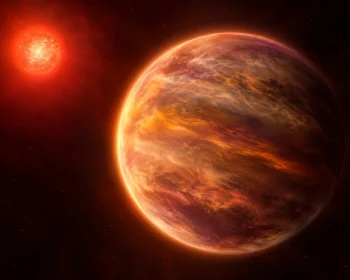
Haze signatures vary across eight sub-Neptunes, including TOI-732 c
icon25. 11. 2026
iconStars | Exoplanets | Red dwarfs | James Webb Space Telescope | TESS
Image: Haze signatures vary across eight sub-Neptunes, including TOI-732 c
Haze evidence differs among the atmospheres of eight sub-Neptunes observed by JWST. The planet LP 791-18 c, TOI-732 c and GJ 3090 b have spectra that favor hazy models. However, effects from the host stars may influence the results for LP 791-18 c and GJ 3090 b, so their haze evidence is less certain. The planets’ transmission spectra show how starlight changes as it passes through an atmosphere during a planet’s transit. Researchers compared models without haze against models using two e...
Read article tag icon
Advertisement
TOI-2120 b is larger than earlier estimates and may be water-rich
icon25. 11. 2026
iconStars | Exoplanets | Red dwarf
Image: TOI-2120 b is larger than earlier estimates and may be water-rich
TOI-2120 b has a revised radius of 2.31 Earth radii and an estimated mass of 5.81 Earth masses. Its density places it toward the water-rich region of composition models, but more radial-velocity measurements are needed....
Read article tag icon
Welopō‘ai triple system has two white dwarfs around a red dwarf
icon24. 11. 2026
iconStars | Red dwarfs | White dwarf
Image: Welopō‘ai triple system has two white dwarfs around a red dwarf
Welopō‘ai is the closest known triple system containing multiple white dwarfs. Its inner white dwarf has a precisely measured mass of 0.6180 times the Sun’s, while a second white dwarf lies 123.9 astronomical units away in projected separation....
Read article tag icon

study iconResearch in Red dwarfs

line

Frequently Asked Questions about nearby stars

What is the nearest star?

Nearest star is Proxima Centauri, located approximately 4.24 light-years (1.30 parsecs) from the Sun. It is part of the Alpha Centauri star system, which also includes Alpha Centauri A and Alpha Centauri B.

What are the nearest stars to Earth?

Nearest stars to Earth include the Alpha Centauri system (Alpha Centauri A, Alpha Centauri B, and Proxima Centauri), Barnard's Star, and Wolf 359. There are also brown dwarfs Luhman 16 and WISE 0855−0714.

What is the solar neighborhood?

Solar neighborhood (also Local Interstellar Cloud) is the region of interstellar space that surrounds the Sun with diameter about 15 light years. Stellar Catalog database includes all stars contained within this region.

How do astronomers measure distances to stars?

Astronomers use methods like parallax, standard candles, and redshift to measure distances to stars. Parallax is especially useful for nearby stars in our solar neighborhood, while other techniques help map the universe beyond.

Are there any exoplanets orbiting the nearest stars?

Yes, several exoplanets have been discovered orbiting the nearest stars. For example, Proxima Centauri has an exoplanet called Proxima Centauri b, which is located in the star's habitable zone and is the closest known exoplanet to Earth.

Why are the nearest stars important for astronomy and physics?

The nearest stars provide valuable laboratories for studying stellar evolution, space environments, and the fundamental physics of stars. Observing these stars helps astronomers understand the structure of our galaxy and the broader universe.
Advertisement

exoplanet iconStellarGuide: Stars

line
Stars
Stars are enormous spheres of hot gas that shine by generating energy through nuclear fusion in their cores. Most stars are made primarily of hydrogen and helium. In the center of a star, intense pressure and temperature cause hydrogen atoms to fuse into helium, releasing a tremendous amount of energy as light and heat.
More about Stars tag icon

Stellar categories

A comparison of spectral classes and typical stellar properties across the catalog categories.
Category Spectral class Typical mass (% of solar mass) Typical size (% of solar radius) Typical temperature (K)
, , 10-200% 50-300% 2000-10000 K
L, T, Y 1.2-8.0% 9-11% 600-2500 K
M 7.5-50% 10-60% 2400-3900 K
K 50-80% 60-90% 3900-5200 K
G 80-120% 80-120% 5200-6000 K
A, F, B, O 200-3000% 200-5000% 7000-40000 K
K|G|F|A|B 80-150% 120-300% 4500-6000 K
A|B|O, G|F|A, M|G|F|A, K|M|S 50-300% 500-20000% 3000-5000 K
K|M|C, G|F, B|O 500-10000% 10000-100000% 3000-35000 K
A|B, G|F, K|M 2000-20000% 50000-200000% 3000-40000 K
WC|WN|WO 1000-10000% 50-500% 30000-200000 K
DA|DC|DQ|DZ 20-140% 0.7-1.5% 5000-150000 K
100-300% 0.001-0.002% 600000-1000000 K
, , 300-10000000% 0.000001-1% 0-10000000 K

Advertisement