do not follow here
Stellar Catalog more icon Nearby stars catalogue more icon
Young stellar objects
more icon

List of nearest Young stellar objects

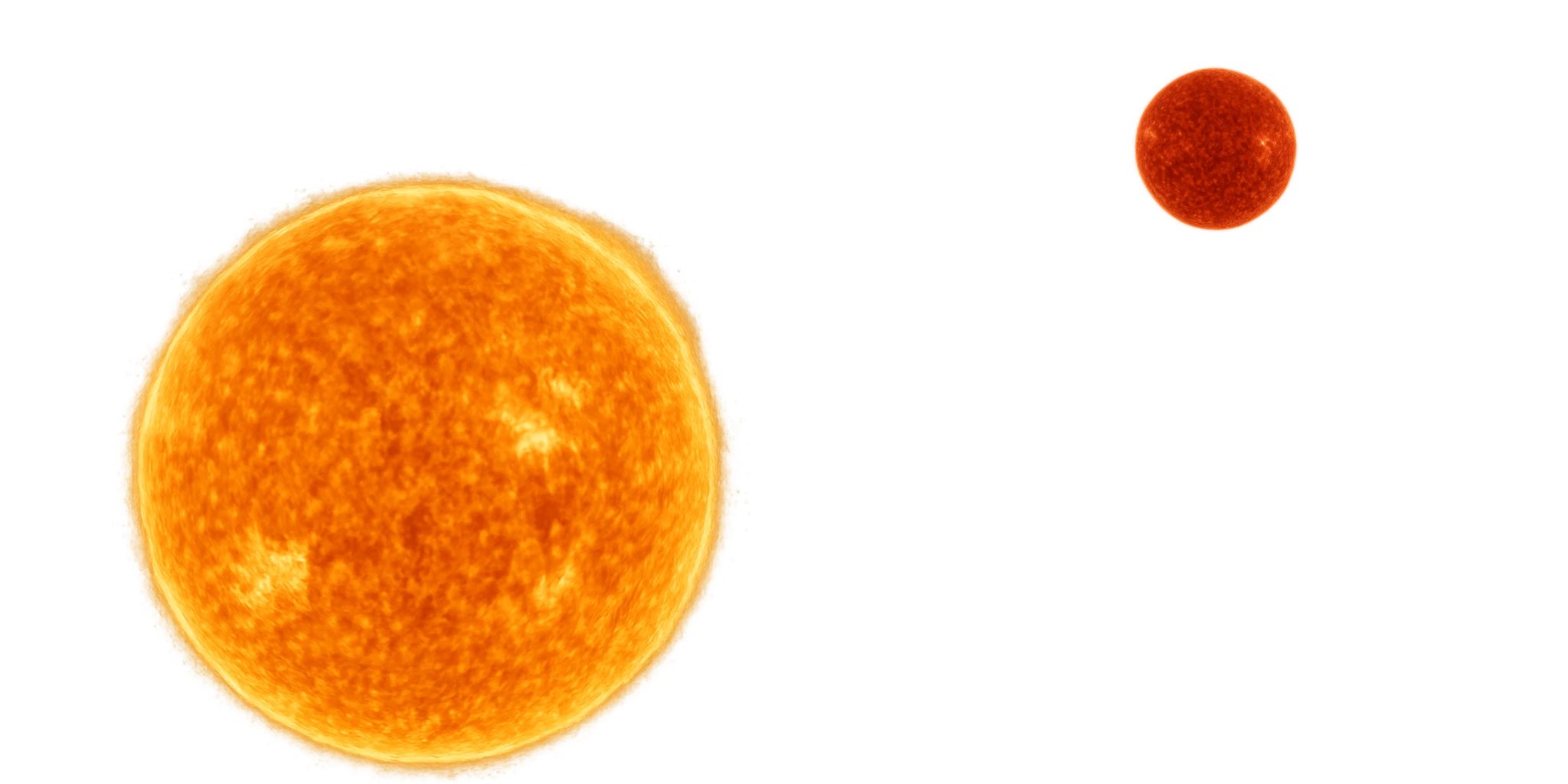
        Young stellar objects (YSOs) are stars in the early stages of development, forming as clouds of gas and dust collapse under gravity; they may be surrounded by a protoplanetary disk. The catalog lists RX J0506.2+0439 at 90.1 light-years and Gliese 3305 at 90.6 light-years as the closest examples, followed by CE Antliae at 111 light-years. 
    
More about Young Stellar Objects
Advertisement
<< <
Stars 61-80
>
Star name Mass Distance

HD 281229
TIC 26532226
- 988 ly

HH 211
SSTc2d J034356.5+320052, Herbig-Haro 211
0 0.08 M☉ 1000 ly

HD 34282
1.5 M☉ 1007 ly

HD 34700
G0 IV - 1143 ly

HD 34700 B
G0 IVe - 1143 ly

HD 290862
B3/5 - 1250 ly

V883 Orionis
V883 Ori, HBC 489
1.3 M☉ 2137 ly

IRAS 12196-6300
2MASS J12222318-6317167, WRAY 16-110, TIC 311327487, PDS 353
B6Ve C - 4585 ly

HD 120678
- 5829 ly

Gaia20eae
- 28487 ly
<< <
Stars 61-80
>
Load all stars
in the catalogue

Young Stellar Objects news

WISPIT 2 gas gaps align with known giant protoplanets
icon24. 11. 2026
iconStars | Exoplanets | Orange dwarfs | Young Stellar Objects | Planet formatio
Image: WISPIT 2 gas gaps align with known giant protoplanets
The gas disk around WISPIT 2 contains gaps and changes in gas motion at the locations of previously detected giant protoplanets. These matching features connect the planets with structures in their birth environment, giving a clearer view of how giant planets interact with the disks around young stars. ALMA observations traced carbon monoxide gas in the disk. The gaps appear in a map of the gas’s emission and in its rotation curve, which shows how quickly the gas moves at different distance...
Read article tag icon
Advertisement
Surface spots on the young orange dwarf V1298 Tau resemble solar sunspots
icon17. 11. 2026
iconStars | Exoplanets | Young Stellar Obje
Image: Surface spots on the young orange dwarf V1298 Tau resemble solar sunspots
Observations of the young orange dwarf V1298 Tau reveal that its starspots share the same structure as our Sun's sunspots. JWST data confirm these spots possess distinct dark umbra and lighter penumbra regions, proving magnetic stability early in a star's life....
Read article tag icon
Stationary nature of the spiral structure in the disk around IM Lupi
icon6. 11. 2026
iconStars | Red dwarfs | Exoplanets | Young Stellar Objects | Planet formatio
Image: Stationary nature of the spiral structure in the disk around IM Lupi
The spiral arms in the disk around star IM Lup are not rotating as previously thought. A reanalysis of ALMA data suggests the observed movement was a geometric mismatch. Researchers also found a new, large-scale spiral structure in the outer disk....
Read article tag icon

study iconResearch in Young stellar objects

line

Frequently Asked Questions about nearby stars

What is the nearest star?

Nearest star is Proxima Centauri, located approximately 4.24 light-years (1.30 parsecs) from the Sun. It is part of the Alpha Centauri star system, which also includes Alpha Centauri A and Alpha Centauri B.

What are the nearest stars to Earth?

Nearest stars to Earth include the Alpha Centauri system (Alpha Centauri A, Alpha Centauri B, and Proxima Centauri), Barnard's Star, and Wolf 359. There are also brown dwarfs Luhman 16 and WISE 0855−0714.

What is the solar neighborhood?

Solar neighborhood (also Local Interstellar Cloud) is the region of interstellar space that surrounds the Sun with diameter about 15 light years. Stellar Catalog database includes all stars contained within this region.

How do astronomers measure distances to stars?

Astronomers use methods like parallax, standard candles, and redshift to measure distances to stars. Parallax is especially useful for nearby stars in our solar neighborhood, while other techniques help map the universe beyond.

Are there any exoplanets orbiting the nearest stars?

Yes, several exoplanets have been discovered orbiting the nearest stars. For example, Proxima Centauri has an exoplanet called Proxima Centauri b, which is located in the star's habitable zone and is the closest known exoplanet to Earth.

Why are the nearest stars important for astronomy and physics?

The nearest stars provide valuable laboratories for studying stellar evolution, space environments, and the fundamental physics of stars. Observing these stars helps astronomers understand the structure of our galaxy and the broader universe.
Advertisement

exoplanet iconStellarGuide: Stars

line
Stars
Stars are enormous spheres of hot gas that shine by generating energy through nuclear fusion in their cores. Most stars are made primarily of hydrogen and helium. In the center of a star, intense pressure and temperature cause hydrogen atoms to fuse into helium, releasing a tremendous amount of energy as light and heat.
More about Stars tag icon

Stellar categories

A comparison of spectral classes and typical stellar properties across the catalog categories.
Category Spectral class Typical mass (% of solar mass) Typical size (% of solar radius) Typical temperature (K)
, , 10-200% 50-300% 2000-10000 K
L, T, Y 1.2-8.0% 9-11% 600-2500 K
M 7.5-50% 10-60% 2400-3900 K
K 50-80% 60-90% 3900-5200 K
G 80-120% 80-120% 5200-6000 K
A, F, B, O 200-3000% 200-5000% 7000-40000 K
K|G|F|A|B 80-150% 120-300% 4500-6000 K
A|B|O, G|F|A, M|G|F|A, K|M|S 50-300% 500-20000% 3000-5000 K
K|M|C, G|F, B|O 500-10000% 10000-100000% 3000-35000 K
A|B, G|F, K|M 2000-20000% 50000-200000% 3000-40000 K
WC|WN|WO 1000-10000% 50-500% 30000-200000 K
DA|DC|DQ|DZ 20-140% 0.7-1.5% 5000-150000 K
100-300% 0.001-0.002% 600000-1000000 K
, , 300-10000000% 0.000001-1% 0-10000000 K

Advertisement