| Sternname |
|
Mass |
Distance |
|
Delta Capricorni Aa Deneb Algedi, Deneb Algiedi, Scheddi, δ Cap, Del Cap, 49 Capricorni, BD−16 5943, FK5 819, GJ 837, HD 207098, HIP 107556, HR 8322, SAO 164644, ADS 15314, WDS 21470-1608 |
A7m III |
2 M☉ |
38 ly |
|
L 308-57 2MASS J06210665-4905379, DENIS J062106.6-490537, TIC 238950307, Gaia DR2 5550620058937466880 |
|
- |
38 ly |
|
G 41-8 JNN 274, NLTT 20558, 2MASS J08561956+1239500, TIC 437041669, WDS J08563+1239AB, WISE J085619.51+123947.3 |
M6V C |
- |
38 ly |
|
LSPM J0602+3910 2MASS J06023045+3910592, TIC 174821904, WISEA J060230.60+391053.3, LSR J0602+3910 |
L1V |
- |
38 ly |
|
Gliese 2106 LTT 5557, NLTT 36550, GJ 2106, CD-56 5362, HIC 69454, HIP 69454, 2MASS J14131288-5644314, TIC 407559875, TYC 8673-4534-1, WISEA J141313.30-564429.5 |
M2V: D |
0.5 M☉ |
38 ly |
|
LSR J2000+3057 2MASS J20000565+3057300, TIC 103245015, WISEA J200006.00+305745.6 |
M6Ve |
- |
38.1 ly |
|
L 43-72 NLTT 45898, DENIS J181115.3-785922, 2MASS J18111528-7859227, TIC 276834958, WISEA J181115.56-785919.9 |
M4.5 D |
- |
38.1 ly |
|
SSSPM J0829-1309 2MASS J08283419-1309198, DENIS J082834.3-130919, TIC 926898, V* V484 Hya, WISEA J082833.75-130919.5, EQ J0829-1309 |
L2 |
- |
38.1 ly |
|
Zeta Doradus GJ 189, Gliese 189, * zet Dor, CPD−57° 735, FK5 189, HD 33262, HIP 23693, HIC 23693, HR 1674, SAO 233822, GC 6258, 2MASS J05053067-5728217, TIC 381949122, TYC 8514-2291-1, WDS J05055-5728A |
F9VFe-0.5 |
1.1 M☉ |
38.1 ly |
|
L 623-94 LHS 3064, DENIS J152212.8-274944, Gliese 2112, GJ 2112, 2MASS J15221293-2749436, NLTT 40004, WISEA J152213.31-274936.3 |
M3: E |
- |
38.2 ly |
|
CD-35 2213 NLTT 14841, TSN 1, C* 315, CGCS 908, EUVE J0517-35.3, L 449-1, 2MASS J05172292-3521545, RBS 636, RE J0517-352, TIC 77957301, WDS J05174-3522AB, WISEA J051722.71-352156.4 |
M4Ve |
- |
38.2 ly |
|
2MASSW J1506544+132106 |
L3 |
- |
38.2 ly |
|
Gliese 572 GJ 572, BD+45 2247, G 179-6, G 201-30, HDS 2118A, HIC 73470, HIP 73470, LTT 14455, 2MASS J15005557+4525343, MCC 314, NLTT 39083, TIC 284266904, TYC 3481-1481-1, WISEA J150055.79+452537.7, RX J1500.9+4525 1 |
M0V |
- |
38.2 ly |
|
Ross 271 LHS 6399, G 126-61, G 127-6, GJ 851, Gliese 851, HIC 109555, HIP 109555, LFT 1691, LTT 16492, NLTT 53159, 2MASS J22113008+1825341, MCC 74, TIC 258822427, TYC 1685-1853-1, WISEA J221130.34+182536.2 |
M2V |
0.5 M☉ |
38.2 ly |
|
G 112-21 LHS 1920, Gliese 1097, GJ 1097, HIC 36338, HIP 36338, 2MASS J07284541-0317524, NLTT 17919, TIC 64910894, TYC 4821-2979-1, USNO 130 |
M3V |
- |
38.3 ly |
|
WISEA J120604.25+840110.5 WISE J120604.38+840110.6 |
Y0 C |
0.01 M☉ |
38.3 ly |
|
L 127-97 LHS 160, Gliese 118, GJ 118, HIC 13389, HIP 13389, LFT 237, LTT 1379, NLTT 9248, 2MASS J02522213-6340475, TIC 220526731, TYC 8862-1495-1, WISEA J025223.72-634040.6 |
M2.5 |
0.4 M☉ |
38.3 ly |
|
CD-28 302 |
M3V |
- |
38.4 ly |
|
Gaia EDR3 6887029163498137856 |
|
- |
38.4 ly |
|
BD-05 1737 |
M2 |
- |
38.5 ly |
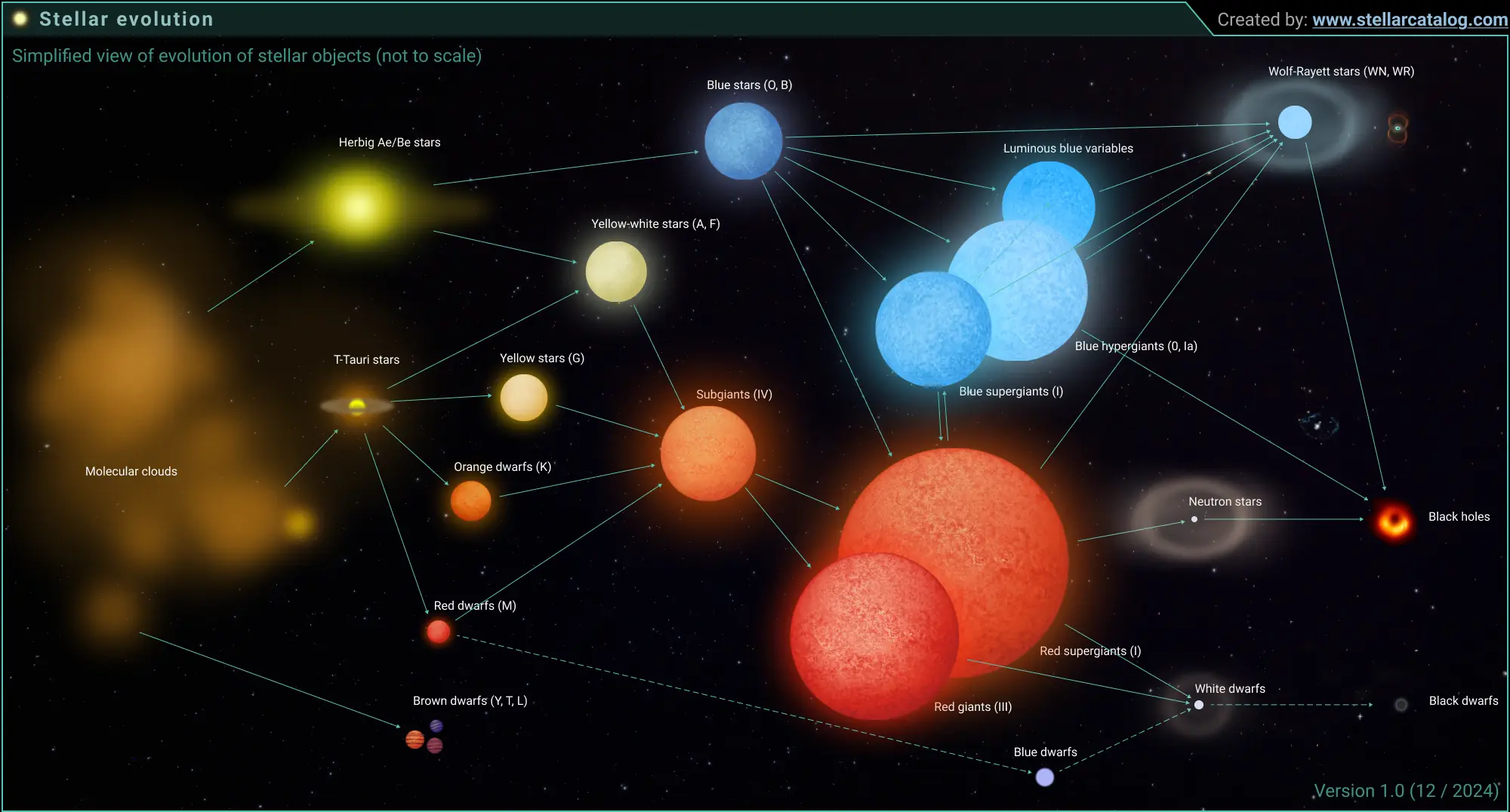
Sternentwicklung
Stars are born and die in various ways depending on their mass, composition, and other factors. The most common life cycle for stars like our Sun involves several key stages.

 sterne
 exoplaneten
 nachricht


 StellarGuide: Sterne


