do not follow here
Stellar Catalog more icon
Nearby stars catalogue
more icon
Filter stellar categories
Recommended categories

List of nearest stars

        Our Milky Way galaxy contains billions of stars, ranging from massive, bright stars to small, faint stellar remnants. Some stars exist on their own, while many are part of binary or multiple star systems. This page presents a list of the nearest stars to the Solar System, helping to map our local stellar neighborhood and understand the diversity of stars closest to us.

The list can be filtered by stellar category, allowing you to explore specific types of stars such as red dwarfs, Sun-like stars, white dwarfs, or brown dwarfs. This flexible view makes it easier to compare different stellar populations and focus on objects of interest. While the main emphasis is on nearby stars, the catalog also extends beyond the immediate neighborhood, offering a broader perspective on stellar types within our galaxy.
    
Advertisement
<< <
Stars 9921-9940
>
Star name Mass Distance

HD 80606
BD+51°1500, CCDM J09226+5036, WDS J09226+5036, STF 1341, HIP 45982, SAO 27230
G5 - 215 ly

HIP 97166
BD+73 878, HIC 97166, 2MASS J19445865+7403457, TIC 237222864, TYC 4457-836-1, Gaia DR1 2288220998917242368
K0V 0.9 M☉ 216 ly

K2-72
EPIC 206209135, 2MASS J22182923-0936444
M2.7 V 0.27 M☉ 217 ly

TIC 402710280
TIC 402710280; Gaia DR3 5828441289812582400
0.88 M☉ 218 ly

TOI 672
TIC 151825527, 2MASS J11115769-3919400
M0V 0.54 M☉ 218 ly

Kepler 138
KOI-314, 2MASS J19213157+4317347, KIC 7603200, WISE J192131.55+431734.9
M1V C 0.52 M☉ 219 ly

TOI 512
CD-38 2650, GSC 07613-01495, 2MASS J06263519-3836241, TYC 7613-1495-1
K0 E 0.74 M☉ 219 ly

HIP 9618
HD 12572, TOI-1471, TIC 306263608
1 M☉ 219 ly

K2 233
TYC 6179-186-1, 2MASS J15215519-2013539, K2-233
K3 0.79 M☉ 221 ly

HD 163607
G5IV 1.1 M☉ 221 ly

TOI 871
0.76 M☉ 221 ly

HIP 29442
TOI-469
K0V 0.88 M☉ 222 ly

Kepler 409
KOI-1925, KIC 9955598, 2MASS J19344300+4651099, WISE J193443.00+465109.9
0.92 M☉ 222 ly

TOI 128
HD 36481
F9/G0V 0.85 M☉ 223 ly

27 Hydra
27 Hya, ADS 7311, HD 80586, HIP 45811, HR 3709, 2MASS J09202901-0933207, TIC 60954380, TYC 5463-1514-1
K0III C 2.3 M☉ 223 ly

TOI-1064
TIC 79748331, Gaia DR3 6683371847364921088
0.75 M☉ 224 ly

TOI 4184
TIC 394357918, 2MASS J02551841-7924554
M5.5 0.24 M☉ 226 ly

HD 35843
TIC 7422496
G 0.94 M☉ 226 ly

HD 220242
2MASS J23215825+2636321, TIC 28393683
1.6 M☉ 226 ly

HD 69123
HIP 40344, IRAS 08123-3520, TYC 7129-4637-1, CD -35 4365, GSC 07129-04637, 2MASS J08141326-3529241, UBV 7929, CPC 18 3567, HD 69123, PPM 284973, UBV M 14130, CPD -35 2079, HIC 40344, SAO 198979, GC 11217, HR 3242
K1III C 1.7 M☉ 227 ly
<< <
Stars 9921-9940
>
Load all stars
in the catalogue

Frequently Asked Questions about nearby stars

What is the nearest star?

Nearest star is Proxima Centauri, located approximately 4.24 light-years (1.30 parsecs) from the Sun. It is part of the Alpha Centauri star system, which also includes Alpha Centauri A and Alpha Centauri B.

What are the nearest stars to Earth?

Nearest stars to Earth include the Alpha Centauri system (Alpha Centauri A, Alpha Centauri B, and Proxima Centauri), Barnard's Star, and Wolf 359. There are also brown dwarfs Luhman 16 and WISE 0855−0714.

What is the solar neighborhood?

Solar neighborhood (also Local Interstellar Cloud) is the region of interstellar space that surrounds the Sun with diameter about 15 light years. Stellar Catalog database includes all stars contained within this region.

How do astronomers measure distances to stars?

Astronomers use methods like parallax, standard candles, and redshift to measure distances to stars. Parallax is especially useful for nearby stars in our solar neighborhood, while other techniques help map the universe beyond.

Are there any exoplanets orbiting the nearest stars?

Yes, several exoplanets have been discovered orbiting the nearest stars. For example, Proxima Centauri has an exoplanet called Proxima Centauri b, which is located in the star's habitable zone and is the closest known exoplanet to Earth.

Why are the nearest stars important for astronomy and physics?

The nearest stars provide valuable laboratories for studying stellar evolution, space environments, and the fundamental physics of stars. Observing these stars helps astronomers understand the structure of our galaxy and the broader universe.
Advertisement

exoplanet iconStellarGuide: Stars

line
Stars
Stars are enormous spheres of hot gas that shine by generating energy through nuclear fusion in their cores. Most stars are made primarily of hydrogen and helium. In the center of a star, intense pressure and temperature cause hydrogen atoms to fuse into helium, releasing a tremendous amount of energy as light and heat.
More about Stars tag icon

Stellar Evolution

Stars are born and die in various ways depending on their mass, composition, and other factors. The most common life cycle for stars like our Sun involves several key stages.
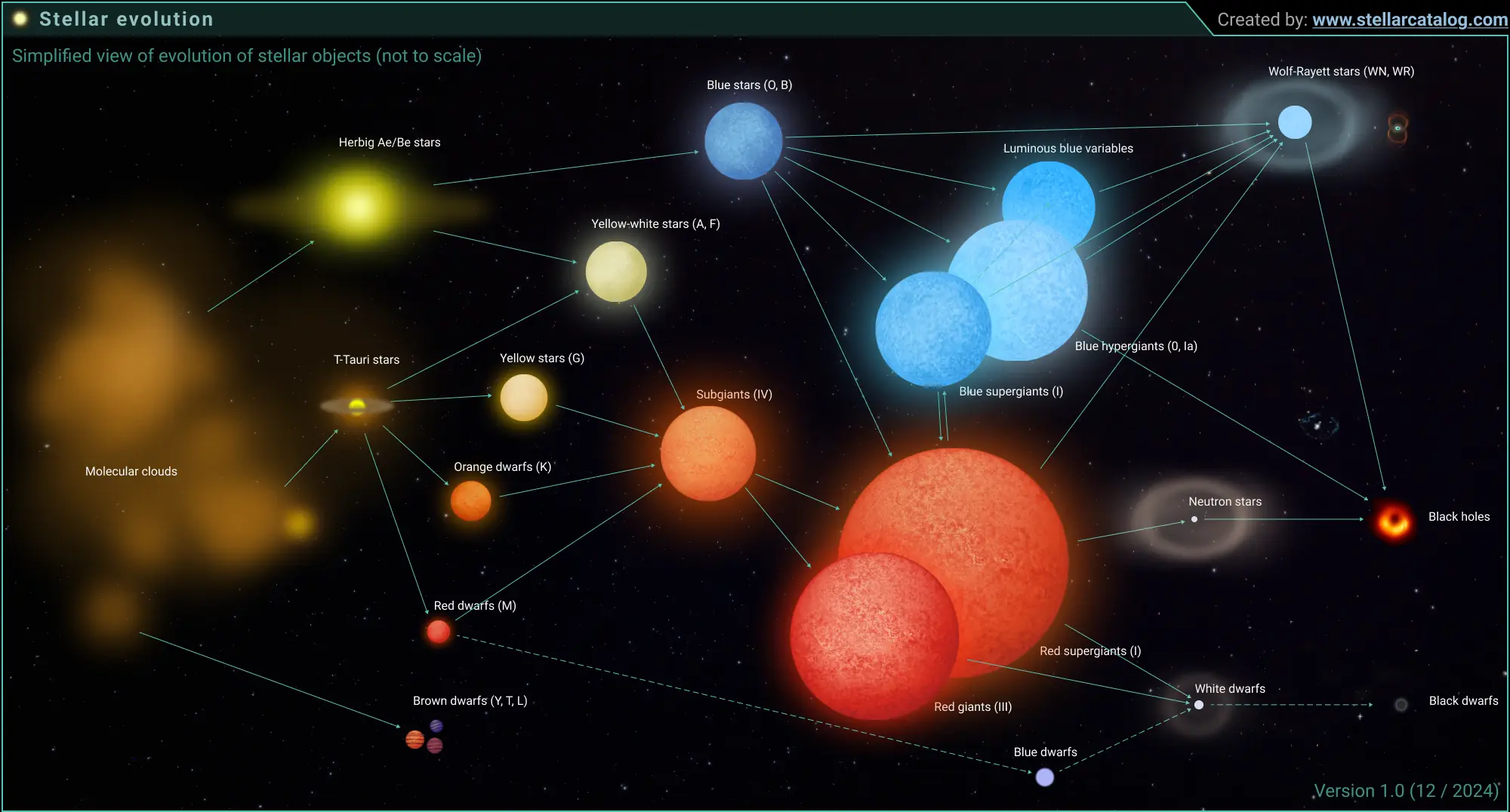
Stellar evolution visualisation

Advertisement
