do not follow here
Stellar Catalog more icon
Nearby stars catalogue
more icon
Filter stellar categories
Recommended categories

List of nearest stars

        Our Milky Way galaxy contains billions of stars, ranging from massive, bright stars to small, faint stellar remnants. Some stars exist on their own, while many are part of binary or multiple star systems. This page presents a list of the nearest stars to the Solar System, helping to map our local stellar neighborhood and understand the diversity of stars closest to us.

The list can be filtered by stellar category, allowing you to explore specific types of stars such as red dwarfs, Sun-like stars, white dwarfs, or brown dwarfs. This flexible view makes it easier to compare different stellar populations and focus on objects of interest. While the main emphasis is on nearby stars, the catalog also extends beyond the immediate neighborhood, offering a broader perspective on stellar types within our galaxy.
    
Advertisement
<< <
Stars 9781-9800
>
Star name Mass Distance

HIP 113103
TIC 121490076, TYC 8011-00766-1, 2MASS J22541736-4300372, Gaia DR2 6541360574788758016
0.76 M☉ 151 ly

Ross 176
TIC 193336820, TOI 4491, Ross 176, LTT 15964, Karmn J20227+473, TYC 3576–00804–1, 2MASS J20224515+4718276
K7 V 0.58 M☉ 152 ly

HD 143105
F5 1.5 M☉ 152 ly

HD 37605
BD+05°985, HIP 26664, SAO 113015, LTT 11695
K0V 0.98 M☉ 152 ly

HD 24040
BD+17°638, HIC 17960, HIP 17960, LTT 11274, NLTT 11955, SAO 93630, G 7-6, GC 4623, 2MASS J03502296+1728349, TIC 456863621, TYC 1252-844-1, WISEA J035023.05+172832.3
G1 D 1.4 M☉ 152 ly

LSPM J0738+5254
LP 123-22
M3V 0.26 M☉ 153 ly

HD 42936
DMPP-3, CD−72°312, CPD−72°451, GC 7845, HD 42936, HIP 28941, SAO 256269
K0V 0.9 M☉ 153 ly

2MASS J0103-5515
2MASS J01033563-5515561, SCR J0103-5515, DLR 1AB, WISEA J010335.77-551556.6, TIC 206502540, DENIS J010335.6-551556, Delorme 1
M5.0 D 0.19 M☉ 154 ly

TOI 1846
TOI-1846, 2MASS J17114930+5431369, TIC 198385543
0.42 M☉ 154 ly

PZ Telescopii
PZ Tel, CD−50°12190, HD 174429, HIP 92680, SAO 245781, PPM 347231, WDS J18531-5011AB
G9IV 1.1 M☉ 154 ly

Gamma Draconis
Etamin, Etanin, Ettanin, Rastaban, Rasaben, Zenith star, 33 Draconis, BD +51°2282, FK5 676, HD 164058, HIP 87833, HIC 87833, HR 6705, SAO 30653
K5 III 1.7 M☉ 154 ly

HD 3167
EPIC 220383386, HIP 2736, 2MASS J00345752+0422531, BD+03 68, K2-96, SAO 109291, TYC 0013-00894-1, WISE J003457.60+042251.4
0.85 M☉ 154 ly

TOI 2015
2MASS J15283191+2721388, UCAC4 587-051672, TIC 368287008, WISE J152831.87+272139.6
M4 0.34 M☉ 154 ly

TWA 30
M5 0.12 M☉ 155 ly

HD 283869
EPIC 248045685
0.74 M☉ 155 ly

TOI 500
HIP 34269, GJ 9224, Gliese 9224, TIC 134200185, CD -47 2804, TYC 8122-00785-1, 2MASS J07061396-4735137, Gaia DR2 5509620021956148736
0.74 M☉ 155 ly

GU Piscium
V* GU Psc, UCAC4 536-002202, NAU 1A, 2MASS J01123504+1703557, TIC 408263079, WISEA J011235.12+170354.4, WISE J011235.12+170354.6, 1SWASP J011235.03+170355.7, 1RXS J011235.6+170401
M3 D 0.35 M☉ 155 ly

HD 213885
G 1.1 M☉ 156 ly

TOI 206
0.35 M☉ 156 ly

HD 136925
G0 - 157 ly
<< <
Stars 9781-9800
>
Load all stars
in the catalogue

Frequently Asked Questions about nearby stars

What is the nearest star?

Nearest star is Proxima Centauri, located approximately 4.24 light-years (1.30 parsecs) from the Sun. It is part of the Alpha Centauri star system, which also includes Alpha Centauri A and Alpha Centauri B.

What are the nearest stars to Earth?

Nearest stars to Earth include the Alpha Centauri system (Alpha Centauri A, Alpha Centauri B, and Proxima Centauri), Barnard's Star, and Wolf 359. There are also brown dwarfs Luhman 16 and WISE 0855−0714.

What is the solar neighborhood?

Solar neighborhood (also Local Interstellar Cloud) is the region of interstellar space that surrounds the Sun with diameter about 15 light years. Stellar Catalog database includes all stars contained within this region.

How do astronomers measure distances to stars?

Astronomers use methods like parallax, standard candles, and redshift to measure distances to stars. Parallax is especially useful for nearby stars in our solar neighborhood, while other techniques help map the universe beyond.

Are there any exoplanets orbiting the nearest stars?

Yes, several exoplanets have been discovered orbiting the nearest stars. For example, Proxima Centauri has an exoplanet called Proxima Centauri b, which is located in the star's habitable zone and is the closest known exoplanet to Earth.

Why are the nearest stars important for astronomy and physics?

The nearest stars provide valuable laboratories for studying stellar evolution, space environments, and the fundamental physics of stars. Observing these stars helps astronomers understand the structure of our galaxy and the broader universe.
Advertisement

exoplanet iconStellarGuide: Stars

line
Stars
Stars are enormous spheres of hot gas that shine by generating energy through nuclear fusion in their cores. Most stars are made primarily of hydrogen and helium. In the center of a star, intense pressure and temperature cause hydrogen atoms to fuse into helium, releasing a tremendous amount of energy as light and heat.
More about Stars tag icon

Stellar Evolution

Stars are born and die in various ways depending on their mass, composition, and other factors. The most common life cycle for stars like our Sun involves several key stages.
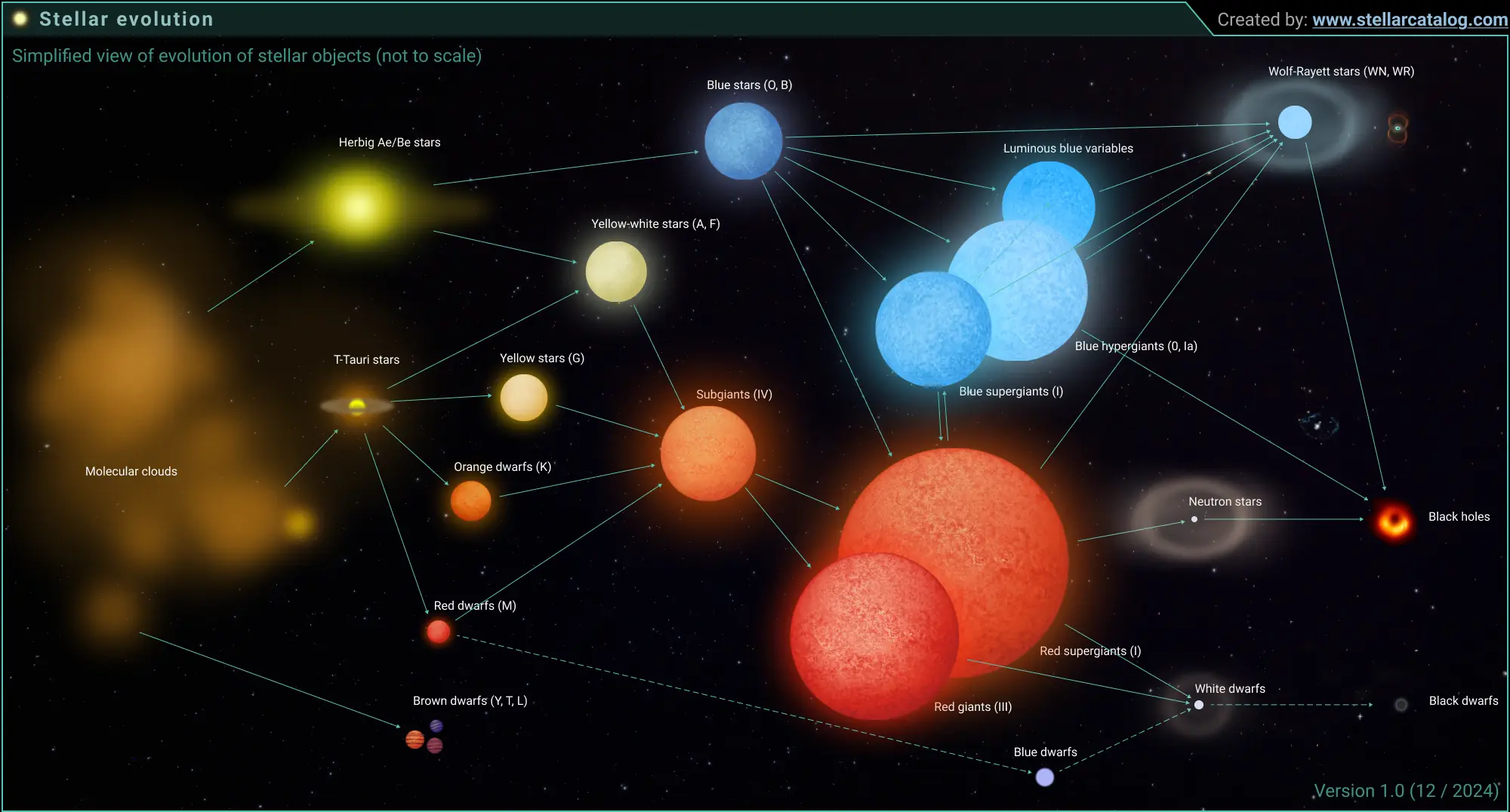
Stellar evolution visualisation

Advertisement
