do not follow here
Stellar Catalog more icon
Nearby stars catalogue
more icon
Filter stellar categories
Recommended categories

List of nearest stars

        Our Milky Way galaxy contains billions of stars, ranging from massive, bright stars to small, faint stellar remnants. Some stars exist on their own, while many are part of binary or multiple star systems. This page presents a list of the nearest stars to the Solar System, helping to map our local stellar neighborhood and understand the diversity of stars closest to us.

The list can be filtered by stellar category, allowing you to explore specific types of stars such as red dwarfs, Sun-like stars, white dwarfs, or brown dwarfs. This flexible view makes it easier to compare different stellar populations and focus on objects of interest. While the main emphasis is on nearby stars, the catalog also extends beyond the immediate neighborhood, offering a broader perspective on stellar types within our galaxy.
    
Advertisement
<< <
Stars 3621-3640
>
Star name Mass Distance

CD-32 11389
K8Vk - 71.8 ly

UCAC4 137-007637
- 71.8 ly

L 702-43
M4 - 71.8 ly

Iota Virginis
Syrma, 99 Vir, iot Vir, BD−05°3843, FK5 525, GJ 9473, Gliese 9473, HD 124850, HIP 69701, HR 5338, SAO 139824
F7III 1.5 M☉ 71.8 ly

LTT 3780
G 162-44, LP 729-54, LTT 3780, NLTT 23974, TOI-732, 2MASS J10183516-1142599, WISEA J101834.88-114302.8, TIC 36724087, LDS 3977A
M4V 0.36 M☉ 71.8 ly

Gaia EDR3 4060791183517338112
- 71.9 ly

Gaia EDR3 4040113527359801088
- 71.9 ly

G 50-21
M4V - 71.9 ly

L 30-61
- 71.9 ly

Gaia EDR3 4054865881000327808
- 71.9 ly

HD 4308
BD−27°223, GC 897, GJ 31.5, Gliese 31.5, GJ 9028, Gliese 9028, HD 4308, HIC 3497, HIP 3497, SAO 248244, PPM 352003, LFT 71, LHS 1139, LPM 40, LTT 416, TYC 8847-598-1, GCRV 50662, 2MASS J00443925-6538581, TIC 234501204, WISEA J004439.51-653905.9
G6VFe-0.9 C 0.95 M☉ 71.9 ly

2MASS J06020172-1001565
- 71.9 ly

MCC 29
K4V - 71.9 ly

LSPM J0805+0417
- 71.9 ly

Epsilon Serpentis
ε Ser, 37 Serpentis, BD+04°3069, HD 141795, HIP 77622, HR 5892, SAO 121218
kA2hA5mA7V 1.8 M☉ 72 ly

Y Velorum
GJ 9332, Gliese 9332, HD 91324, HIP 51523, TIC 447823435, TYC 8601-4516-1, WISEA J103121.36-534253.4, HR 4134, SAO 238146
F9VFe-0.8CH-0.7 1.2 M☉ 72 ly

2MASS J1744-5834
2MASS J17442494-5834151
- 72 ly

HD 26913
G8V - 72 ly

G 94-16
M4.5Ve - 72 ly

HD 26923
G0IV - 72 ly
<< <
Stars 3621-3640
>
Load all stars
in the catalogue

Frequently Asked Questions about nearby stars

What is the nearest star?

Nearest star is Proxima Centauri, located approximately 4.24 light-years (1.30 parsecs) from the Sun. It is part of the Alpha Centauri star system, which also includes Alpha Centauri A and Alpha Centauri B.

What are the nearest stars to Earth?

Nearest stars to Earth include the Alpha Centauri system (Alpha Centauri A, Alpha Centauri B, and Proxima Centauri), Barnard's Star, and Wolf 359. There are also brown dwarfs Luhman 16 and WISE 0855−0714.

What is the solar neighborhood?

Solar neighborhood (also Local Interstellar Cloud) is the region of interstellar space that surrounds the Sun with diameter about 15 light years. Stellar Catalog database includes all stars contained within this region.

How do astronomers measure distances to stars?

Astronomers use methods like parallax, standard candles, and redshift to measure distances to stars. Parallax is especially useful for nearby stars in our solar neighborhood, while other techniques help map the universe beyond.

Are there any exoplanets orbiting the nearest stars?

Yes, several exoplanets have been discovered orbiting the nearest stars. For example, Proxima Centauri has an exoplanet called Proxima Centauri b, which is located in the star's habitable zone and is the closest known exoplanet to Earth.

Why are the nearest stars important for astronomy and physics?

The nearest stars provide valuable laboratories for studying stellar evolution, space environments, and the fundamental physics of stars. Observing these stars helps astronomers understand the structure of our galaxy and the broader universe.
Advertisement

exoplanet iconStellarGuide: Stars

line
Stars
Stars are enormous spheres of hot gas that shine by generating energy through nuclear fusion in their cores. Most stars are made primarily of hydrogen and helium. In the center of a star, intense pressure and temperature cause hydrogen atoms to fuse into helium, releasing a tremendous amount of energy as light and heat.
More about Stars tag icon

Stellar Evolution

Stars are born and die in various ways depending on their mass, composition, and other factors. The most common life cycle for stars like our Sun involves several key stages.
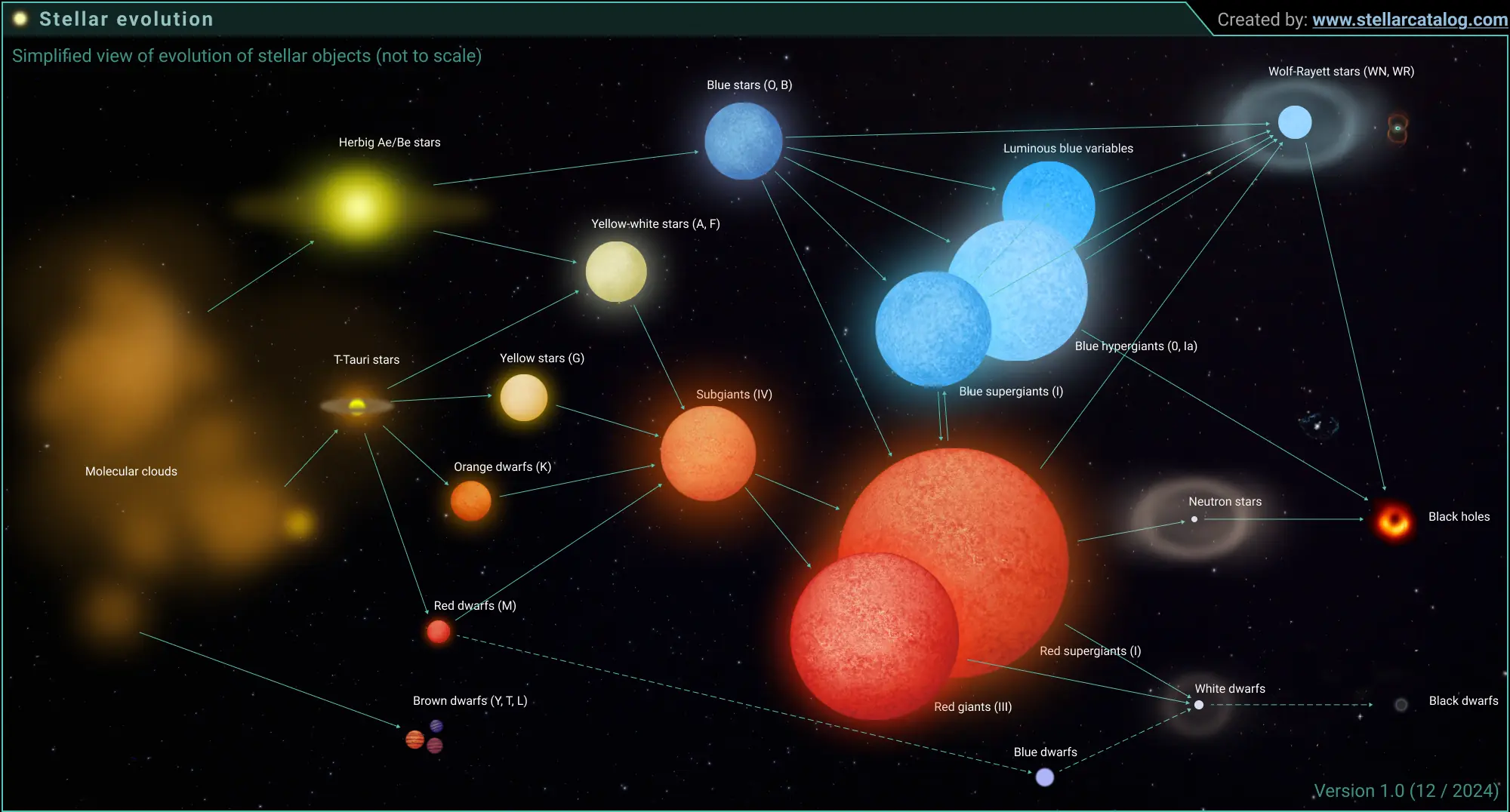
Stellar evolution visualisation

Advertisement