
 stars
stars exoplanets
 news
news


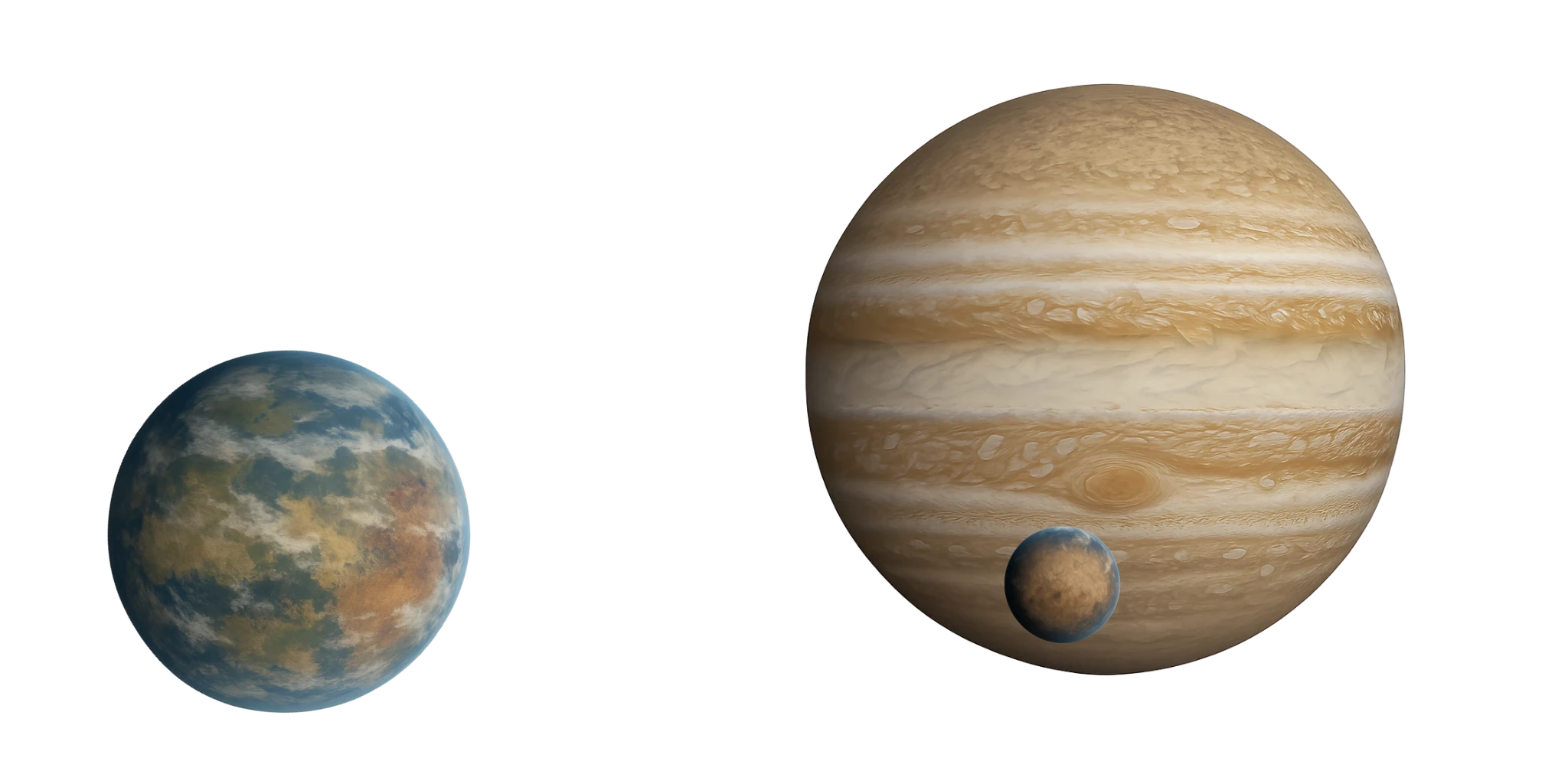
Exoplanets
Exoplanets are planets that orbit stars outside our solar system. Since the first confirmed discovery in 1992, astronomers have identified almost 6,000 exoplanets, with many more awaiting confirmation.More about Exoplanets

Closest exoplanets, the worlds discovered beyond the Solar System sorted by the distance of their host stars from the Sun.

These close systems are especially important because their planets are easier to observe, measure, and study in detail. Nearby exoplanets are prime targets for current and future observations aimed at understanding planetary atmospheres, compositions, and potential habitability.

As detection methods improve, the census of planets around the closest stars continues to grow, revealing a wide diversity of worlds—from rocky planets to gas giants. Exploring the nearest exoplanets is a key step toward understanding how planetary systems form and how our own Solar System compares to others in the Milky Way.
| Exoplanet | Discovery |
Mass |
Distance (Light Years) |
|
|---|---|---|---|---|
| WASP 143 b | 2018 | 230.5 M⊕ | 1304.5 ly | |
| Kepler 451 e | 06 / 2026 | 1192.2 M⊕ | 1304.6 ly | |
| TOI 3688 A b | 10 / 2022 | 311.5 M⊕ | 1307.8 ly | |
| TOI 2525 c | 2022 | 208.9 M⊕ | 1309 ly | |
| TOI 2525 b | 2022 | 26.7 M⊕ | 1309 ly | |
| WASP 17 b | 2009 | 154.5 M⊕ | 1314.6 ly | |
| TOI 375 b | 09 / 2025 | 236.6 M⊕ | 1316.2 ly | |
| TOI 375 d | 09 / 2025 | 445.6 M⊕ | 1316.2 ly | |
| TOI 375 c | 09 / 2025 | 669.2 M⊕ | 1316.2 ly | |
| TOI 1338 A b | 2020 | 21.8 M⊕ | 1317.7 ly | |
| TOI 1338 A c | 01 / 2023 | 65.2 M⊕ | 1317.7 ly | |
| Kepler 1870 b | 2017 | - | 1317.9 ly | |
| Kepler 104 b | 2014 | 10 M⊕ | 1318.8 ly | |
| Kepler 104 d | 2014 | 5.5 M⊕ | 1318.8 ly | |
| Kepler 104 c | 2014 | 7.1 M⊕ | 1318.8 ly | |
| TOI 1295 b | 2024 | 451.4 M⊕ | 1322.8 ly | |
| HAT-P-63 b | 2020 | 195.2 M⊕ | 1325 ly | |
| TOI 558 b | 1080.9 M⊕ | 1325.5 ly | ||
| WASP 167 b | 2017 | 108.1 M⊕ | 1345.7 ly | |
| WASP 12 b | 2008 | 467.3 M⊕ | 1347 ly | |
 StellarGuide: Exoplanets
Exoplanets are planets that orbit stars outside our solar system. Since the first confirmed discovery in 1992, astronomers have identified almost 6,000 exoplanets, with many more awaiting confirmation.More about Exoplanets