do not follow here
Stellar Catalog more icon
Catalogue étoile
more icon
Filter stellar categories
Recommended categories

Liste des etoile

        Notre galaxie, la Voie lactée, abrite des milliards d'étoiles, des plus massives et brillantes aux plus faibles vestiges stellaires. Certaines étoiles sont isolées, tandis que beaucoup font partie de systèmes binaires ou multiples. Cette page présente une liste des étoiles les plus proches du Système solaire, permettant de cartographier notre voisinage stellaire et de comprendre la diversité des étoiles qui nous sont les plus proches.

La liste peut être filtrée par catégorie stellaire, ce qui vous permet d'explorer des types d'étoiles spécifiques comme les naines rouges, les étoiles semblables au Soleil, les naines blanches ou les naines brunes. Cette vue flexible facilite la comparaison de différentes populations stellaires et la concentration sur les objets d'intérêt. Bien que l'accent soit mis principalement sur les étoiles proches, le catalogue s'étend également au-delà de notre voisinage immédiat, offrant une perspective plus large sur les types d'étoiles au sein de notre galaxie.
    
Advertisement
<< <
Etoile 1901-1920
>
Nom de l étoile Mass Distance

Gaia EDR3 4271449399422291712
- 58 ly

Wolf 1466
M1 - 58 ly

39 Serpentis
39 Ser
G1VFe-1 - 58 ly

HIP 38594
HIC 38594, LTT 2976, NLTT 18618, CD-24 6144, 2MASS J07541090-2518116, Ross 429, SAO 174768, TIC 128902569, TYC 6557-844-1, WISEA J075410.65-251809.3, WDS J07542-2518A
M0 D 0.61 M☉ 58 ly

Tau6 Eridani
τ6 Eri, 27 Eridani, CD−23°1565, FK5 140, GC 168827, HD 23754, HIP 17651, HR 1173, SAO 101600
F5IV-V 1.4 M☉ 58 ly

2MASSI J0354-1437
2MASSI J0354200-143738, Gaia EDR3 5110641302736199424
- 58 ly

G 139-3
GJ 3981, Gliese 3981, TIC 353287103, WISEA J165824.95+135810.7, NLTT 43925, 2MASS J16582531+1358106
M4.0V - 58 ly

G 210-20
- 58 ly

iota Pavonis
ι Pav, HD 165499, HR 6761
G0V - 58 ly

G 125-23
M4 - 58 ly

2MASS J1615+0546
2MASS J16154245+0546400
M9 - 58.1 ly

UPM J0900+7522
- 58.1 ly

G 31-39
M4V - 58.1 ly

BD+05 127
M0.0Ve - 58.1 ly

DO 34294
M0 - 58.1 ly

G 268-131
Gaia EDR3 5041034524411980288
M4 - 58.1 ly

SCR J0753-2524
DA10 - 58.1 ly

Ross 226
M3V - 58.1 ly

G 9-11
M3.0Ve - 58.1 ly

Rho Geminorum
ρ Gem A, 62 Gem, BD+32° 1562, HD 58946, HIP 36366, Gliese 274A, GJ 274 A, HR 2852
F1V 1.4 M☉ 58.1 ly
<< <
Etoile 1901-1920
>
Charger toutes les étoiles
dans le catalogue

Frequently Asked Questions about nearby stars

What is the nearest star?

Nearest star is Proxima Centauri, located approximately 4.24 light-years (1.30 parsecs) from the Sun. It is part of the Alpha Centauri star system, which also includes Alpha Centauri A and Alpha Centauri B.

What are the nearest stars to Earth?

Nearest stars to Earth include the Alpha Centauri system (Alpha Centauri A, Alpha Centauri B, and Proxima Centauri), Barnard's Star, and Wolf 359. There are also brown dwarfs Luhman 16 and WISE 0855−0714.

What is the solar neighborhood?

Solar neighborhood (also Local Interstellar Cloud) is the region of interstellar space that surrounds the Sun with diameter about 15 light years. Stellar Catalog database includes all stars contained within this region.

How do astronomers measure distances to stars?

Astronomers use methods like parallax, standard candles, and redshift to measure distances to stars. Parallax is especially useful for nearby stars in our solar neighborhood, while other techniques help map the universe beyond.

Are there any exoplanets orbiting the nearest stars?

Yes, several exoplanets have been discovered orbiting the nearest stars. For example, Proxima Centauri has an exoplanet called Proxima Centauri b, which is located in the star's habitable zone and is the closest known exoplanet to Earth.

Why are the nearest stars important for astronomy and physics?

The nearest stars provide valuable laboratories for studying stellar evolution, space environments, and the fundamental physics of stars. Observing these stars helps astronomers understand the structure of our galaxy and the broader universe.
Advertisement

exoplanet iconStellarGuide: Étoiles

line
Étoiles
Les étoiles sont d’immenses sphères de gaz chaud qui brillent en produisant de l’énergie grâce à la fusion nucléaire dans leur noyau. La plupart des étoiles sont composées principalement d’hydrogène et d’hélium. Au centre d’une étoile, la pression et la température élevées provoquent la fusion des atomes d’hydrogène en hélium, libérant ainsi une énorme quantité d’énergie sous forme de lumière et de chaleur.
More about Étoiles tag icon

Stellar categories

A comparison of spectral classes and typical stellar properties across the catalog categories.
Category Classe spectrale Typical mass (% of solar mass) Typical size (% of solar radius) Typical temperature (K)
, , 10-200% 50-300% 2000-10000 K
L, T, Y 1.2-8.0% 9-11% 600-2500 K
M 7.5-50% 10-60% 2400-3900 K
K 50-80% 60-90% 3900-5200 K
G 80-120% 80-120% 5200-6000 K
A, F, B, O 200-3000% 200-5000% 7000-40000 K
K|G|F|A|B 80-150% 120-300% 4500-6000 K
A|B|O, G|F|A, M|G|F|A, K|M|S 50-300% 500-20000% 3000-5000 K
K|M|C, G|F, B|O 500-10000% 10000-100000% 3000-35000 K
A|B, G|F, K|M 2000-20000% 50000-200000% 3000-40000 K
WC|WN|WO 1000-10000% 50-500% 30000-200000 K
DA|DC|DQ|DZ 20-140% 0.7-1.5% 5000-150000 K
100-300% 0.001-0.002% 600000-1000000 K
, , 300-10000000% 0.000001-1% 0-10000000 K

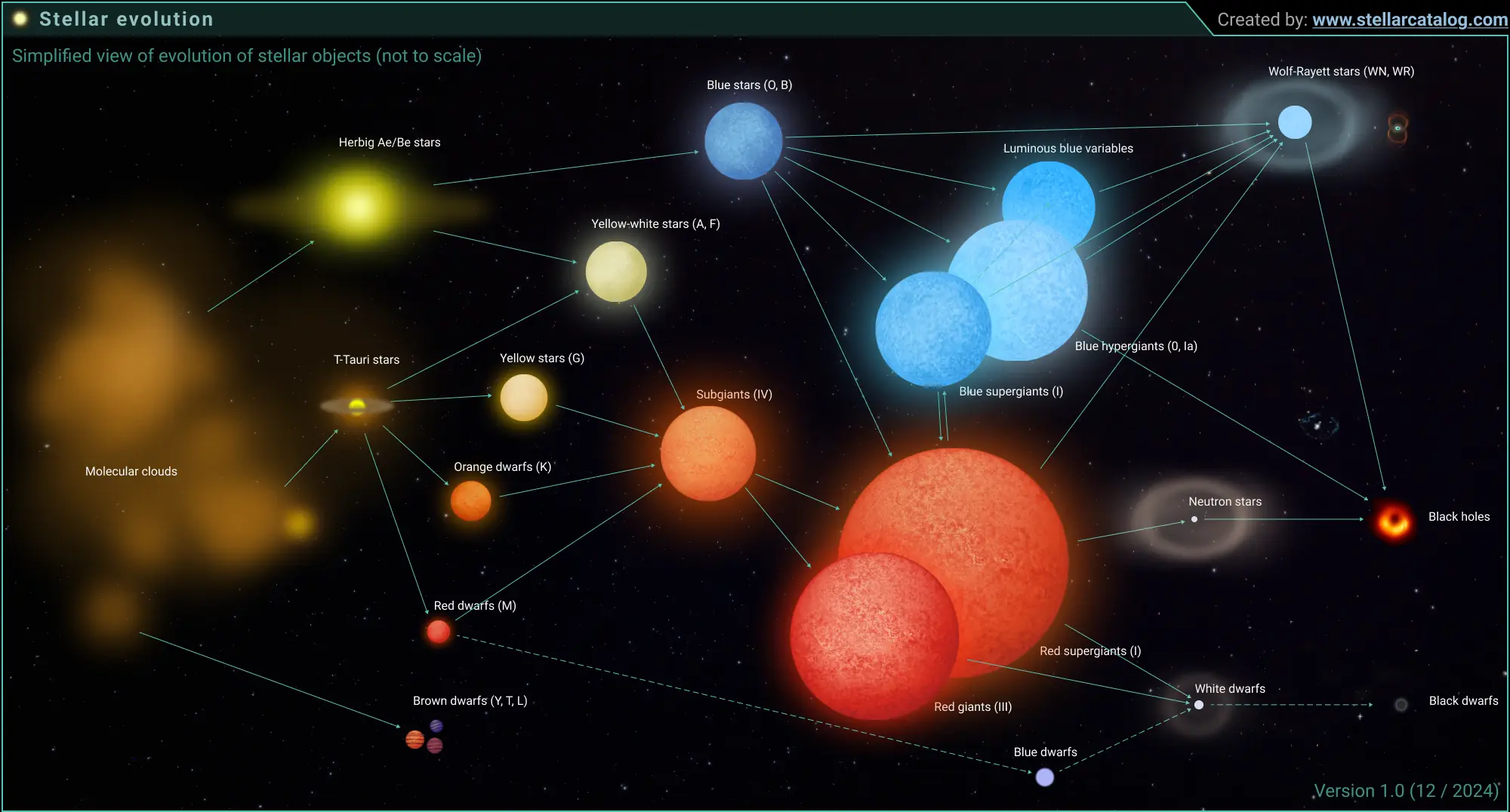
Évolution stellaire

Stars are born and die in various ways depending on their mass, composition, and other factors. The most common life cycle for stars like our Sun involves several key stages.
Stellar evolution visualisation

Advertisement