do not follow here
Stellar Catalog more icon
Catálogo de estrellas
more icon
Filter stellar categories
Recommended categories

Lista de estrellas

        Nuestra galaxia, la Vía Láctea, contiene miles de millones de estrellas, desde estrellas masivas y brillantes hasta pequeños y tenues remanentes estelares. Algunas estrellas existen de forma independiente, mientras que muchas forman parte de sistemas binarios o múltiples. Esta página presenta una lista de las estrellas más cercanas al Sistema Solar, lo que ayuda a mapear nuestro vecindario estelar local y a comprender la diversidad de estrellas más cercanas a nosotros.

La lista se puede filtrar por categoría estelar, lo que permite explorar tipos específicos de estrellas, como enanas rojas, estrellas similares al Sol, enanas blancas o enanas marrones. Esta vista flexible facilita la comparación de diferentes poblaciones estelares y permite centrarse en objetos de interés. Si bien el enfoque principal se centra en las estrellas cercanas, el catálogo también se extiende más allá del vecindario inmediato, ofreciendo una perspectiva más amplia sobre los tipos de estrellas dentro de nuestra galaxia.
    
Advertisement
<< <
Estrellas 7821-7840
>
Nombre de la estrella Mass Distance

Gaia DR3 4059922775527398912
- 92.3 ly

Gaia DR3 6033663004863198208
- 92.3 ly

SCR J1947-7646
- 92.3 ly

2MASS J20160601-1159150
- 92.3 ly

Theta Pegasi
tet Peg, Biham, θ Peg, 26 Peg, FK5 834, HD 210418, HIP 109427, HR 8450, SAO 127340
A1Va 2.1 M☉ 92.3 ly

LP 316-604
GJ 3616, Gliese 3616
- 92.3 ly

LEHPM 880
- 92.3 ly

Wolf 1409
GJ 9617, Gliese 9617, TIC 298599660, G 227-24, WISEA J180750.93+524753.8, 2MASS J18075138+5247545
K5D - 92.3 ly

3 Cygni
3 Cyg, HD 182807, LHS 3464, 2MASS J19252577+2454468, TIC 110541820
F8 - 92.3 ly

Gaia DR3 3098800766422701312
- 92.3 ly

Wolf 397
K5 - 92.3 ly

LP 626-29
DC - 92.3 ly

BD+07 3922
M0.5Ve - 92.3 ly

Gaia DR3 4110625414219462656
- 92.3 ly

UCAC4 271-087328
- 92.3 ly

PG 1157+004
DA - 92.3 ly

LP 683-33
- 92.3 ly

UCAC4 696-110459
- 92.3 ly

2MASSI J0952219-192431
M7Ve - 92.3 ly

SIPS J0938-2748
M7.5 - 92.3 ly
<< <
Estrellas 7821-7840
>
Cargar todas las estrellas
en el catálogo

Frequently Asked Questions about nearby stars

What is the nearest star?

Nearest star is Proxima Centauri, located approximately 4.24 light-years (1.30 parsecs) from the Sun. It is part of the Alpha Centauri star system, which also includes Alpha Centauri A and Alpha Centauri B.

What are the nearest stars to Earth?

Nearest stars to Earth include the Alpha Centauri system (Alpha Centauri A, Alpha Centauri B, and Proxima Centauri), Barnard's Star, and Wolf 359. There are also brown dwarfs Luhman 16 and WISE 0855−0714.

What is the solar neighborhood?

Solar neighborhood (also Local Interstellar Cloud) is the region of interstellar space that surrounds the Sun with diameter about 15 light years. Stellar Catalog database includes all stars contained within this region.

How do astronomers measure distances to stars?

Astronomers use methods like parallax, standard candles, and redshift to measure distances to stars. Parallax is especially useful for nearby stars in our solar neighborhood, while other techniques help map the universe beyond.

Are there any exoplanets orbiting the nearest stars?

Yes, several exoplanets have been discovered orbiting the nearest stars. For example, Proxima Centauri has an exoplanet called Proxima Centauri b, which is located in the star's habitable zone and is the closest known exoplanet to Earth.

Why are the nearest stars important for astronomy and physics?

The nearest stars provide valuable laboratories for studying stellar evolution, space environments, and the fundamental physics of stars. Observing these stars helps astronomers understand the structure of our galaxy and the broader universe.
Advertisement

exoplanet iconStellarGuide: Estrellas

line
Estrellas
Las estrellas son enormes esferas de gas caliente que brillan al generar energía mediante fusión nuclear en sus núcleos. La mayoría de las estrellas están compuestas principalmente de hidrógeno y helio. En el centro de una estrella, la alta presión y temperatura hacen que los átomos de hidrógeno se fusionen en helio, liberando una enorme cantidad de energía en forma de luz y calor.
More about Estrellas tag icon

Stellar categories

A comparison of spectral classes and typical stellar properties across the catalog categories.
Category Clase espectral Typical mass (% of solar mass) Typical size (% of solar radius) Typical temperature (K)
, , 10-200% 50-300% 2000-10000 K
L, T, Y 1.2-8.0% 9-11% 600-2500 K
M 7.5-50% 10-60% 2400-3900 K
K 50-80% 60-90% 3900-5200 K
G 80-120% 80-120% 5200-6000 K
A, F, B, O 200-3000% 200-5000% 7000-40000 K
K|G|F|A|B 80-150% 120-300% 4500-6000 K
A|B|O, G|F|A, M|G|F|A, K|M|S 50-300% 500-20000% 3000-5000 K
K|M|C, G|F, B|O 500-10000% 10000-100000% 3000-35000 K
A|B, G|F, K|M 2000-20000% 50000-200000% 3000-40000 K
WC|WN|WO 1000-10000% 50-500% 30000-200000 K
DA|DC|DQ|DZ 20-140% 0.7-1.5% 5000-150000 K
100-300% 0.001-0.002% 600000-1000000 K
, , 300-10000000% 0.000001-1% 0-10000000 K

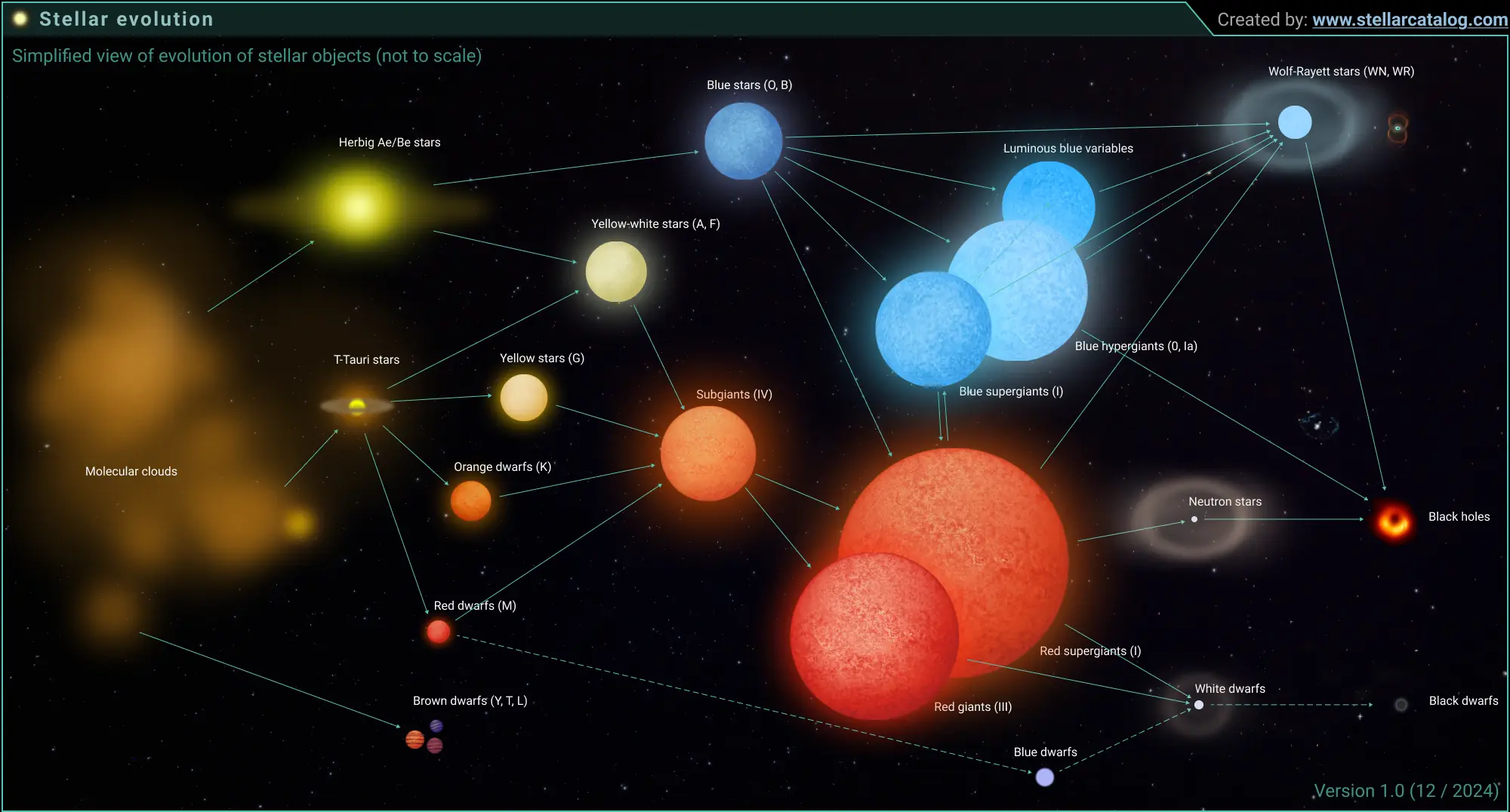
Evolución estelar

Stars are born and die in various ways depending on their mass, composition, and other factors. The most common life cycle for stars like our Sun involves several key stages.
Stellar evolution visualisation

Advertisement