do not follow here
Stellar Catalog more icon
Звездный каталог
more icon
Filter stellar categories
Recommended categories

Список Звезды

        Наша галактика Млечный Путь содержит миллиарды звёзд, от массивных, ярких звёзд до небольших, тусклых звёздных остатков. Некоторые звёзды существуют сами по себе, в то время как многие являются частью двойных или многозвёздных систем. На этой странице представлен список ближайших к Солнечной системе звёзд, помогающий составить карту нашего местного звёздного окружения и понять разнообразие звёзд, находящихся ближе всего к нам.

Список можно отфильтровать по категориям звёзд, что позволяет изучать конкретные типы звёзд, такие как красные карлики, солнечноподобные звёзды, белые карлики или коричневые карлики. Такой гибкий подход упрощает сравнение различных звёздных популяций и позволяет сосредоточиться на интересующих объектах. Хотя основное внимание уделяется близлежащим звёздам, каталог также выходит за пределы нашего непосредственного окружения, предлагая более широкий взгляд на типы звёзд в нашей галактике.
    
Advertisement
<< <
Звезды 2201-2220
>
Имя звезды Mass Distance

HD 49601
K6V - 60.8 ly

PM J00081+4757
M3.5 - 60.8 ly

WT 682
2MASS J20082378-5521256, WISEA J200824.02-552127.6, Gaia DR2 6472836050915560448, TIC 366989133
M6 - 60.8 ly

LP 903-20
M4 - 60.8 ly

LP 423-14
M7.0V - 60.9 ly

LP 869-19
M3.5 - 60.9 ly

GD 1212
DA4.5 - 60.9 ly

G 118-51
M3.0V - 60.9 ly

PM J17394-2327
- 60.9 ly

UCAC3 169-135909
- 60.9 ly

HD 16909
K3.5Vk - 60.9 ly

HD 20280
K5.5Vk: - 60.9 ly

LP 322-936
M5: - 60.9 ly

LP 709-18
M4 - 60.9 ly

G 13-51
M4.26 - 60.9 ly

SCR J0111-4908
- 61 ly

L 66-86
M2 - 61 ly

2MASS J18311816-0732250
- 61 ly

LP 715-51
M2.5V - 61 ly

2MASSW J1004392-333518
L5 - 61 ly
<< <
Звезды 2201-2220
>
Загрузить все звезды
в каталоге

Frequently Asked Questions about nearby stars

What is the nearest star?

Nearest star is Proxima Centauri, located approximately 4.24 light-years (1.30 parsecs) from the Sun. It is part of the Alpha Centauri star system, which also includes Alpha Centauri A and Alpha Centauri B.

What are the nearest stars to Earth?

Nearest stars to Earth include the Alpha Centauri system (Alpha Centauri A, Alpha Centauri B, and Proxima Centauri), Barnard's Star, and Wolf 359. There are also brown dwarfs Luhman 16 and WISE 0855−0714.

What is the solar neighborhood?

Solar neighborhood (also Local Interstellar Cloud) is the region of interstellar space that surrounds the Sun with diameter about 15 light years. Stellar Catalog database includes all stars contained within this region.

How do astronomers measure distances to stars?

Astronomers use methods like parallax, standard candles, and redshift to measure distances to stars. Parallax is especially useful for nearby stars in our solar neighborhood, while other techniques help map the universe beyond.

Are there any exoplanets orbiting the nearest stars?

Yes, several exoplanets have been discovered orbiting the nearest stars. For example, Proxima Centauri has an exoplanet called Proxima Centauri b, which is located in the star's habitable zone and is the closest known exoplanet to Earth.

Why are the nearest stars important for astronomy and physics?

The nearest stars provide valuable laboratories for studying stellar evolution, space environments, and the fundamental physics of stars. Observing these stars helps astronomers understand the structure of our galaxy and the broader universe.
Advertisement

exoplanet iconStellarGuide: Звезды

line
Звезды
Звёзды — это огромные шары раскалённого газа, которые светятся благодаря выработке энергии в процессе ядерного синтеза в их ядрах. Большинство звёзд состоит в основном из водорода и гелия. В центре звезды из-за высокого давления и температуры атомы водорода сливаются в гелий, высвобождая огромное количество энергии в виде света и тепла.
More about Звезды tag icon

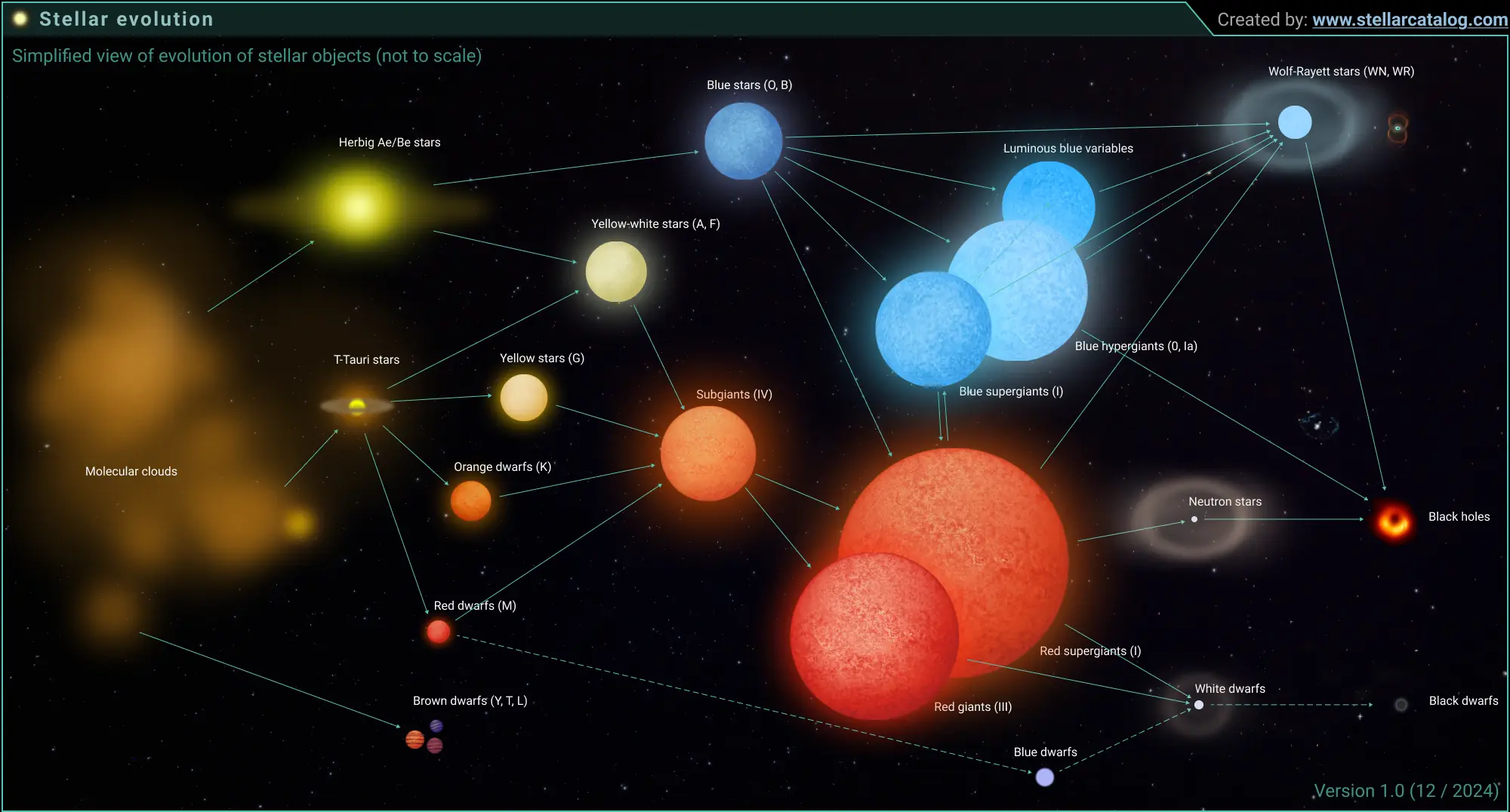
Звездная эволюция

Stars are born and die in various ways depending on their mass, composition, and other factors. The most common life cycle for stars like our Sun involves several key stages.
Stellar evolution visualisation

Advertisement