
 stars
 exoplanets
 news


Browse the latest scientific studies on stars and exoplanets in our galaxy. Stellar Catalog provides access to scientific data from astrophysics and stellar or planetary astronomy. It's a resource for anyone interested in the newest discoveries about what lies beyond our solar system.
WASP-4 c has a 29-year orbit, while WASP-4 b shows no significant decay
 13. 11. 2026
WASP-4 c, a distant giant companion to the hot Jupiter WASP-4 b, has a minimum mass of 9.3 Jupiter masses and an orbital period of about 29 years. Combining measurements of stellar motion, planet transits and the star’s position on the sky also finds no significant orbital decay for WASP-4 b. Simulated Gaia data could sharpen estimates of WASP-4 c’s orbit.
Star system: WASP-4 | Distance from the Sun: 891 light years
WASP-4 c is a distant giant companion with a minimum mass of 9.3 times Jupiter’s and an orbital period of about 10,600 days, or 29 years. The combined measurements also show no significant orbital decay for the hot Jupiter WASP-4 b. Changes in transit times can look like orbital decay, but the travel time of light from a moving star can also shift when the planet’s transits appear to occur. The analysis combines newly collected radial-velocity measurements from the HARPS instrument with earlier records of WASP-4 b’s transit times. Radial velocity tracks small movements of a star toward or away from us, which can reveal the pull of an orbiting companion. Transit-timing variations are changes in the schedule of a planet crossing in front of its star. The light-travel-time effect describes apparent timing shifts caused by the changing distance light travels as the star moves in its orbit. The same model also incorporates astrometry, which measures a star’s position and motion across the sky. Simulations of future measurements from the European Space Agency’s Gaia mission indicate that combining all three types of data can improve estimates of WASP-4 c’s properties. In the simulated Gaia Data Release 5 results, the uncertainty falls by about 10 percent for the orbital period, 25 percent for the time of inferior conjunction, and 33 percent for the radial-velocity semi-amplitude. Inferior conjunction is the point in an orbit when the companion passes between its star and Earth. The semi-amplitude measures the size of the star’s back-and-forth motion caused by the companion.Key findings
- WASP-4 c has a minimum mass of 9.3 ± 1.7 Jupiter masses.
- Its orbital period is 10,600 days, with an uncertainty of +1,100 and -1,000 days.
- No significant orbital decay is found for WASP-4 b.
- Simulated Gaia Data Release 5 measurements reduce uncertainties for three WASP-4 c parameters by about 10, 25 and 33 percent.
Generated by LLM, corrected by human
Related themes
Stars mentioned
Advertisement
Related articles
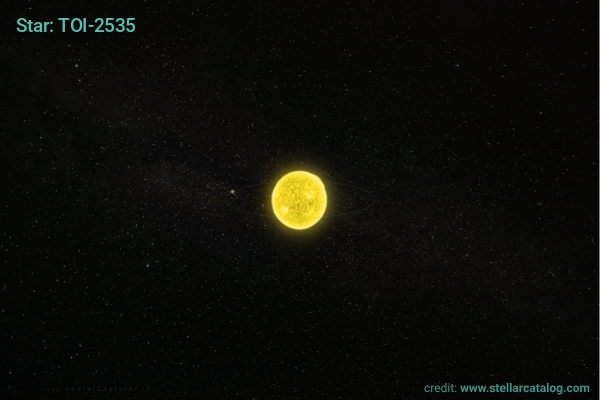
Transits of hot Jupiter TOI-2535 b observed to disappear over time
11. 11. 2026
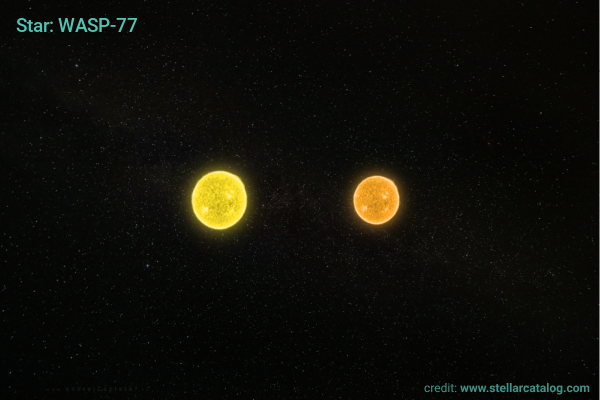
 Atmospheric composition of WASP-77 b revealed by new high-speed computational model
6. 11. 2026
 How the Solar System and other planetary systems evolve
13. 11. 2026
11. 11. 2026The hot Jupiter planet TOI-2535 b has provided a rare look at orbital evolution in action. Observations from the TESS satellite show that the planet's path across its star has shifted over seven years, eventually causing its transits to sto...
Read article
6. 11. 2026A new high-performance software tool called BeAR allows researchers to analyze exoplanet atmospheres at unprecedented speeds by utilizing graphics processing units. By applying this system to the hot Jupiter WASP-77 b, the team confirmed sp...
Read article
13. 11. 2026This book explores how planetary systems form and change, with most of its discussion focused on the Solar System. It covers the formation of planets and the Earth-Moon system, shifting orbits, asteroid and icy-body belts, and the movement...
Read article
 Research for the same star

Advertisement
Research with similar tags
Browse the latest scientific studies on stars and exoplanets in our galaxy. Stellar Catalog provides access to scientific data from astrophysics and stellar or planetary astronomy. It's a resource for anyone interested in the newest discoveries about what lies beyond our solar system.
Latest discoveries
More research
Advertisement