do not follow here
News
Article

TOI-1699A hosts a volatile-rich sub-Neptune and a massive outer planet

publication date16. 11. 2026
TOI-1699A is a star in a wide binary system, with two planets orbiting the brighter star. The inner planet, TOI-1699A b, is a sub-Neptune with a substantial envelope of volatile materials. The outer planet, TOI-1699A c, has at least 5.54 times Jupiter’s mass. The observations also rule out certain additional planets in the system.
Star system: TOI-1699 | Distance from the Sun: 675 light years
TOI-1699A hosts a volatile-rich sub-Neptune and a massive outer planet
Star system: TOI-1699 | Distance from the Sun: 675 light years
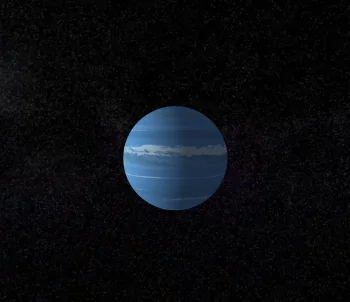
TOI-1699A has two known planets orbiting its primary star, which shares a wide binary system with a smaller companion star. The inner planet, TOI-1699A b, is a sub-Neptune: a planet larger than Earth but smaller than Neptune. Its measured density indicates that it needs a substantial envelope of volatile materials, such as gases or ices, to account for its properties.

Researchers measured the system using space- and ground-based observations. TESS first detected TOI-1699A b, and follow-up observations with CHEOPS and ground-based telescopes confirmed it. HARPS-N measurements of the star’s motion also revealed the outer planet, TOI-1699A c. This method detects a planet through the small gravitational tug it exerts on its star.

TOI-1699A b completes an orbit in about 4.55 days and measures about 3.10 times Earth’s radius. Its mass is about 13.9 times Earth’s, and its density is about 2.58 grams per cubic centimetre. TOI-1699A c orbits every 108.75 days and has a minimum mass of 5.54 times Jupiter’s. Its orbit is slightly elongated. If the planets’ orbits lie in the same plane, TOI-1699A c is not expected to pass in front of its star as seen from Earth. The system’s stability also rules against the outer companion being a star and places its mass below about 18 times Jupiter’s.

The analysis rules out additional planets with periods between 54 and 235 days, as well as planets heavier than 27 Earth masses at shorter periods. Future measurements of the star’s position and motion could help determine TOI-1699A c’s true mass and orbital tilt.

Key findings

  • TOI-1699A b orbits its star every 4.55 days and has about 3.10 Earth radii and 13.9 Earth masses.
  • The inner planet’s density is about 2.58 grams per cubic centimetre, indicating a substantial volatile envelope.
  • TOI-1699A c has a 108.75-day orbit and a minimum mass of 5.54 Jupiter masses; its true mass is limited to about 18 Jupiter masses.
  • No additional planets were found in the tested ranges: 54 to 235-day periods, or shorter periods for planets above 27 Earth masses.
Generated by LLM, corrected by human

Share this discovery

Stars mentioned

G5V, Yellow star
TOI-1699A, also known as TIC 22705558 and TYC 3415-428-1, is a G5 V star about 674.7 light-years from the Sun. It has 0.989 times the Sun’s mass, 1.036 times its radius, a temperature of 5,649 kelvin, and an estimated age of 5.4 billion years. The primary star belongs to a wide binary with an M3 V companion at a projected separation of about 348 astronomical units.
mass: 0.99 M☉
radius: 1 R☉
distance: 675 ly
stars in the system: 1
exoplanets: 2
Advertisement
Advertisement

study iconResearch with similar tags

line
Advertisement
Get your next news from nearby stars
Stellar Catalog brings the stars from our galaxy to you. Discover their position, physical properties and whether there are any exoplanets or disks orbiting them. The data in Stellar Catalog come from respectable sources like Gaia space telescope, or SIMBAD database.

Advertisement