
 stars
 exoplanets
 news


Browse the latest scientific studies on stars and exoplanets in our galaxy. Stellar Catalog provides access to scientific data from astrophysics and stellar or planetary astronomy. It's a resource for anyone interested in the newest discoveries about what lies beyond our solar system.
Stellar activity of Gliese 9404 complicates the status of its suspected planet
 23. 11. 2026
Recent analysis of the star Gliese 9404 suggests that a previously reported planet orbiting the star may actually be a false signal caused by stellar activity. By modeling the natural behavior of the star, researchers found insufficient evidence to confirm the presence of the planet, which was originally estimated to have an orbital period of about 13.5 days. Further observations are required to settle the mystery.
Star system: Gliese 9404 | Distance from the Sun: 77.8 light years
Gliese 9404 is a nearby red dwarf star located approximately 77.6 light-years away. Previous attempts to identify planets around this star suggested the existence of a world completing an orbit every 13.5 days. This claim relied on measuring the radial velocity of the star - a technique that detects the tiny wobbles in a star's position caused by the gravitational tug of an orbiting body. However, such measurements are often difficult because the star itself is not perfectly still. To re-evaluate the data, a new approach combined the analysis of radial velocity measurements with indicators of stellar activity, such as the star's rotation and changes in its spectral lines. These indicators help distinguish between the steady, repeating tug of a planet and the natural, chaotic behavior of the star's surface. By using advanced statistical modeling to account for these stellar cycles, the analysis determined that the signal previously attributed to a planet is likely an artifact of the star's own activity. The current findings indicate that there is not enough evidence to confirm the presence of any planet in the 2 to 100-day orbital period range. The data quality remains insufficient to separate true planetary signals from the complex noise produced by the star. Future observations using additional high-resolution spectroscopy will be necessary to characterize the star's behavior more accurately and verify if any planetary signal truly exists.Key findings
- The reported planet candidate around Gliese 9404 lacks sufficient evidence to be confirmed.
- Radial velocity signals initially attributed to a planet are likely caused by the intrinsic stellar activity of the red dwarf.
- Statistical modeling shows that the current data is inadequate to distinguish between planetary influence and stellar surface variations.
- Additional spectroscopic observations are required to determine the physical nature of the detected signals.
Generated by LLM, corrected by human
Related themes
Stars mentioned
M0.5Ve, Red dwarf
Gliese 9404, also known as BD+29 2279, is a red dwarf star situated approximately 77.8 light-years from the Sun. It possesses a mass of 0.62 solar masses and is categorized as a red dwarf, a common type of small, cool star found throughout the galaxy.
mass: 0.62 M☉
radius: 0.3 R☉
distance: 77.8 ly
stars in the system: 1
exoplanets: 1
Advertisement
Related articles
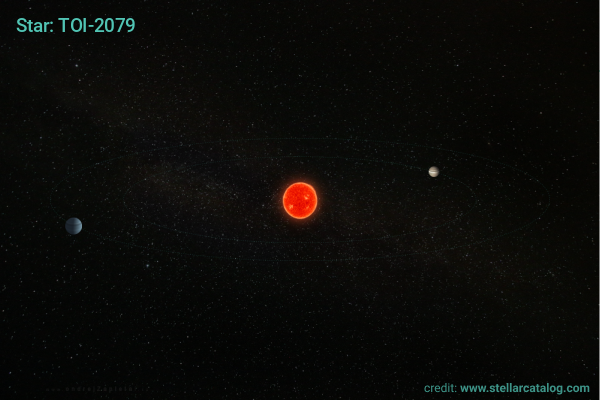
Two super-Earth-sized planets orbit the adolescent red dwarf TOI-2079
23. 11. 2026
 Atmospheric features detected on the cold sub-Neptune exoplanet TOI-6478 b
20. 11. 2026
 WISPIT 2 gas gaps align with known giant protoplanets
24. 11. 2026

23. 11. 2026TOI-2079, a red dwarf about 1.5 billion years old, hosts two validated planets on close orbits. TOI-2079 b completes an orbit in about 1.49 days, while TOI-2079 c takes about 9.32 days. Both planets are larger than Earth, and their measured...
Read article
20. 11. 2026Researchers have detected clear spectral features in the atmosphere of the cold sub-Neptune exoplanet TOI-6478 b. With an equilibrium temperature of 220 Kelvin, this planet challenges the common difficulty of observing atmospheres on sub-Ne...
Read article
24. 11. 2026The young star WISPIT 2 is surrounded by a disk of gas and dust with gaps that line up with previously detected giant protoplanets. ALMA observations also show changes in the gas’s motion at those locations. Together, these features connect...
Read article
 Research for the same star

Advertisement
Research with similar tags
Browse the latest scientific studies on stars and exoplanets in our galaxy. Stellar Catalog provides access to scientific data from astrophysics and stellar or planetary astronomy. It's a resource for anyone interested in the newest discoveries about what lies beyond our solar system.
Latest discoveries
More research
Advertisement