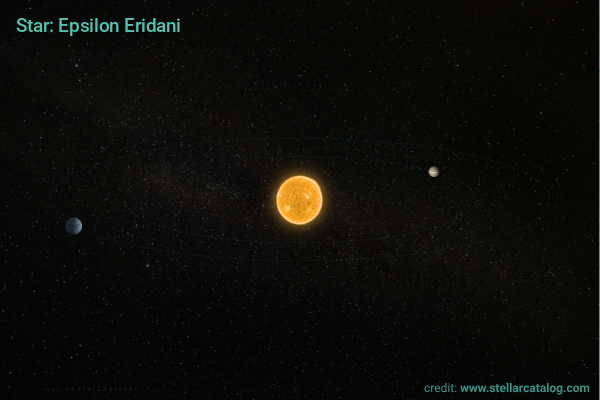
Epsilon Eridani, a nearby orange dwarf star located about 10.5 light-years away, hosts the closest known debris disk - a ring of dust and icy rocks orbiting the star. This system also features a large planet, Epsilon Eridani b, which is similar to Jupiter. New measurements of the outer debris belt suggest it is remarkably circular and dynamically cold, meaning the particles within it have very orderly, stable orbits.

To determine the shape of this disk, researchers re-examined data from the Atacama Large Millimeter/submillimeter Array (ALMA), a powerful radio telescope observatory. They looked for eccentricity, a measure of how much an orbit deviates from a perfect circle, to see if the gravity of unseen planets might be pulling the belt into an oval shape.

The study found a very small amount of forced eccentricity, which is a shape change driven by the gravitational influence of a planet. These findings provide the most precise limits on the disk shape measured in millimeters to date. By combining this information with data from infrared space telescopes, the researchers also narrowed down the potential masses and locations of other planets that might exist further out in the system.

Key findings
- The outer debris disk of Epsilon Eridani is nearly circular and dynamically cold.
- A tentative forced eccentricity of 1.62 percent was identified at a high level of statistical confidence.
- The study established the lowest upper limits on disk eccentricity for any debris disk measured by millimeter waves so far.
- New constraints suggest any additional planets beyond Epsilon Eridani b have masses between 0.0002 and 0.3 times the mass of Jupiter at distances of 6 to 60 astronomical units.
Stars mentioned
K2 V, Orange star
mass: 0.82 M☉
radius: 0.7 R☉
distance: 10.5 ly
exoplanets: 2

 stars
stars exoplanets
 news
news


 3. 10. 2026


