The planetary system orbiting the star HD 65216 contains at least two giant planets moving on elongated, eccentric orbits. By combining radial velocity data, which measures the subtle wobbling motion of a star caused by the gravitational tug of orbiting planets, with astrometric measurements, which track the star's precise movement across the sky, researchers have updated the physical characteristics and orbital paths of these massive worlds.
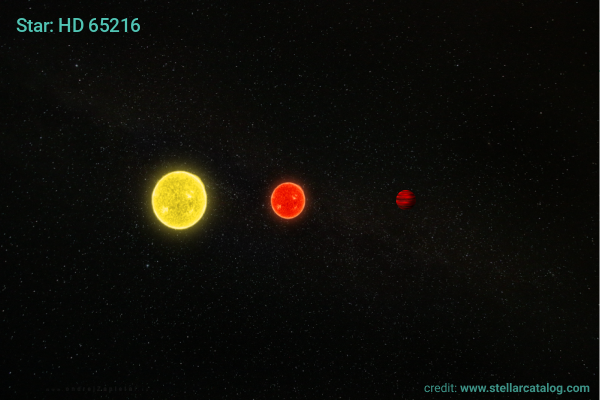
Analysis of the radial velocity data allowed for a better understanding of the orbits of the two planets. By comparing historical data from the Hipparcos and Gaia space missions, the movement of the star was used to constrain the tilt, or inclination, of the orbit of the outer planet, HD 65216 c.

The study determined that HD 65216 c has an eccentric orbit with a period of approximately 7007 days. Assuming the two planets lie in the same orbital plane, their true masses are calculated at 2.23 times the mass of Jupiter for HD 65216 b and 3.32 times the mass of Jupiter for HD 65216 c. Future data from the Gaia mission will further refine these measurements.

Key findings
- HD 65216 c moves on an eccentric orbit with a period of approximately 7007 days.
- HD 65216 b has a calculated mass of 2.23 Jupiter masses.
- HD 65216 c has a calculated mass of 3.32 Jupiter masses.
- Joint analysis of radial velocity and proper motion helps define the true mass of giant planets.
Generated by LLM, corrected by human
Stars mentioned
G5V, Yellow star
mass: 0.95 M☉
radius: 1 R☉
distance: 115 ly
exoplanets: 2

 stars
stars exoplanets
 news
news


 5. 10. 2026


