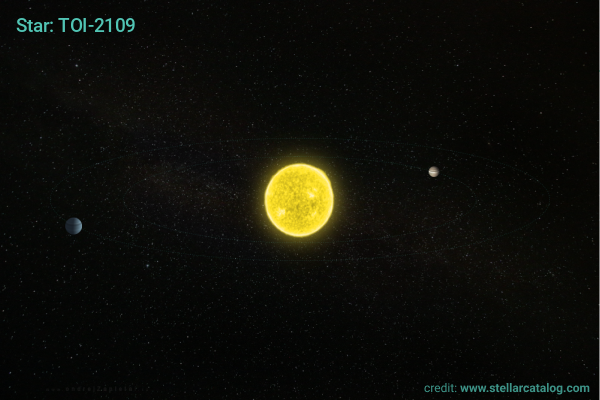
TOI-2109 b is an extreme gas giant known as an ultra-hot Jupiter, orbiting its host star in less than 17 hours. It possesses a mass over five times that of Jupiter and is currently recognized as having the fastest predicted orbital decay of any known giant planet. Recent data from the James Webb Space Telescope and the Hubble Space Telescope have provided evidence of complex gravitational influences affecting the planet's path as it orbits its star.

Transit timing variations are subtle changes in the predicted times when a planet passes in front of its star. By analyzing these shifts, evidence was found for a nearby planetary companion, which creates a rhythmic, wave-like signal in the timing data. This suggests the planet did not undergo a violent migration, but rather followed a more stable path.

Furthermore, a long-term trend in the timing data indicates that the orbit of TOI-2109 b is slowly decaying, causing the planet to move closer to its host star over time. This decay is measured at approximately 3.46 milliseconds per year. While this effect could be influenced by other gravitational factors, it positions the planet as one of the few known examples of an exoplanet spiraling toward its host.

Key findings
- TOI-2109 b exhibits sinusoidal transit timing variations, confirming the presence of a nearby planetary companion.
- The planet displays a quadratic long-term trend in timing, consistent with orbital decay at a rate of 3.46 milliseconds per year.
- Data rules out several non-planetary explanations for the observed timing fluctuations.
- The system provides critical insights into the evolution of ultra-hot Jupiters and their orbital stability.
Stars mentioned

 stars
stars exoplanets
 news
news


 24. 9. 2026


