Rocky planets orbiting Red dwarf stars present a unique challenge for observers because the stars themselves often have active surfaces that can mimic the signals of an atmosphere. A new analysis method has been developed to separate these stellar signals from potential atmospheric data. By applying this technique to four observations of the planet TRAPPIST-1 c, researchers have determined that the planet does not show evidence of a significant, thick atmosphere, appearing instead as a featureless and airless world.

To ensure the accuracy of these results, the researchers calibrated their model using 17 archival observations of TRAPPIST-1 b, an inner sibling planet known to be airless. This control group allowed them to quantify how much of the measured signal is merely stellar noise, often referred to as a stellar floor, rather than light passing through a planetary atmosphere.

The findings for TRAPPIST-1 c specifically rule out models for clear, pure carbon dioxide atmospheres or those dominated by nitrogen with smaller amounts of carbon dioxide. While water vapour signals were harder to isolate due to the persistent noise from the star, the data overall support a bare, rocky surface for this exoplanet. The study also highlights that while observing more transits helps to detect carbon dioxide, water vapour detections remain limited by the inherent variability of the host star.

Key findings
- TRAPPIST-1 c is consistent with being an airless, rocky world with no significant atmosphere.
- The analysis ruled out clear carbon dioxide atmospheres and nitrogen-dominated atmospheres with 1 percent carbon dioxide.
- A new calibration framework successfully accounted for stellar contamination by using the airless planet TRAPPIST-1 b as a control.
- Water vapour detection is restricted by a persistent stellar noise floor, regardless of the number of observations.
- Detecting carbon dioxide on similar planets is possible with this method, though it requires significantly more transit observations than would be needed in a quieter system.
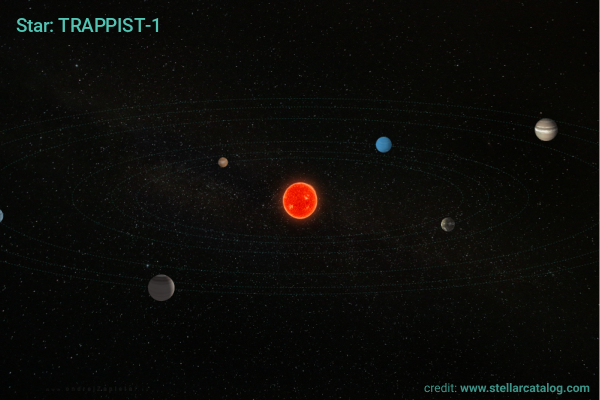
Stars mentioned
M7.5e, Red dwarf
mass: 0.09 M☉
radius: 0.3 R☉
distance: 40.7 ly
exoplanets: 7

 stars
stars exoplanets
 news
news


 3. 10. 2026


