
 stars
 exoplanets
 news


Browse the latest scientific studies on stars and exoplanets in our galaxy. Stellar Catalog provides access to scientific data from astrophysics and stellar or planetary astronomy. It's a resource for anyone interested in the newest discoveries about what lies beyond our solar system.
DQ Tau's hot molecular gas dims as emission shifts outward
 6. 11. 2026
The young binary DQ Tau produces bursts of material falling onto its stars about every 16 days. During three bursts, observations tracked carbon monoxide and water gas in the small cavity inside the surrounding disk. Their infrared emission weakened and the gas appeared to move outward over a month, unlike other signals that responded to the bursts. The pattern points to changing disk dynamics rather than rapid chemical changes.
Star system: DQ Tauri A | Distance from the Sun: 637 light years
In DQ Tau, the infrared signals from hot molecular gas grew fainter and narrower over about 30 to 35 days, even as the binary produced repeated bursts of material falling onto its stars. The changing signals indicate that the gas giving off the light became cooler and less massive, while its emitting region moved farther from the stars. This region lies in the disk’s inner cavity, roughly 0.2 to 0.4 astronomical units across. An astronomical unit is the average distance between Earth and the Sun. The binary’s orbit takes about 16 days, and its bursts are linked to that cycle. Seven instruments monitored the system for 40 days, including nine observations with JWST’s MIRI instrument and nine with the ground-based IRTF iSHELL instrument. They measured the brightness and width of infrared lines from water and carbon monoxide. The width of a line shows how quickly the gas is moving; the team used these speeds to estimate how far the gas orbits from the stars. The accretion luminosity pulses, which measure the energy released as material falls onto the stars, varied by factors of about 9 to 80. The molecular gas did not respond to each burst in the same way as atomic hydrogen or the infrared glow near five micrometers. Instead, its changing light appears to reflect movement and changing conditions in the disk more than fast chemical reactions. The pattern fits the idea that gas gathers near the disk’s edge and affects the strength of later bursts and the gas density in the cavity every four to five orbits. What causes this longer-term pattern remains unclear.Key findings
- Water and carbon monoxide emission lines became fainter and narrower over about 30 to 35 days.
- The line widths indicate that the emitting gas moved to larger orbital distances as its temperature and mass decreased.
- The gas changes differed from the responses of atomic hydrogen and the five-micrometer infrared glow.
- The observed variations are consistent with gas building up near the disk edge every four to five orbits, though the cause is unknown.
Generated by LLM, corrected by human
Stars mentioned
Advertisement
Related articles
Variability in the DQ Tau binary system shapes its surrounding planet-forming disk
9. 9. 2026

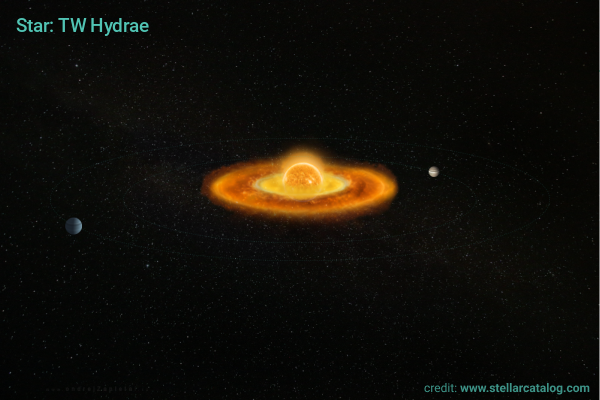
 High resolution imaging reveals structural details of the protoplanetary disk around TW Hydrae
1. 8. 2026
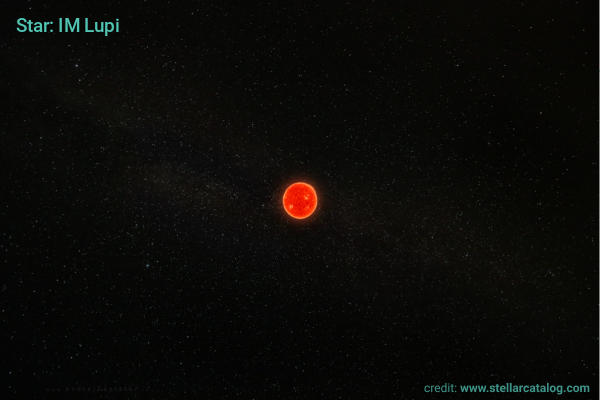
 Stationary nature of the spiral structure in the disk around IM Lupi
6. 11. 2026
9. 9. 2026The planet-forming disk surrounding the young binary star system DQ Tau is significantly influenced by the variable radiation and matter-gathering processes of its host stars. By analyzing light emissions from the disk, it is possible to un...
Read article
1. 8. 2026The protoplanetary disk surrounding the star TW Hydrae, the nearest such disk to Earth, has been observed in unprecedented detail. Protoplanetary disks are rotating, flattened clouds of gas and dust that surround young stars, serving as the...
Read article
6. 11. 2026A new analysis of the protoplanetary disk surrounding the star IM Lupi reveals that its prominent spiral arms do not show the expected rotation. By correcting the disk geometry in existing data, researchers found that previous reports of mo...
Read article
 Research for the same star

Advertisement
Research with similar tags
Browse the latest scientific studies on stars and exoplanets in our galaxy. Stellar Catalog provides access to scientific data from astrophysics and stellar or planetary astronomy. It's a resource for anyone interested in the newest discoveries about what lies beyond our solar system.
Latest discoveries
More research
Advertisement