
 stars
 exoplanets
 news


Browse the latest scientific studies on stars and exoplanets in our galaxy. Stellar Catalog provides access to scientific data from astrophysics and stellar or planetary astronomy. It's a resource for anyone interested in the newest discoveries about what lies beyond our solar system.
Chemical makeup of planet hosting red dwarfs reveals insights into their planetary systems
 6. 11. 2026
Analysis of 42 red dwarf stars reveals new details about their chemical compositions and the potential structures of the planets orbiting them. By measuring elements like magnesium, silicon, and iron, the study identifies specific stars belonging to the thick disk of the Milky Way and estimates that planets around these stars likely possess core-mass fractions ranging from 20 to 40 percent.
Star system: Gliese 1252 | Distance from the Sun: 66.5 light years
Red dwarfs are the most common stars in the Milky Way, yet their complex light patterns make them difficult to study. Their atmospheres are often dominated by dense molecular absorption, which masks the signatures of individual elements. To bypass this, researchers analyzed infrared light, which provides a clearer view of the stellar composition. By observing 40 planet-hosting red dwarfs and two additional stars in binary systems, the team successfully measured the levels of oxygen, magnesium, silicon, and iron within these stars. To determine these chemical abundances, the team compared the observed infrared light spectra against synthetic models of stellar atmospheres. They measured temperatures using water and hydroxyl molecules and calculated iron content using specific iron and iron-hydride markers. This data allows for a better understanding of how these stars formed and evolved. By combining this chemical information with measurements of how the stars move through the galaxy, the team identified Gliese 1252 and L181-1 as likely members of the Milky Way's thick disk, an older population of stars located in the galaxy's central plane. The findings also have implications for the planets orbiting these stars. By calculating the ratios of silicon, magnesium, and iron, researchers estimated the internal composition of the orbiting planets. These calculations suggest that the rocky cores of these exoplanets account for 20 to 40 percent of their total mass. This data provides a foundational step in linking the chemistry of host stars to the physical characteristics of the small planets they frequently host.Key findings
- Gliese 1252 and L181-1 were identified as members of the thick disk stellar population.
- Kepler 42 is likely a member of the thick disk based on its velocity and low iron content.
- Planets orbiting the surveyed red dwarfs are estimated to have core-mass fractions between 20 and 40 percent.
- Infrared spectroscopy provides a reliable way to measure chemical abundances in red dwarfs.
Generated by LLM, corrected by human
Related themes
Stars mentioned
M2.5V, Red dwarf
mass: 0.38 M☉
radius: 0.3 R☉
distance: 66.5 ly
stars in the system: 1
exoplanets: 1
Advertisement
Related articles
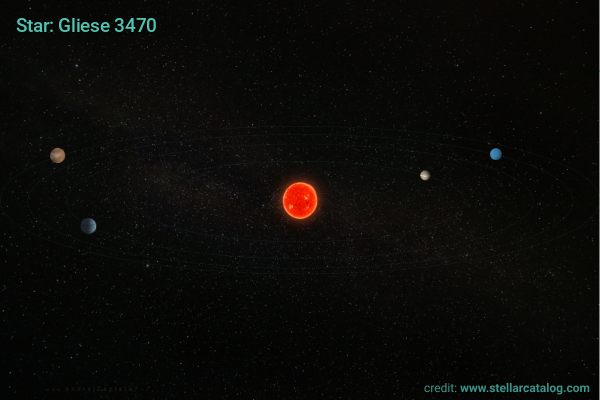
Gliese 3470's surface motions can rival signals from its Neptune-size planet
5. 11. 2026
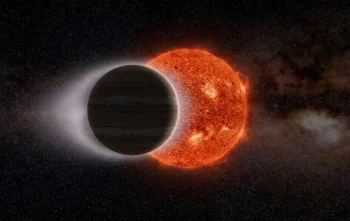
 Asymmetric helium outflow detected from the atmosphere of planet TOI-3884 b
23. 10. 2026
 Stationary nature of the spiral structure in the disk around IM Lupi
6. 11. 2026
5. 11. 2026The Red dwarf Gliese 3470’s changing surface can create spectral effects as strong as signals from its Neptune-size planet, Gliese 3470 b. Simulations and observations show that these stellar effects complicate transit measurements, while c...
Read article
23. 10. 2026Researchers have identified an evaporating atmosphere of helium escaping from the super-Neptune exoplanet TOI-3884 b. The planet, which orbits a Red dwarf star in a polar path, exhibits an unusual asymmetric outflow of gas that precedes the...
Read article
6. 11. 2026A new analysis of the protoplanetary disk surrounding the star IM Lupi reveals that its prominent spiral arms do not show the expected rotation. By correcting the disk geometry in existing data, researchers found that previous reports of mo...
Read article
 Research for the same star

Advertisement
Research with similar tags
Browse the latest scientific studies on stars and exoplanets in our galaxy. Stellar Catalog provides access to scientific data from astrophysics and stellar or planetary astronomy. It's a resource for anyone interested in the newest discoveries about what lies beyond our solar system.
Latest discoveries
More research
Advertisement