do not follow here
News
Article

Chemical abundances measured for six orange dwarf stars hosting exoplanets

publication date9. 11. 2026
Researchers have determined the chemical composition of six orange dwarf stars that host exoplanets targeted by the James Webb Space Telescope. By using near-infrared light analysis, the team successfully measured carbon and oxygen ratios in these stars, providing essential baseline data for understanding the formation and evolution of these planetary systems and their atmospheres.
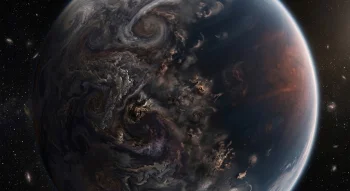
Star system: WASP-43 | Distance from the Sun: 284 light years
Chemical abundances measured for six orange dwarf stars hosting exoplanets
Star system: WASP-43 | Distance from the Sun: 284 light years
Orange dwarf stars are cooler than our Sun, with temperatures below 4700 Kelvin. Their light spectra are often cluttered with many molecules, making it difficult to measure their chemical composition using traditional optical methods. To overcome this, recent work utilized near-infrared light - which is invisible to the human eye but carries distinct signatures of elements - to examine six host stars: K2-141, NGTS-10, WASP-43, WASP-69, WASP-80, and HATS-72.

The investigation relied on near-infrared spectra captured by the IGRINS instrument. By applying specialized model atmospheres and spectral synthesis codes, the team derived specific ratios of carbon and oxygen for each star. These measurements are crucial for researchers studying the exoplanets orbiting these stars, as the star's own chemistry provides a necessary reference point to interpret the chemical makeup of the planets.

In addition to elemental ratios, the analysis explored isotopic ratios by looking at carbon monoxide lines within the near-infrared range. While the current data proved too noisy to reliably determine oxygen isotopes, the team successfully identified sub-solar ratios of carbon isotopes in five of the six stars. These findings, combined with updated age estimates for each host star, help refine models of how stars and their planetary systems change over time across the galaxy.

Key findings

  • Elemental carbon and oxygen abundance ratios were measured for K2-141, NGTS-10, WASP-43, WASP-69, WASP-80, and HATS-72.
  • Near-infrared spectroscopy successfully bypassed the molecular interference common in optical observations of cool orange dwarf stars.
  • Sub-solar ratios of carbon isotopes were identified in five of the six studied systems.
  • Updated age estimates for all six stars were derived to support models of galactic chemical evolution.
Generated by LLM, corrected by human

Share this discovery

Stars mentioned

K7V C, Orange star
mass: 0.72 M☉
radius: 0.7 R☉
distance: 284 ly
stars in the system: 1
exoplanets: 1
Advertisement

study iconResearch for the same star

line
Advertisement

study iconResearch with similar tags

line
Advertisement
Get your next news from nearby stars
Stellar Catalog brings the stars from our galaxy to you. Discover their position, physical properties and whether there are any exoplanets or disks orbiting them. The data in Stellar Catalog come from respectable sources like Gaia space telescope, or SIMBAD database.

Advertisement