do not follow here
News
Article

Atmospheric features detected on the cold sub-Neptune exoplanet TOI-6478 b

publication date20. 11. 2026
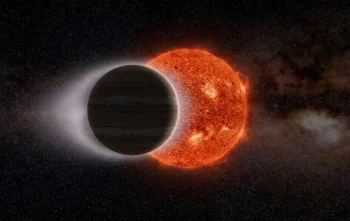
Researchers have detected clear spectral features in the atmosphere of the cold sub-Neptune exoplanet TOI-6478 b. With an equilibrium temperature of 220 Kelvin, this planet challenges the common difficulty of observing atmospheres on sub-Neptunes, which are often obscured by clouds or hazes. Observations using the Hubble Space Telescope reveal strong signals that point toward methane as a likely component of its atmosphere.
Star system: TOI-6478 | Distance from the Sun: 126 light years
Atmospheric features detected on the cold sub-Neptune exoplanet TOI-6478 b
Star system: TOI-6478 | Distance from the Sun: 126 light years
The sub-Neptune exoplanet TOI-6478 b has revealed distinct atmospheric features, providing a rare opportunity to study a planet with an equilibrium temperature of only 220 Kelvin. Sub-Neptunes, which are planets larger than Earth but smaller than Neptune, frequently show featureless spectra because clouds or high-altitude hazes block our view of their atmospheres. However, current trends suggest that the coldest sub-Neptunes may have clearer skies, likely because clouds settle deeper into the atmosphere or hazes fail to form in the cold environment.

To observe this, the Hubble Space Telescope utilized its WFC3 instrument to record the strongest spectral signal ever detected for this class of planet. To ensure the results were accurate, the analysis incorporated the Transit Light Source Effect, a method that accounts for stellar activity to prevent misinterpreting surface spots on the host star as signals from the planet's atmosphere. While the current data confirms the presence of an absorption feature at 1.4 micrometers, the narrow range of the telescope cannot distinguish between the signatures of water vapor and methane.

Atmospheric models suggest that methane is the most probable candidate for the absorption signal. Because the planet is so cold, water vapor is expected to condense or become trapped at higher pressures, preventing it from being the primary absorber at the observed levels. While Hubble established the presence of these features, a broader analysis using the James Webb Space Telescope is expected to provide the necessary data to confirm the specific chemical composition of the atmosphere.

Key findings

  • TOI-6478 b shows the highest signal-to-noise spectral feature ever recorded for a sub-Neptune planet.
  • The planet maintains a cold equilibrium temperature of 220 Kelvin.
  • The observed spectral feature at 1.4 micrometers indicates clear atmospheric absorption.
  • Physical models suggest methane is the likely source of the detected spectral absorption.
  • Future observations with the James Webb Space Telescope will be required to distinguish between different atmospheric gases.
Generated by LLM, corrected by human

Share this discovery

Stars mentioned

M5, Red dwarf
TOI-6478 is a Red dwarf star located approximately 125.85 light years from the Sun. It has a mass of 0.230 solar masses, a radius of 0.234 solar radii, and a surface temperature of 3230 Kelvin. The system is estimated to be 6.5 billion years old.
mass: 0.23 M☉
radius: 0.3 R☉
distance: 126 ly
stars in the system: 1
exoplanets: 1
Advertisement
Advertisement

study iconResearch with similar tags

line
Advertisement
Get your next news from nearby stars
Stellar Catalog brings the stars from our galaxy to you. Discover their position, physical properties and whether there are any exoplanets or disks orbiting them. The data in Stellar Catalog come from respectable sources like Gaia space telescope, or SIMBAD database.

Advertisement