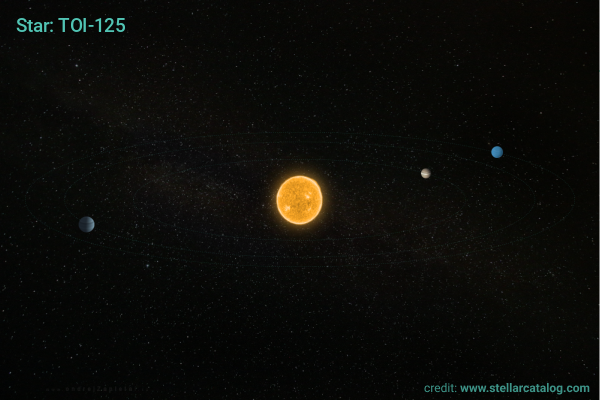
The James Webb Space Telescope has provided detailed data on the atmospheres of two sub-Neptune planets orbiting the sun-like star TOI-125. By studying these two planets, TOI-125 b and TOI-125 c, within the same star system, researchers can compare how their atmospheres formed and evolved under similar conditions. Both planets show signs of dense, cloud-covered atmospheres or high levels of heavy elements, often referred to as metal enrichment, which challenges existing planetary models.

The research team used the telescope to capture transmission spectra, which is a method of analyzing light as it filters through a planet's atmosphere during a transit—the moment a planet passes in front of its host star. By measuring how the starlight changes, the team identified the chemical signatures and cloud characteristics of each planet.

TOI-125 b, which orbits its star every 4.65 days, and TOI-125 c, which orbits every 9.15 days, both exhibit muted atmospheric features. This suggests either a very high concentration of heavy elements, roughly 100 to 150 times that found in the Sun, or the presence of high-altitude clouds that obscure the view of the deeper atmosphere. Further observations at shorter wavelengths are required to confirm these findings.

Key findings
- TOI-125 b and TOI-125 c show potential evidence of significant metal enrichment in their atmospheres.
- Data suggests high-altitude clouds or a high concentration of heavy elements block the view of deeper atmospheric layers.
- Transit timing variations caused difficulties in observing the full transit of planet TOI-125 c.
- The results challenge current theories regarding how atmospheric features change based on planet temperature.
Stars mentioned

 stars
stars exoplanets
 news
news


 29. 9. 2026


