Researchers have identified 29 potential outer giant planets orbiting within existing exoplanetary systems by analyzing stellar motion data. By utilizing measurements from the Hipparcos and Gaia space missions, the team detected the subtle gravitational tugs these distant companions exert on their host stars, providing new targets for future observations to understand how these planets shape their systems.
Giant planets located far from their host stars play a fundamental role in the formation and long-term stability of planetary systems. Because these planets have extremely long orbital periods, they are difficult to detect using standard methods like transits, where a planet passes in front of its star, or radial velocity, which measures the star's wobble caused by an orbiting planet's gravity. To overcome these limitations, a new approach uses astrometry, the precise measurement of a star's position and movement over time, to detect the subtle stellar reflex motion induced by distant, massive companions.

By analyzing data from the Hipparcos mission and the second and third data releases from the Gaia space observatory, a catalogue of stellar movements was compiled to search for these elusive giants. Researchers screened 170 exoplanet-hosting stars, selecting 29 systems that showed evidence of a companion with a semi-major axis—the average distance between the planet and its star—greater than 8.4 astronomical units. One astronomical unit is equivalent to the distance between the Earth and the Sun. These candidates were further evaluated by combining the astrometric results with existing radial velocity measurements and direct imaging data from previous scientific studies.

Eight of the identified systems had previously reported radial velocity variations that remained unexplained. The presence of these outer giant candidates offers a possible explanation for those signals, although more detailed analysis is required to confirm that the same companions are responsible for both the astrometric and radial velocity observations. These candidates are now considered high-priority targets for upcoming observations with the Gaia fourth data release, which will provide deeper insights into their orbits and potential influence on the architecture of their respective planetary systems.

Key findings
- Identification of 29 new outer giant planet candidates in systems already known to host inner planets.
- All candidates have a median semi-major axis beyond 8.4 astronomical units from their host stars.
- Candidates fall within a mass range of 0.3 to 13 times the mass of Jupiter.
- Eight of the candidates may explain previously detected but unexplained radial velocity trends in their host systems.
- The findings provide a target list for future joint astrometric and radial velocity analysis using Gaia data.
Generated by LLM, corrected by human
Stars mentioned
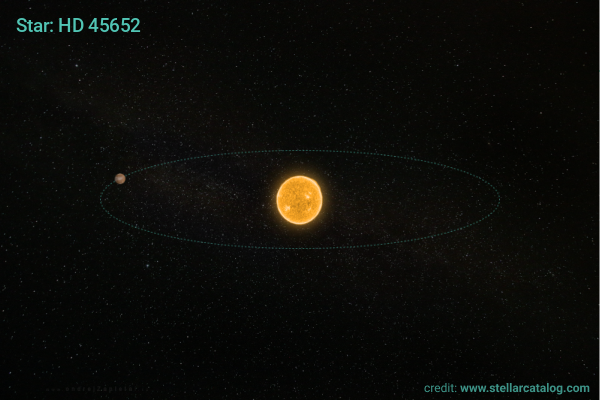
K5, Orange star
mass: 0.92 M☉
radius: 0.7 R☉
distance: 114 ly
exoplanets: 1

 stars
stars exoplanets
 news
news


 5. 10. 2026


