do not follow here
Stellar Catalog more icon
Katalog blízkých hvězd
more icon
Filter stellar categories
Recommended categories

Seznam nejbližších hvězdy

        V Mléčné dráze, naší domovské galaxii jsou miliardy hvězd, od hmotných, jasných hvězd až po malé, slabé trpaslíky. Některé hvězdy existují samy o sobě, zatímco mnoho z nich je součástí dvojhvězdných nebo vícenásobných hvězdných systémů. Tato stránka představuje seznam hvězd nejbližších sluneční soustavě, což pomáhá zmapovat naše místní hvězdné okolí a pochopit rozmanitost hvězd, které jsou nám nejblíže.

Seznam lze filtrovat podle hvězdné kategorie, což vám umožňuje prozkoumat specifické typy hvězd, jako jsou červení trpaslíci, hvězdy podobné Slunci, bílí trpaslíci nebo hnědí trpaslíci. Toto flexibilní zobrazení usnadňuje porovnávání různých hvězdných populací a zaměření na objekty zájmu. I když je hlavní důraz kladen na blízké hvězdy, katalog rozšiřuje i bezprostřední okolí a nabízí širší pohled na typy hvězd v naší galaxii.
    
Advertisement
<< <
Hvězdy 7461-7480
>
Název hvězdy Mass Distance

LP 205-44
M5.84 - 90.8 ly

LP 618-51
- 90.8 ly

LSPM J1614+0906
DC - 90.8 ly

2MASS J15192409-3407502
- 90.8 ly

Gaia DR3 4320189542997799168
- 90.8 ly

G 134-63
M5V - 90.9 ly

StKM 1-291
M1.0Ve - 90.9 ly

LSPM J0530+1503
- 90.9 ly

G 159-30
K7V - 90.9 ly

TOI 5799
G 143-29
M2.0V 0.34 M☉ 90.9 ly

PM J10273+7959
M2.0Ve - 90.9 ly

HD 99453
F7V - 90.9 ly

Gaia DR3 4514737443973528832
- 90.9 ly

HD 144087
K1(V) - 90.9 ly

UCAC4 671-055873
- 90.9 ly

LP 671-46
- 90.9 ly

2MASS J00151547+4239288
- 90.9 ly

Gaia DR3 5867208729756833280
- 90.9 ly

UCAC4 595-006335
DA - 90.9 ly

Wolf 1506
M3 - 90.9 ly
<< <
Hvězdy 7461-7480
>
Načíst všechny hvězdy
v našem katalogu

Frequently Asked Questions about nearby stars

What is the nearest star?

Nearest star is Proxima Centauri, located approximately 4.24 light-years (1.30 parsecs) from the Sun. It is part of the Alpha Centauri star system, which also includes Alpha Centauri A and Alpha Centauri B.

What are the nearest stars to Earth?

Nearest stars to Earth include the Alpha Centauri system (Alpha Centauri A, Alpha Centauri B, and Proxima Centauri), Barnard's Star, and Wolf 359. There are also brown dwarfs Luhman 16 and WISE 0855−0714.

What is the solar neighborhood?

Solar neighborhood (also Local Interstellar Cloud) is the region of interstellar space that surrounds the Sun with diameter about 15 light years. Stellar Catalog database includes all stars contained within this region.

How do astronomers measure distances to stars?

Astronomers use methods like parallax, standard candles, and redshift to measure distances to stars. Parallax is especially useful for nearby stars in our solar neighborhood, while other techniques help map the universe beyond.

Are there any exoplanets orbiting the nearest stars?

Yes, several exoplanets have been discovered orbiting the nearest stars. For example, Proxima Centauri has an exoplanet called Proxima Centauri b, which is located in the star's habitable zone and is the closest known exoplanet to Earth.

Why are the nearest stars important for astronomy and physics?

The nearest stars provide valuable laboratories for studying stellar evolution, space environments, and the fundamental physics of stars. Observing these stars helps astronomers understand the structure of our galaxy and the broader universe.
Advertisement

exoplanet iconStellarGuide: Hvězdy

line
Hvězdy
Hvězdy jsou obrovské koule horkého plynu, které září díky energii vznikající jadernou fúzí v jejich jádru. Většina hvězd se skládá převážně z vodíku a helia. V centru hvězdy dochází díky vysokému tlaku a teplotě k přeměně vodíku na helium, přičemž se uvolňuje obrovské množství energie ve formě světla a tepla.
More about Hvězdy tag icon

Stellar categories

A comparison of spectral classes and typical stellar properties across the catalog categories.
Category Spektrální třída Typical mass (% of solar mass) Typical size (% of solar radius) Typical temperature (K)
, , 10-200% 50-300% 2000-10000 K
L, T, Y 1.2-8.0% 9-11% 600-2500 K
M 7.5-50% 10-60% 2400-3900 K
K 50-80% 60-90% 3900-5200 K
G 80-120% 80-120% 5200-6000 K
A, F, B, O 200-3000% 200-5000% 7000-40000 K
K|G|F|A|B 80-150% 120-300% 4500-6000 K
A|B|O, G|F|A, M|G|F|A, K|M|S 50-300% 500-20000% 3000-5000 K
K|M|C, G|F, B|O 500-10000% 10000-100000% 3000-35000 K
A|B, G|F, K|M 2000-20000% 50000-200000% 3000-40000 K
WC|WN|WO 1000-10000% 50-500% 30000-200000 K
DA|DC|DQ|DZ 20-140% 0.7-1.5% 5000-150000 K
100-300% 0.001-0.002% 600000-1000000 K
, , 300-10000000% 0.000001-1% 0-10000000 K

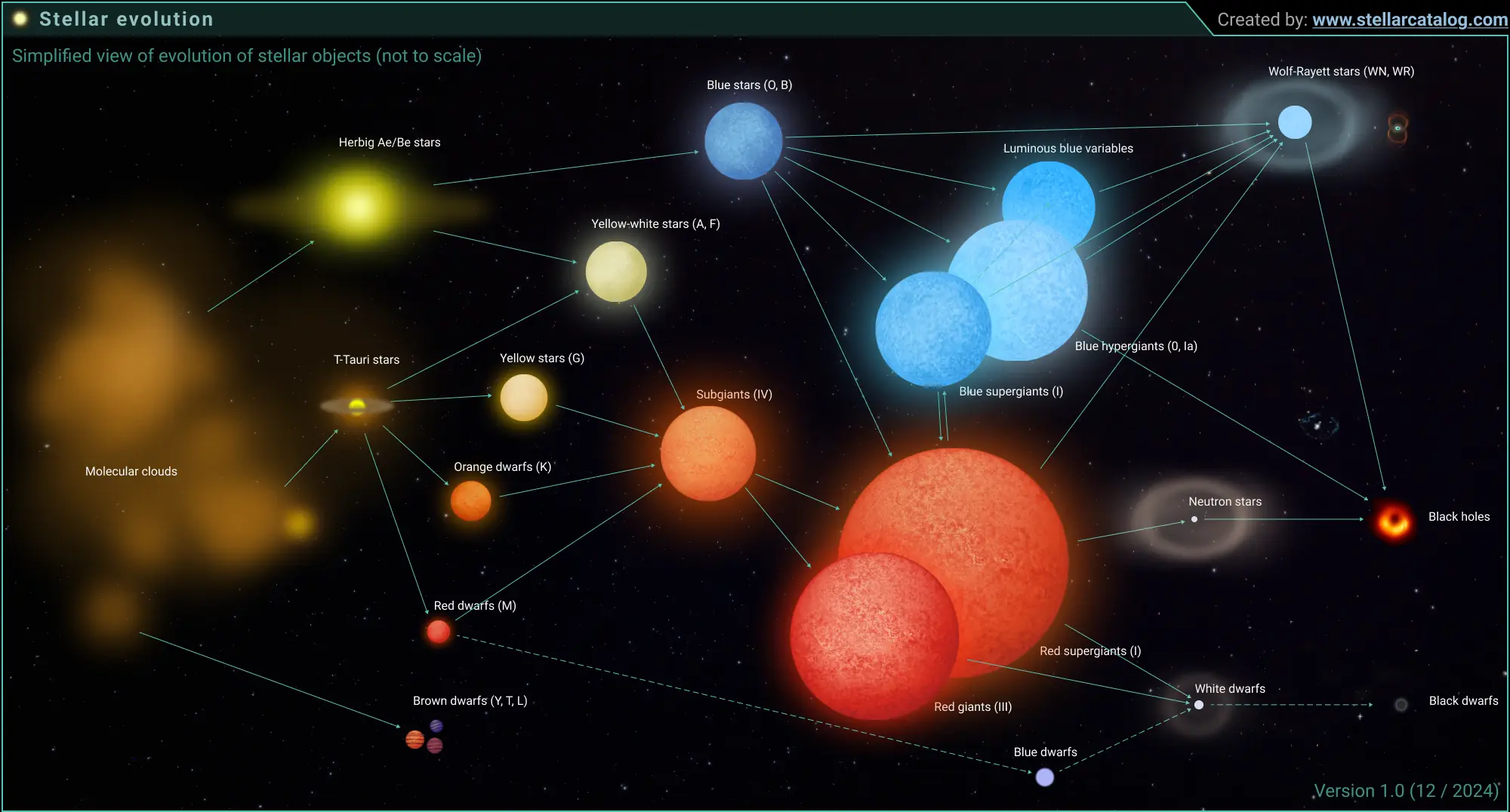
Vývoj hvězd

Stars are born and die in various ways depending on their mass, composition, and other factors. The most common life cycle for stars like our Sun involves several key stages.
Stellar evolution visualisation

Advertisement