do not follow here
Stellar Catalog more icon Catalogue étoile more icon
Des étoiles semblables au soleil
more icon
Filter stellar categories
Recommended categories

Liste des Des étoiles semblables au soleil


Plus à propos Étoiles de type solaire
Advertisement
<< <
Etoile 301-320
>
Nom de l étoile Mass Distance

HD 196850
G1V - 88.9 ly

HD 74842
G8V - 89 ly

HD 29587
BD+41° 931, FK5 4419, HIP 21832, SAO 39690, TYC 2901-00064-1, 2MASS J04413631+4207065
G2V 1 M☉ 89 ly

HD 30278
G9V - 89 ly

HD 186306
G9V - 89.1 ly

HD 361
G1V - 89.1 ly

HD 168871
G1/2V - 89.2 ly

HD 187748
TYC 3947-1193-1, USNO-A2 1425-09990347, HIP 97438
G0 - 89.5 ly

LDS 5667
HD 39881, GJ 224, Gliese 224, HIP 28066, HR 2067, TIC 91928222, TYC 728-3142-1, WISEA J055603.70+135525.2, LHS 1803, BD+13 1036,SAO 95004
G8 - 89.5 ly

HD 215641
G8V - 89.5 ly

HD 107146
G1V 1 M☉ 89.6 ly

HD 174719
TYC 452-237-1, USNO-A2 0900-13661819, HIP 92569
G5/6V - 89.7 ly

HD 60272
G9V - 89.7 ly

HD 28255 B
G7V - 89.8 ly

HD 28255
G4V - 89.8 ly

HD 31000
TYC 2399-1394-1, USNO-A2 1200-02602146, HIP 22776
G5V - 89.8 ly

HD 73524
G0Vp - 90 ly

13 Orionis
G3 - 90 ly

HD 144585
BD-13 4342,SAO 159706,HD 144585,HR 5996
G2V - 90 ly

HD 55720
TYC 8127-2077-1, USNO-A2 0375-03159863, HIP 34739
G8V - 90.1 ly
<< <
Etoile 301-320
>
Charger toutes les étoiles
dans le catalogue

Étoiles de type solaire nouvelles

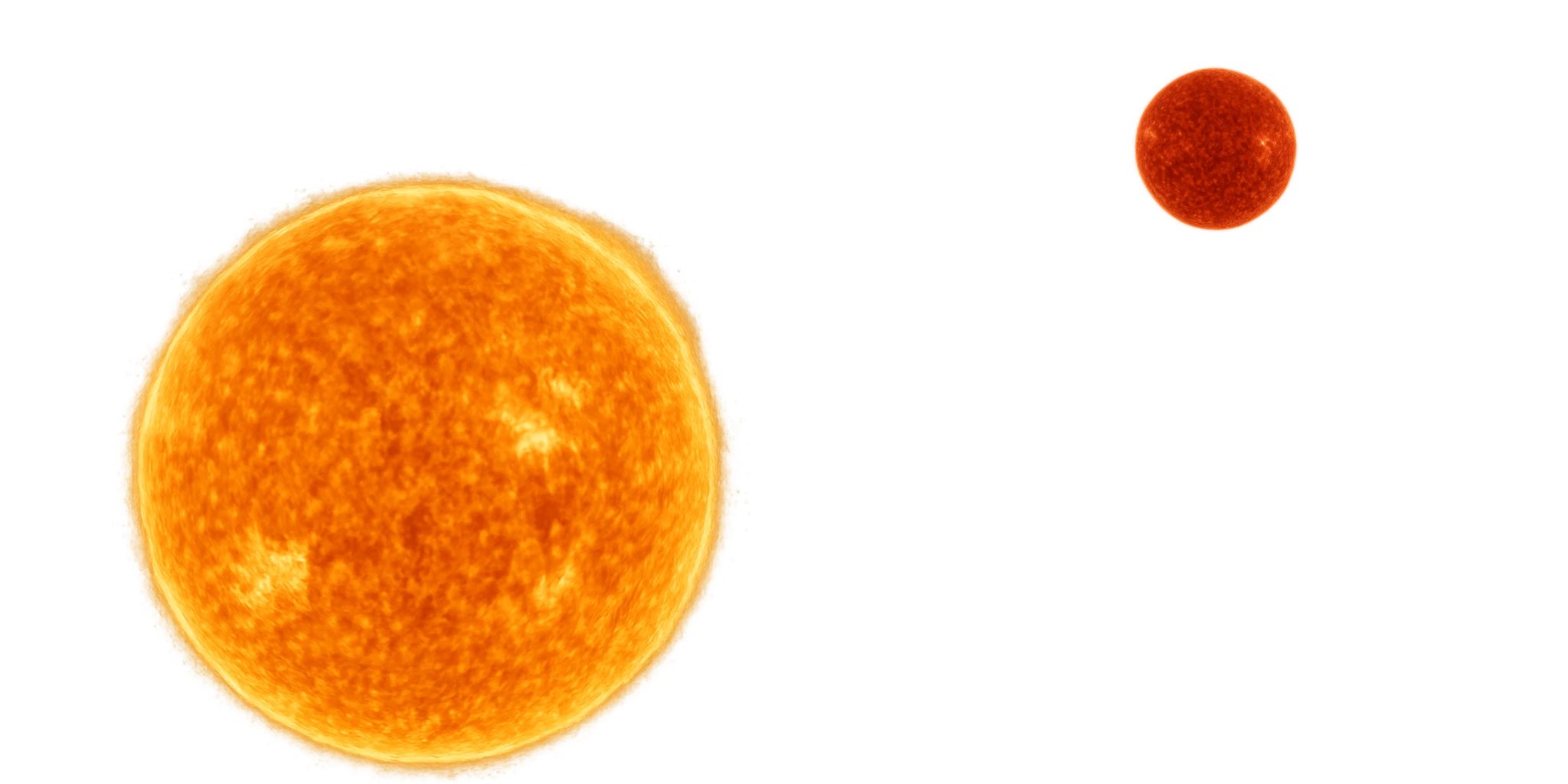
Granulation patterns in LTT 9779 and WASP 121 revealed by JWST
iconToday
iconÉtoiles | Exoplanètes | Étoiles de type solaire | Télescope spatial James Webb
Image: Granulation patterns in LTT 9779 and WASP 121 revealed by JWST
Stars are not perfectly static spheres of light. Their surfaces are covered in granulation, a boiling pattern caused by heat rising from deep within the star and cooling as it reaches the surface. These granules appear as bright, shifting cells that create constant, tiny flickers in a star's brightness. Understanding these rapid fluctuations is essential because they can mimic or mask the faint signals of orbiting planets. By analyzing high-precision data from the JWST, researchers measured t...
Read article tag icon
Advertisement
Thick-disk stars identified as hosts to ancient hot jupiter planets
icon16. 10. 2026
iconÉtoiles | Exoplanètes | Étoiles de type solaire | Jupiter chaud | Formation des planète
Image: Thick-disk stars identified as hosts to ancient hot jupiter planets
New analysis of 268 stars identifies several hot Jupiters orbiting ancient stars in the Milky Way's thick disk. These systems, over 8 billion years old, show distinct differences in mass and orbital periods compared to younger thin-disk populations....
Read article tag icon
Atmospheric differences between morning and evening sides of planet WASP-39 b revealed
icon12. 10. 2026
iconÉtoiles | Exoplanètes | Étoiles de type solaire | Jupiter chaud | Atmosphères planétaire
Image: Atmospheric differences between morning and evening sides of planet WASP-39 b revealed
Observations of the hot Jupiter WASP-39 b reveal significant differences between its morning and evening atmospheres. Climate models successfully match temperature patterns but still struggle to explain the observed asymmetry in carbon dioxide levels....
Read article tag icon

study iconResearch in Des étoiles semblables au soleil

line

Frequently Asked Questions about nearby stars

What is the nearest star?

Nearest star is Proxima Centauri, located approximately 4.24 light-years (1.30 parsecs) from the Sun. It is part of the Alpha Centauri star system, which also includes Alpha Centauri A and Alpha Centauri B.

What are the nearest stars to Earth?

Nearest stars to Earth include the Alpha Centauri system (Alpha Centauri A, Alpha Centauri B, and Proxima Centauri), Barnard's Star, and Wolf 359. There are also brown dwarfs Luhman 16 and WISE 0855−0714.

What is the solar neighborhood?

Solar neighborhood (also Local Interstellar Cloud) is the region of interstellar space that surrounds the Sun with diameter about 15 light years. Stellar Catalog database includes all stars contained within this region.

How do astronomers measure distances to stars?

Astronomers use methods like parallax, standard candles, and redshift to measure distances to stars. Parallax is especially useful for nearby stars in our solar neighborhood, while other techniques help map the universe beyond.

Are there any exoplanets orbiting the nearest stars?

Yes, several exoplanets have been discovered orbiting the nearest stars. For example, Proxima Centauri has an exoplanet called Proxima Centauri b, which is located in the star's habitable zone and is the closest known exoplanet to Earth.

Why are the nearest stars important for astronomy and physics?

The nearest stars provide valuable laboratories for studying stellar evolution, space environments, and the fundamental physics of stars. Observing these stars helps astronomers understand the structure of our galaxy and the broader universe.
Advertisement

exoplanet iconStellarGuide: Étoiles

line
Étoiles
Les étoiles sont d’immenses sphères de gaz chaud qui brillent en produisant de l’énergie grâce à la fusion nucléaire dans leur noyau. La plupart des étoiles sont composées principalement d’hydrogène et d’hélium. Au centre d’une étoile, la pression et la température élevées provoquent la fusion des atomes d’hydrogène en hélium, libérant ainsi une énorme quantité d’énergie sous forme de lumière et de chaleur.
More about Étoiles tag icon

Advertisement