do not follow here
Stellar Catalog more icon Catálogo de estrellas more icon
Estrellas similares al sol
more icon
Filter stellar categories
Recommended categories

Lista de Estrellas similares al sol


Más sobre Estrellas de tipo solar
Advertisement
<< <
Estrellas 281-300
>
Nombre de la estrella Mass Distance

HD 1388
G0V - 87.8 ly

HD 26018
G5 - 87.8 ly

HD 11130
G9V - 87.9 ly

V443 Andromedae
V* V443 And
G7V - 87.9 ly

HD 189087
G8 - 88.1 ly

HD 158259
HIP 85268, 2MASS J17252406+5247263, TYC 3888-1886-1, TOI-1462, GSC 03888-01886
G5VmF9 0.99 M☉ 88.1 ly

HD 136894
G8+V - 88.1 ly

HD 10800 B
G2V 1 M☉ 88.1 ly

HD 10800 Aa
3 G. Octantis, CPD−83°27, GC 2063, GJ 67.1, Gliese 67.1, HIP 7601, HR 512, SAO 258271, WDS J01379-8259AB
G1V 1.1 M☉ 88.1 ly

HD 187923
NSV 12490, BD+11° 4019, GJ 4126, Gliese 4126, HD 187923, HIP 97767, HR 7569, SAO 105348, WDS J19521+1138A, LTT 15805
G0V 1.3 M☉ 88.1 ly

HD 69655
G1V - 88.1 ly

11 Aquarii
11 Aqr, BD−05°5433, HD 199960, HIP 103682, HR 8041, SAO 145022
G1V 1.1 M☉ 88.2 ly

HD 173701
G8V - 88.2 ly

HD 178450
V478 Lyr, V478 Lyrae
G8V 0.89 M☉ 88.2 ly

HD 89813
G9V - 88.3 ly

HD 97998
G1V - 88.4 ly

HD 206374
G6.5V - 88.6 ly

HD 202108
G3V - 88.6 ly

HD 68978
G0.5V - 88.7 ly

HD 56124
G0 - 88.9 ly
<< <
Estrellas 281-300
>
Cargar todas las estrellas
en el catálogo

Estrellas de tipo solar noticias

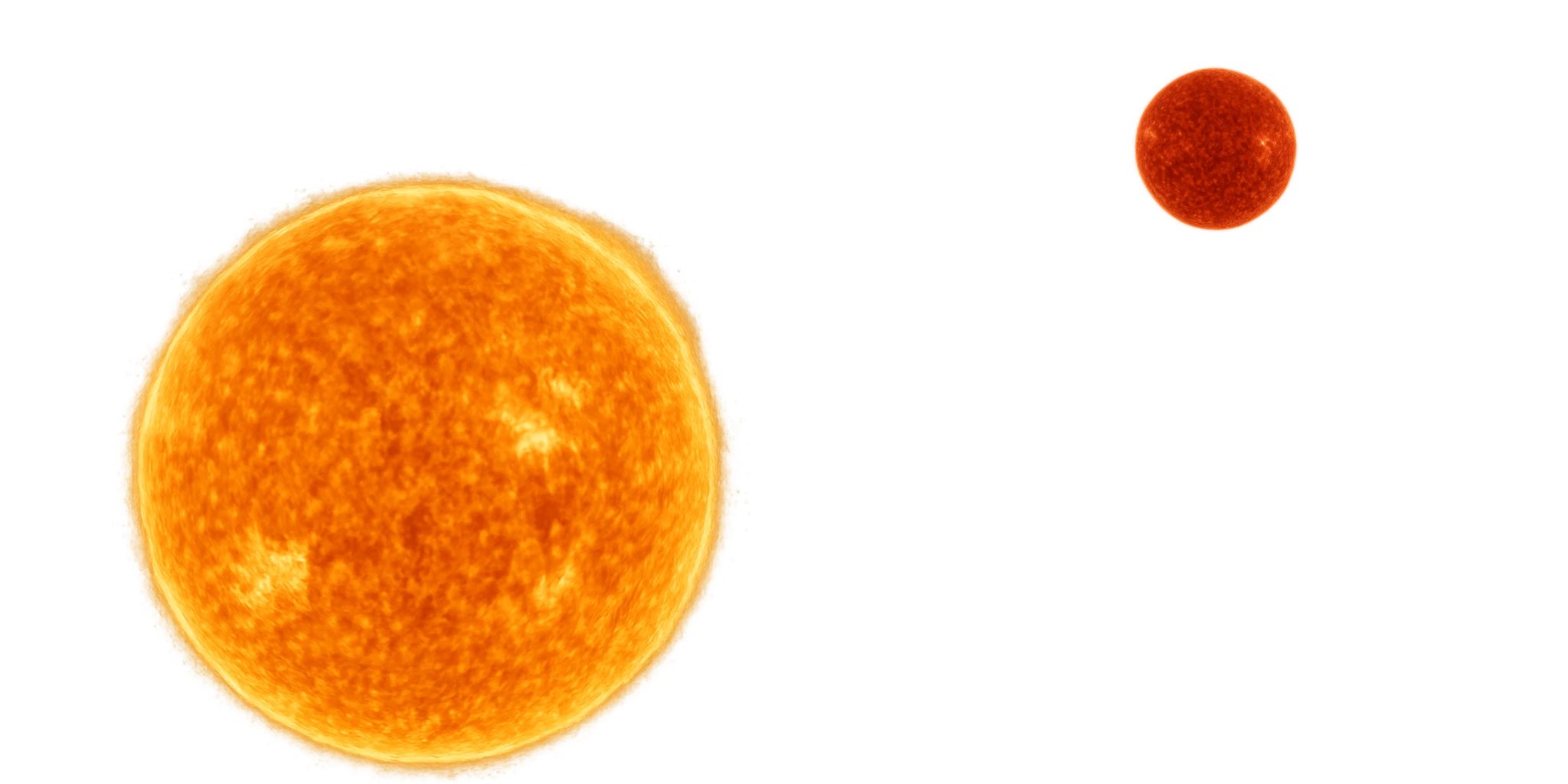
Granulation patterns in LTT 9779 and WASP 121 revealed by JWST
iconToday
iconEstrellas | Exoplanetas | Estrellas de tipo solar | Telescopio espacial James Webb
Image: Granulation patterns in LTT 9779 and WASP 121 revealed by JWST
Stars are not perfectly static spheres of light. Their surfaces are covered in granulation, a boiling pattern caused by heat rising from deep within the star and cooling as it reaches the surface. These granules appear as bright, shifting cells that create constant, tiny flickers in a star's brightness. Understanding these rapid fluctuations is essential because they can mimic or mask the faint signals of orbiting planets. By analyzing high-precision data from the JWST, researchers measured t...
Read article tag icon
Advertisement
Thick-disk stars identified as hosts to ancient hot jupiter planets
icon16. 10. 2026
iconEstrellas | Exoplanetas | Estrellas de tipo solar | Júpiter caliente | Formación planetari
Image: Thick-disk stars identified as hosts to ancient hot jupiter planets
New analysis of 268 stars identifies several hot Jupiters orbiting ancient stars in the Milky Way's thick disk. These systems, over 8 billion years old, show distinct differences in mass and orbital periods compared to younger thin-disk populations....
Read article tag icon
Atmospheric differences between morning and evening sides of planet WASP-39 b revealed
icon12. 10. 2026
iconEstrellas | Exoplanetas | Estrellas de tipo solar | Júpiter caliente | Atmósferas planetari
Image: Atmospheric differences between morning and evening sides of planet WASP-39 b revealed
Observations of the hot Jupiter WASP-39 b reveal significant differences between its morning and evening atmospheres. Climate models successfully match temperature patterns but still struggle to explain the observed asymmetry in carbon dioxide levels....
Read article tag icon

study iconResearch in Estrellas similares al sol

line

Frequently Asked Questions about nearby stars

What is the nearest star?

Nearest star is Proxima Centauri, located approximately 4.24 light-years (1.30 parsecs) from the Sun. It is part of the Alpha Centauri star system, which also includes Alpha Centauri A and Alpha Centauri B.

What are the nearest stars to Earth?

Nearest stars to Earth include the Alpha Centauri system (Alpha Centauri A, Alpha Centauri B, and Proxima Centauri), Barnard's Star, and Wolf 359. There are also brown dwarfs Luhman 16 and WISE 0855−0714.

What is the solar neighborhood?

Solar neighborhood (also Local Interstellar Cloud) is the region of interstellar space that surrounds the Sun with diameter about 15 light years. Stellar Catalog database includes all stars contained within this region.

How do astronomers measure distances to stars?

Astronomers use methods like parallax, standard candles, and redshift to measure distances to stars. Parallax is especially useful for nearby stars in our solar neighborhood, while other techniques help map the universe beyond.

Are there any exoplanets orbiting the nearest stars?

Yes, several exoplanets have been discovered orbiting the nearest stars. For example, Proxima Centauri has an exoplanet called Proxima Centauri b, which is located in the star's habitable zone and is the closest known exoplanet to Earth.

Why are the nearest stars important for astronomy and physics?

The nearest stars provide valuable laboratories for studying stellar evolution, space environments, and the fundamental physics of stars. Observing these stars helps astronomers understand the structure of our galaxy and the broader universe.
Advertisement

exoplanet iconStellarGuide: Estrellas

line
Estrellas
Las estrellas son enormes esferas de gas caliente que brillan al generar energía mediante fusión nuclear en sus núcleos. La mayoría de las estrellas están compuestas principalmente de hidrógeno y helio. En el centro de una estrella, la alta presión y temperatura hacen que los átomos de hidrógeno se fusionen en helio, liberando una enorme cantidad de energía en forma de luz y calor.
More about Estrellas tag icon

Advertisement